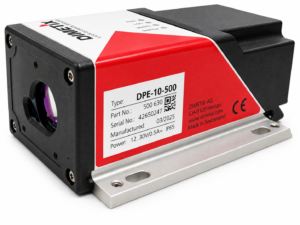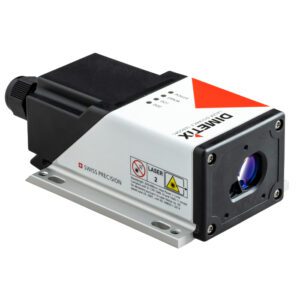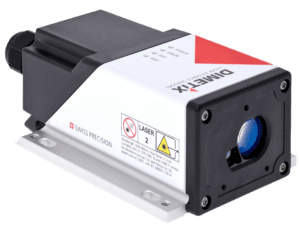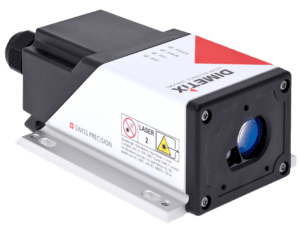


















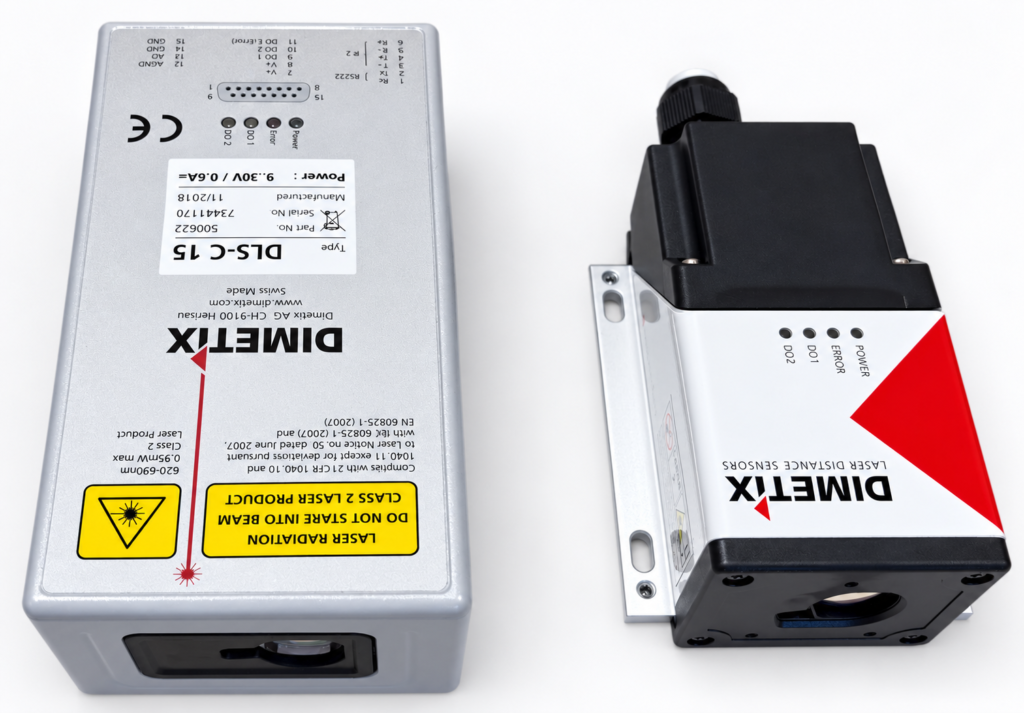
Dimetix AG It is a Swiss manufacturer specializing in the development and manufacture of High-precision industrial laser distance sensors for non-contact measurement. Its technology allows measuring distance, position, displacement, separation, dimensions, level and movement in applications such as automation, machinery, railways, steelmaking, logistics and structural monitoring.
The Dimetix D Series It covers different industrial measurement needs: sensors for measuring up to approximately 50 m over natural surfaces, models capable of achieving approximately 100 m directly above the object and without a reflector, versions up to 150 m with reflector and long-range industrial sensors capable of measuring up to 500 m with reflective sheeting.
According to the model, the range offers Typical accuracies up to ±0.5 mm @1σ / ±1.0 mm @2σ, measurement frequencies up to 250 Hz and operation from -40 to +60 °C.
- Up to ~50 m on natural surfaces: DAE-10-050 and DBN-50-050.
- Up to ~100 m over natural surfaces, without a reflector: DAN, DEN, DEH and DPE.
- Up to 150 m with reflector: DAN-10-150 and DAN-30-150.
- Up to 500 m with reflector: DEN, DEH and DPE.
1. Dimetix D Series Range and Sensor Selection
The D Series has different versions to select the sensor according to the actual working distance, surface type, accuracy, measurement speed, and temperature, avoiding over-provisioning the application.
Comparison of Dimetix D Series Laser Sensors
| Model | Natural surface | With reflector | Accuracy @1σ | Accuracy @2σ | Frequency | Temperature |
|---|---|---|---|---|---|---|
| DBN-50-050 | up to ~50 m | — | ±2.5 mm | ±5.0 mm | 10 Hz | -10…+50 °C |
| DAE-10-050 | up to ~50 m | ~40…50 m | ±0.5 mm | ±1.0 mm | 100 Hz | -40…+60 °C |
| DAN-10-150 | up to ~100 m | ~40…150 m | ±0.5 mm | ±1.0 mm | 100 Hz | -10…+50 °C |
| DAN-30-150 | up to ~100 m | ~40…150 m | ±1.5 mm | ±3.0 mm | 100 Hz | -10…+50 °C |
| DEN-10-500 | up to ~100 m | ~0.5…500 m | ±0.5 mm | ±1.0 mm | 100 Hz | -10…+50 °C |
| DEH-30-500 | up to ~100 m | ~0.5…500 m | ±1.5 mm | ±3.0 mm | 100 Hz | -10…+60 °C |
| DPE-10-500 | up to ~100 m | ~0.5…500 m | ±0.5 mm | ±1.0 mm | 250 Hz | -40…+60 °C |
| DPE-30-500 | up to ~100 m | ~0.5…500 m | ±1.5 mm | ±3.0 mm | 250 Hz | -40…+60 °C |
How to correctly compare accuracy
Dimetix officially specifies the accuracy of its sensors using a confidence level of 95.4 %, equivalent to 2σ. Other manufacturers may publish their performance at 1σ, approximately 68.3 %.
For example, ±0.5 mm @1σ and ±1.0 mm @2σ represent the same statistical distribution, expressed with different levels of confidence.
For transparency, GUEMISA shows both values to facilitate a homogeneous technical comparison between sensors from different manufacturers.
Which Dimetix sensor should I choose?
- Up to ~50 my high precision: DAE-10-050 — ±0.5 mm @1σ / ±1.0 mm @2σ.
- Up to ~50 m with moderate requirements: DBN-50-050.
- Up to ~100 m without reflector and high precision: DAN-10-150, DEN-10-500 or DPE-10-500.
- Up to 150 m with reflector: DAN-10-150 or DAN-30-150.
- Up to 500 m with reflector: DEN, DEH or DPE.
- Up to 250 Hz: DPE-10-500 and DPE-30-500.
- Operation from -40 °C: DAE-10-050, DPE-10-500 and DPE-30-500.
2. Applications and types of measurement
Dimetix sensors are not limited to measuring absolute distance. One or more laser measurements can be used to determine position, displacement, separation, width, diameter, length, height, alignment, parallelism, level, and deformation.
Railway and track geometry
Dimetix sensors can be used to perform measurements of track geometry, track gauge, lane spacing, alignment, leveling, position and parallelism.
They can also be integrated into measuring carts and test benches to determine the position or separation between wheels and other components without mechanical contact.
Measurement of width, diameter and dimensions
One or more Dimetix sensors can be used non-contact dimensional measurements. Two facing sensors allow the calculation of width, diameter, separation or position when the fixed distance between them is known.
This principle can be used to measure coils, rolls, wheels, cylinders, profiles, parts, and other industrial products.
Iron and steel industry, foundry and metallurgy
Dimetix documents applications for Hot metal level measurement, positioning of transfer carts, coils, diameters, dimensions and steelmaking machinery.
Non-contact measurement allows the sensor to be kept away from hot materials and used, when optical conditions are suitable, to measure level of aluminum, steel and other cast materials.
Cranes, overhead cranes and stacker cranes
Dimetix sensors can continuously determine the position of cranes, overhead cranes, trolleys, stacker cranes and other mobile mechanisms.
The measurements can be used for positioning, path control, timing, and motion monitoring.
Level measurement
The distance to the surface of a material allows us to determine the level in silos, hoppers, tanks, solids and raw materials without direct contact with the product.
Civil works and structural monitoring
Remote measurement allows for control displacements, movements and changes in position in bridges, tunnels, pillars, buildings, slopes and other structures.
3. Technical installation guide and frequently asked questions
How to correctly install a reflective plate or sheet?
Dimetix recommends using a suitable reflector for the sensor and mounting it with a slight inclination with respect to the perpendicular of the beam to avoid excessively direct reflection towards the receiving optics.
The entire laser spot must remain within the reflective surface throughout the entire application path. The reflector must be kept clean and undamaged.
Can it be measured through glass?
Dimetix recommends avoiding measurement through glass whenever possible, as reflections and optical losses can affect the measurement.
When it is necessary to use a window, it is recommended anti-reflective coated glass, Keep it clean and install it at an approximate angle of 5th or higher regarding the front of the sensor.
Can a mirror be used to deflect the laser beam?
It should be avoided when the installation allows for a direct path. If it is necessary to modify the optical path, Dimetix recommends using a mirror suitable for optical applications, large enough and correctly oriented.
The mirror should be kept clean and it is advisable to check the plausibility of the measurements obtained during operation.
Can it be measured directly on a very shiny or mirror-like surface?
Extremely reflective surfaces should be avoided. Excessive reflection can cause measurement fluctuations or errors.
When a shiny surface cannot be avoided, it is advisable to modify the angle of incidence and check the actual behavior of the application.
How do rough or irregular surfaces affect things?
When a surface is rough, different areas of the laser spot may be at different distances. The geometry and roughness of the object must be taken into account when interpreting the measurement.
What about wood, plastic, or semi-transparent materials?
In certain porous or partially translucent materials, some of the light may penetrate the material slightly, so the measurement may differ from the exact position of the outer surface.
In precision applications, it is advisable to validate the behavior on the specific material beforehand.
Can Dimetix measure moving objects?
Yes. The capacity depends on the target speed, the surface, and the selected measurement frequency.
The models DPE-10-500 and DPE-30-500 reach up to 250 Hz, allowing work on dynamic applications where a high refresh rate is needed.
How does sunlight affect the measurement?
Intense ambient light can reduce the quality of the optical signal and the maximum achievable performance.
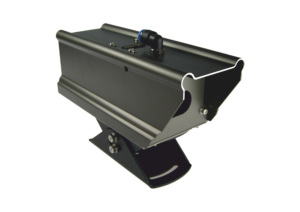
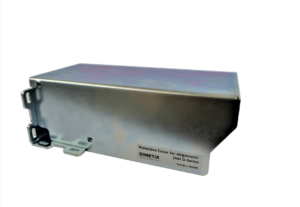
In outdoor applications, visors, covers, or other mechanical devices can be used to reduce direct sunlight. The sensor should not be pointed directly at the sun.
Can a Dimetix sensor be used outdoors?
The D Series has protection IP65. In permanent outdoor installations, it is advisable to protect the optics especially from rain, snow, dirt and water accumulation.
The DAE and DPE models also allow working from -40 to +60 °C.
How does dust affect a laser sensor?
Small amounts of dust may not impede the measurement, but high concentrations of suspended particles can reflect part of the beam and reduce the quality of the measurement.
In very dusty environments, it may be necessary to protect the optics or keep them clean using a suitable solution.
What do 1σ and 2σ mean in Dimetix accuracy?
1σ represents approximately 68.3 % of the measurements within the indicated range, while 2σ corresponds approximately to 95.4 %.
Therefore, ±0.5 mm @1σ and ±1.0 mm @2σ can describe the same statistical distribution.
It is important to check this criterion when comparing sensors from different manufacturers.
How do you align a Dimetix sensor over a long distance?
The greater the distance, the more important the sensor's angular alignment becomes. Small orientation errors can produce significant shifts in the laser spot on the target.
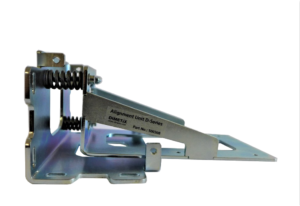
Dimetix has a alignment unit for the D Series which allows the sensor to be adjusted on two axes. In long-travel applications, it must be ensured that the laser dot remains within the target or reflector throughout the intended movement.
4. Interfaces, configuration and integration
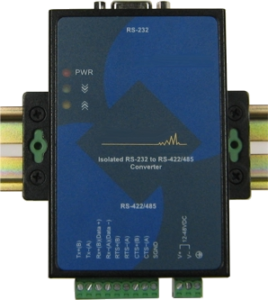
Industrial interfaces
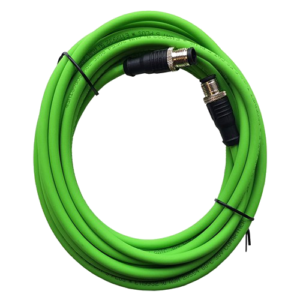
According to the model, the D Series can have different interfaces for integration into PLCs, data acquisition systems and industrial automation.
- RS-232.
- RS-422.
- SSI according to model.
- Programmable analog output 0/4-20 mA depending on the model.
- Digital inputs and outputs.
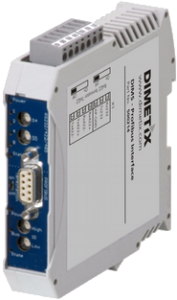
- PROFINET via industrial interface for D Series.
- EtherNet/IP via industrial interface for D Series.
- EtherCAT via industrial interface for D Series.
Configuration
Dimetix software tools allow you to configure sensor parameters, check measurements, and save configurations for use on other compatible equipment.
Maintenance and calibration
The D Series requires little maintenance, but the optics must be kept clean to avoid signal loss or errors.
Dimetix also offers calibration and recalibration services for its sensors.
OEM Integration
Dimetix also works with manufacturers and integrators who need to incorporate laser measurement technology into machinery, their own equipment, and OEM solutions.
GUEMISA offers technical support to define the appropriate model, range, accuracy, reflector, interfaces, and accessories for each application.
Use cases


DIMETIX AG Products
Products: 26