






















The Non-contact laser measurement in steel mills and metallurgical processes It allows monitoring distance, position, level, and specific dimensions without installing mechanical components on the material. In processes involving hot steel, aluminum, slabs, coils, bars, or rolled products, this technology allows the sensor to be placed at a safe distance from the process and the measurement to be transmitted directly to the PLC or control system.
The Dimetix laser distance sensors They are used in steelmaking and metallurgical applications such as the Liquid steel level control, mold filling, slab dimensional measurement, slab positioning, coil diameter, control of the loop between winders and unwinders, measurement of hot-rolled rings, and control of certain cutting and positioning processes.
Not all laser measurement applications in the metal sector use the same technology. A Dimetix distance sensor measures the absolute distance between the sensor and a target. From one or more measurements, variables such as level, position, diameter, width, or other dimensions can be obtained. For other tasks, such as complete 3D profile reconstruction, surface defects, micrometric thicknesses, or surface velocity, different specific optical technologies exist.
What can be measured non-contact with a laser sensor in a steel mill?
Within a steel or metallurgical plant, there are multiple points where mechanical measurement is difficult due to temperature, product movement, available distance, or the risk of wear. Optical measurement allows the measurement point to be moved outside the immediate process area.
| Process | Measured variable | Application |
|---|---|---|
| Casting and smelting | Level | Steel, iron or liquid aluminum in molds and containers |
| Slab production | Distance / dimensions | Thickness, width, length, skew, and position |
| Coils | Radius / diameter | Diameter control during winding or unwinding |
| Winder / unwinder | Loop position | Slack control and process regulation |
| Long products | Position / dimension | Bars, profiles and tubes |
| Ring rolling | Diameter and position | Tracking rings during rolling |
| Court | Position / Length | Pre-cut positioning and automation |
| Product transport | Presence / position | Detection and positioning of slabs and large pieces |
Level control of liquid steel and molten metal
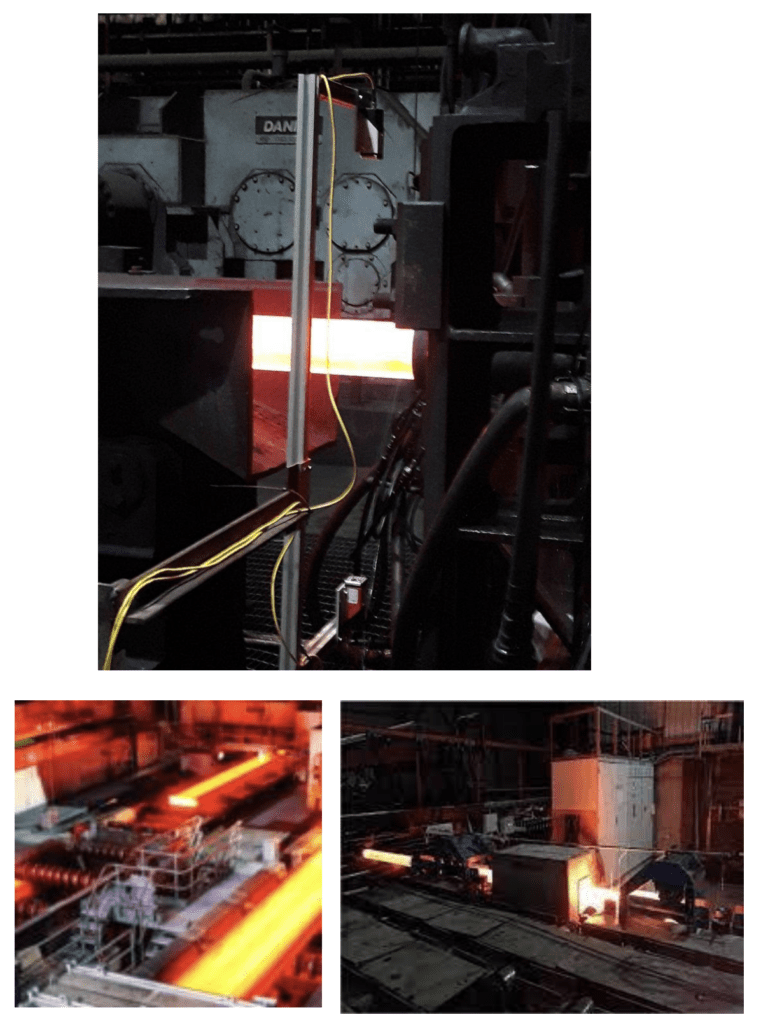
He molten metal level control It is one of the most demanding applications of optical measurement. The goal is to determine the distance between the sensor and the metal surface without inserting any probe into the bath or making contact with the product.
Dimetix specifically documents this application in AE0213 Hot Steel Level Monitoring. It uses a DPE-10-500 to measure the level of hot steel in molds and use the information to control the filling process and the advance of the conveyor.
The measured distance allows detection of when the target level has been reached. This information can be sent to the automation system to modify the line speed, stop the advance, or activate a process sequence. The goal is to avoid both overfilled like the insufficient filling, reducing waste and improving production uniformity.
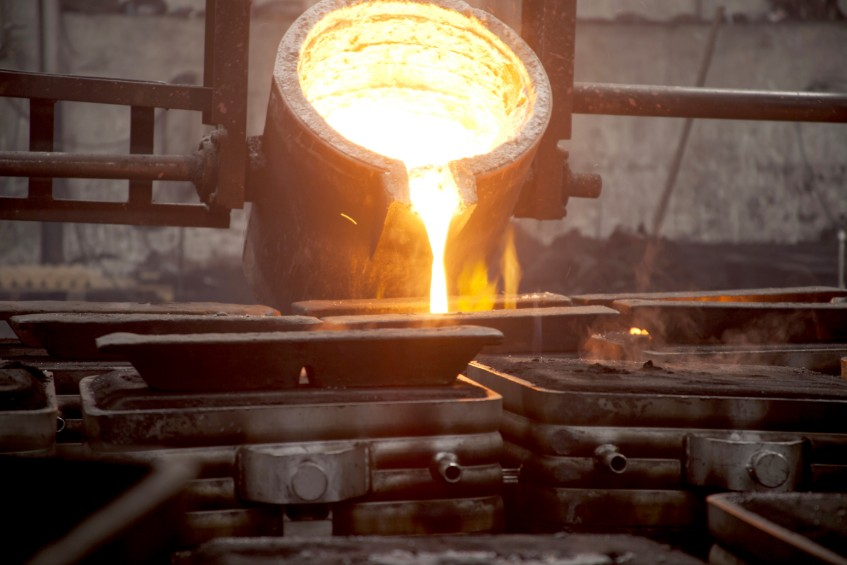
Dimetix also has the case AE1102 Controlling of the filling and pouring of steel and iron, in which laser sensors are used in foundries to control the filling and pouring of steel and iron and prevent overflows.
In these environments, special attention must be paid to the installation distance, temperature at the sensor location, thermal radiation, smoke, dust, and the optical behavior of the surface. The fact that an application is possible does not mean that any installation will work without a prior study of the actual conditions.
Aluminum ingot filling control: a real-world application of GUEMISA
In an application developed by GUEMISA, the client needed to achieve that all ingot molds received a homogeneous amount of aluminum. Variations in filling caused differences between pieces and could require reprocessing material that did not meet specifications.
The solution consisted of performing a online measurement of mold fill level and relate that information to the progress of the process. In this way it was possible to determine when the established level was reached and coordinate the operation of the conveyor belt.
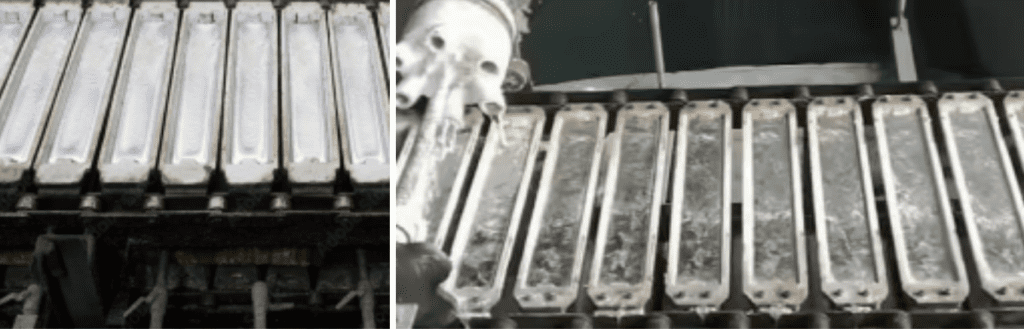
In addition to improving process repeatability, an automatic measurement avoids relying exclusively on a visual check by the operator and allows the variable to be incorporated directly into the automation system.
Level in aluminum tanks for injection molding presses
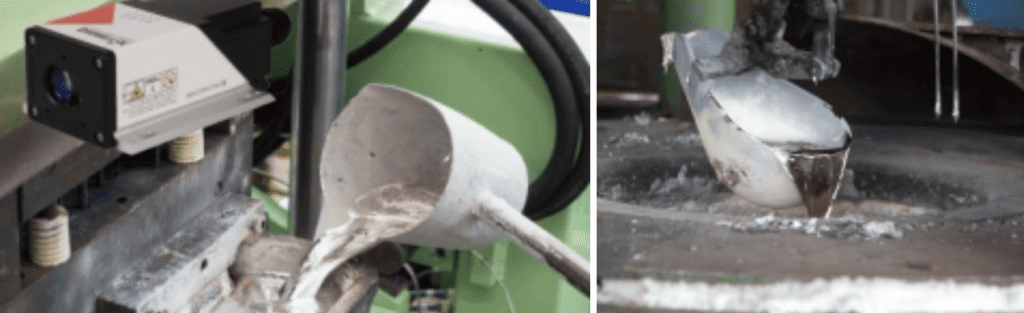
Another application developed for a client consisted of controlling the level of the storage tank of an aluminum injection press. The objective was to know when a new supply of material should be made and to notify the operator in charge of the transport bucket.
Non-contact measurement allows monitoring the level from a distance from the metal and generating warning signals or commands for automation when defined limits are reached.
Dimensional measurement of steel slabs and plates
The manufacture of steel slabs or plates It is necessary to check its dimensions before the subsequent rolling stages. A dimensional deviation can cause downstream problems, increase scrap, or require additional corrections.
Dimetix documents this application in AE0214 Slab Production. Using distance sensors located on both sides of the product, it is possible to measure the distance to the edges and, knowing the fixed geometry of the installation, calculate certain dimensions of the slab.
The application includes the control of thickness, length, and skew or geometric deviation during cooling and transport phases. For certain width measurements, for example, two facing or offset sensors can be used, each measuring one end of the product.
The principle is simple: the system knows the fixed distance between the mounting references. Subtracting the two measured distances to the product yields the corresponding dimension. The same principle can be used to check position, misalignment, or deviations from a nominal reference.
Detection and positioning of slabs under demanding steelmaking conditions
In addition to dimensional control, a laser distance sensor can be used to detect the presence and position of a slab within a facility.
The Dimetix case AE0705 Slab Position Monitoring This corresponds to an application by Voestalpine Rail Technology in which a DPE-30-500 was used to solve slab detection in the presence of difficult conditions such as intense background radiation, smoke, flames, and reflections.
According to Dimetix documentation, the solution was tested for eight weeks without any detection errors before replacing the previous system. This type of application demonstrates a significant difference between a simple presence detector and a absolute distance measurementIn addition to knowing that a part exists, the PLC can know where it is located.
Measuring the diameter of steel coils
During sheet metal winding or unwinding, the coil diameter changes continuously. Non-contact measurement allows this change to be monitored without installing a wheel, mechanical arm, or measuring device directly on the coil.
In the app AE0215 Diameter of Coils, Dimetix uses distance sensors to continuously measure the outer surface of the coil. Knowing the fixed position of the coil's axis or center, the measured distance allows its radius, and subsequently its diameter, to be calculated.
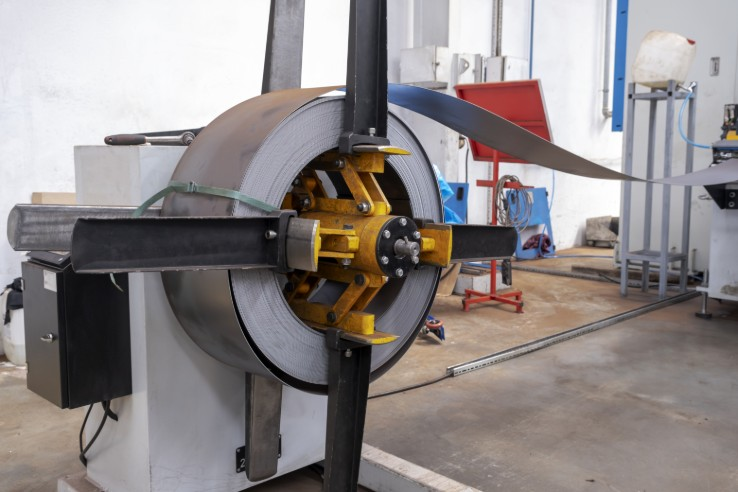
The information can be used for process monitoring, coil status calculation, cycle change automation, or as an additional control system variable.
Control of the loop between winders and unwinders
In metal strip cutting, rolling, slitting and transformation lines, it is common to create a loop or accumulation of material between two stages that operate at different speeds.
Dimetix documents this application as AE0212 Slack Control on Winders and Unwinders. The sensor measures the distance to the bottom of the sheet metal loop from a fixed position and provides the control system with a continuous measurement of its position.
If the loop descends or ascends outside the intended position, the PLC can modify the relative speeds of the winder and unwinder. The sensor does not directly measure the mechanical tension of the web; it measures the geometric position of the loop, which the system uses as a variable to regulate the process.
Diameter and position measurement in hot-rolled rings
The processes of ring rolling They produce seamless rings by progressively deforming a preform between tools and rollers. During rolling, the outside diameter changes continuously, and the ring's position must be kept under control.
In the case AE0217 Monitoring of Hot Rolled Rings, Dimetix uses laser distance sensors to perform non-contact measurements of diameter and position during the process. The measurement can be transmitted to the control system to detect deviations, correct the process, and verify the final dimensions once rolling is complete.
Dimensional control of bars, tubes and long products
In certain extrusion, lamination or manufacturing processes of long products it may be necessary to control the position of the surface and use one or more measurements to determine a dimension of the product.
To measure a diameter The geometry of the installation must be studied. In some cases, a known mechanical reference can be used; in others, it is preferable to use two facing sensors and calculate the dimension from both distances. This avoids attributing a geometric measurement to a single sensor, as it actually depends on the complete arrangement of the system.
GUEMISA has worked on dimensional control applications on steel tubes and bars after the production process. In facilities where the ambient temperature around the mounting point exceeded the temperature permissible by the sensor, specific protections were developed to keep the equipment within its operating conditions.
In one of these projects, with areas reaching approximately 120 °C, a protective housing with Peltier-effect cooling was designed. It is important to distinguish between the product temperature, the temperature radiated towards the sensor and the actual temperature of the sensor itselfThe equipment must always be kept within its specified limits.
Cutting to length and positioning of metal products
Another application of laser distance sensors in metallurgy is the pre-cut positioning of bars, profiles, tubes and other long products.
In these machines, the sensor can measure the distance to the end of the material, a carriage, or a movable stop. The PLC compares the measured position with the programmed length and can enable the cutting cycle when the setpoint is reached.
This application is developed in more detail in our use case on cutting length control and positioning using laser sensors.
Measurement on hot, shiny or incandescent steel
One of the most important questions in steelmaking is whether a laser sensor can measure on hot, shiny, or incandescent surfaces. The answer should not be simplified to a yes or no: it depends on the sensor, distance, geometry, signal strength, temperature, ambient light, smoke, particles, and optical characteristics of the target.
Dimetix confirms that applications exist on hot or incandescent surfaces, but also recommends evaluating difficult surfaces under actual process conditions. A dark, porous, shiny, or red-hot surface may reduce range, measurement speed, or stability compared to nominal conditions.
Therefore, in a steelmaking application, it is especially important to carry out preliminary tests when there are:
- incandescent steel or metal;
- intense specular reflections;
- smoke, vapor, dust or husk;
- direct thermal radiation;
- high ambient temperatures;
- significant changes in surface finish;
- measurement distances close to the application limit;
- need for a high reading frequency.
Not all laser sensors for metal measure the same.
In the metallurgical sector, the term "laser sensor" is used for very different technologies. To select the right solution, it's necessary to start with the physical quantity that we want to measure, not only because of the type of light used.
| Technology | What does it measure? | Common applications in metal |
|---|---|---|
| Laser distance sensor | Absolute distance to a point | Level, position, coil diameter, slabs, rings, positioning |
| Laser triangulation | Short displacements with high resolution | Geometry, height, level at short distance |
| 2D/3D Laser Profilometer | Cross-section | Profiles, bars, complete geometry, dimensional defects |
| Optical micrometer | Diameter or width | Wire, bars, small products |
| Confocal sensor | High-precision distance or thickness | Thin sheet metal and metrological applications |
| Doppler laser speedometer | Surface velocity and cumulative length | Lamination, synchronized cutting, continuous lines |
Dimetix sensors belong to the first group: they are industrial distance sensors. Its advantage appears when the application can be resolved from an absolute distance and needs to be done without contact, at several meters and with direct integration into automation.
Features of Dimetix sensors for metallurgical applications
The Dimetix D Series is designed for high-precision, long-range industrial distance measurements. Depending on the model and measurement conditions, it offers particularly useful features for automation and steelmaking applications.
| Precision | Up to ±1 mm depending on model and conditions |
| Repeatability | Up to ±0.3 mm depending on model and conditions |
| Natural surfaces | Up to approximately 100 m in the longer-range models |
| Reflective sheeting | Up to approximately 500 m depending on the model |
| Measurement speed | Up to 250 Hz |
| Operating temperature | Down to -40…+60 °C in models with extended range |
| Protection | IP65 |
| Interfaces | RS-232, RS-422/485, SSI and others depending on the model |
| Industrial networks | PROFINET, EtherNet/IP and EtherCAT through available solutions for the D Series |
One particularly interesting model for many of these applications is the Dimetrix DPE-10-500, However, the choice should be made according to distance, surface area, accuracy, measurement frequency, and actual environmental conditions.
Integration with PLC and process control
The value of an industrial measurement lies not only in knowing a distance. In an automated system, the reading can become a process variable and be used to make decisions.
Some examples are:
- stop filling when a mold reaches the target level;
- modify the speed of a belt or conveyor;
- detect a slab out of position;
- calculate the diameter of a coil;
- to maintain the position of a sheet metal loop inside a window;
- compare measured dimensions with programmed tolerances;
- record trends and generate alerts;
- enable a cutting operation when a certain position is reached.
Industrial communications allow the sensor to be integrated with PLCs, data acquisition systems, SCADA, and monitoring software to incorporate the measurement into the overall operation of the installation.
Advantages of non-contact measurement in steelmaking and metallurgy
- Without mechanical wear at the point of measurement.
- Possibility of installing the sensor away from hot or moving products.
- Absolute measurement of distance and position.
- Direct integration with automation systems.
- Measurement on large products where a mechanical transducer would be difficult to install.
- Possibility of thermally and mechanically protecting the sensor while maintaining line of sight.
- Continuous process control and automatic alarm generation.
- Reduction of manual checks at potentially hazardous points.
- Application in both new machinery and certain retrofit projects.
How to select a laser sensor for a steel mill
In the steel industry, selecting a sensor solely based on its maximum range is not advisable. To determine if an application is technically feasible, the actual conditions at the measurement point must be analyzed.
- minimum and maximum distance;
- required accuracy and repeatability;
- speed of movement of the target;
- required update frequency;
- product temperature;
- actual temperature at the sensor location;
- received thermal radiation;
- presence of smoke, vapor, dust or husk;
- reflectivity and surface finish;
- available angle of incidence;
- possibility of using a reference or reflector;
- communication interface with the PLC;
- need for protections, air purging or cooling.
For applications on particularly difficult, hot, or shiny surfaces, we recommend performing a test under representative conditions of the process before finalizing the design.
Dimetix application cases in the metal industry
Dimetix offers various documented applications specifically for steelmaking and metal processing. Among the most relevant are:
| Reference | Application |
|---|---|
| AE0213 | Hot Steel Level Monitoring |
| AE0214 | Slab Production — slab dimensions |
| AE0215 | Diameter of Coils |
| AE0212 | Slack Control on Winders and Unwinders — slack loop control |
| AE0217 | Monitoring of Hot Rolled Rings — Diameter and Position of Rolled Rings |
| AE0705 | Slab Position Monitoring — presence and position of slabs |
| AE1102 | Controlling of the Filling and Pouring of Steel and Iron |
| AE0112 | Cutting Application — positioning and cutting to length |
Laser measurement for steel mills, foundries and machinery manufacturers
These solutions may be of interest to integrated steel mills, steel and aluminum foundries, rolling mills, tube and bar manufacturers, service centers, coil producers, steelmaking machinery manufacturers, and automation integrators.
GUEMISA can study the application based on the actual geometry of the installation, measuring distance, material, temperature, required accuracy and existing control system to determine if a Dimetix laser sensor is suitable or if the magnitude requires another measuring technology.
You can browse our range of industrial laser distance sensors or send us the process data to study the measurement configuration.