






















Compatibility between Dimetix DLS-C 15 and DPE-10-500 in an existing installation
Replacing a discontinued industrial sensor can become a problem
when the equipment is part of an installation developed years ago. In addition to the
Metrological performance, the communication protocol, the commands must be preserved
used by the software and compatibility with existing control systems.
In this case we are analyzing the replacement of the old laser sensor
Dimetix DLS-C 15 by the current
Dimetrix DPE-10-500 in a museum facility located in Catalonia,
equipped with 16 distance sensors.
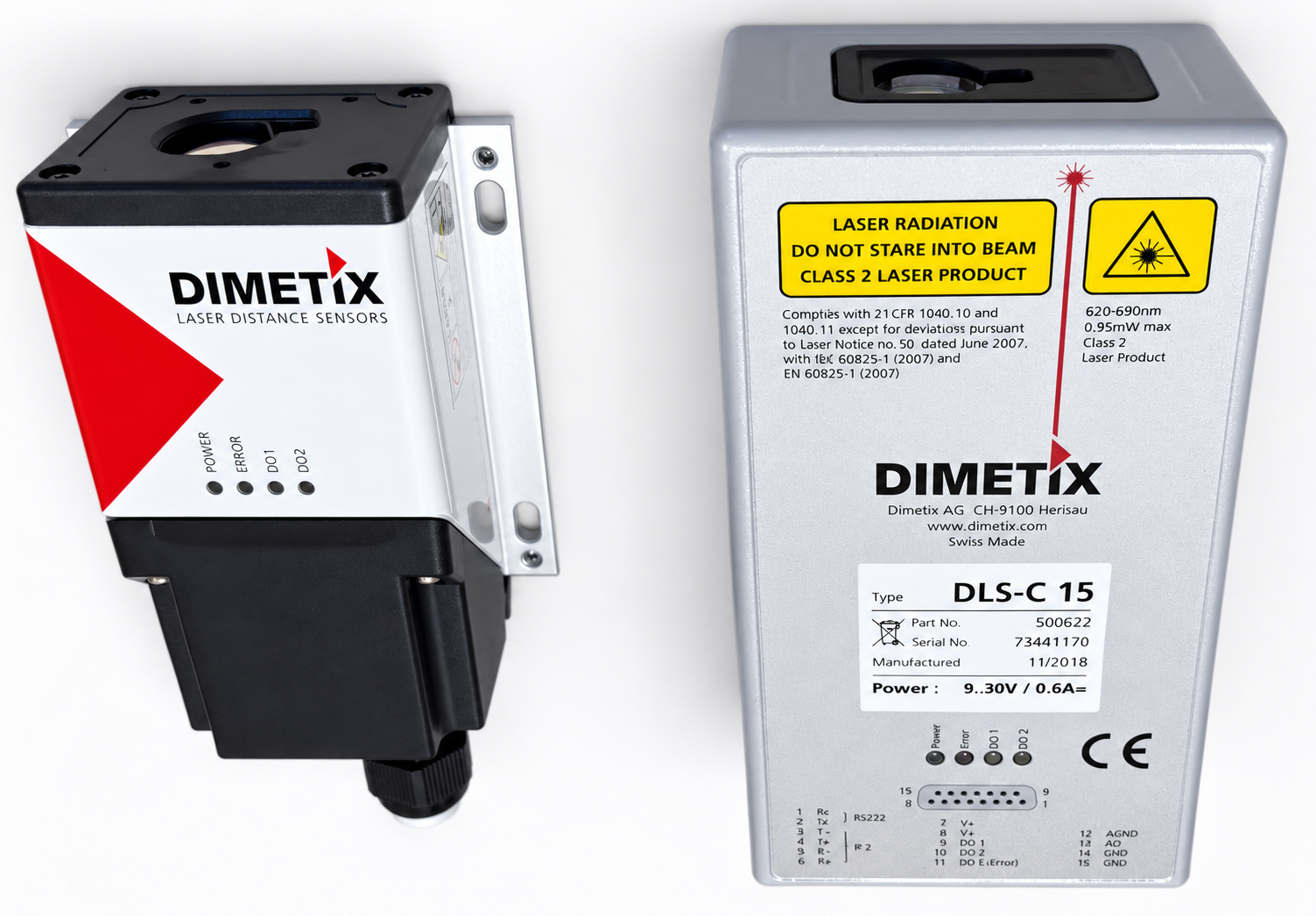
Comparison between the old Dimetix DLS-C 15 laser sensor and the current one
DPE-10-500, tested as an alternative to modernize an existing installation.
Key data of the use case
-
Manufacturer:
Dimetix AG - Sector: Museums and technical facilities
- Location: Catalonia
-
Application:
Non-contact laser distance measurement
- Installed model: Dimetix DLS-C 15
- Tested model: Dimetrix DPE-10-500
- Number of existing sensors: 16 units
- Operating system used: Windows 7
- Interfaces analyzed: USB, RS-232 and RS-422
The problem: replacing a discontinued Dimetix DLS-C 15
The analyzed installation has 16 sensors
Dimetix DLS-C 15 which have been operating within their
measurement system. However, this model belongs to a previous generation.
from Dimetix sensors and is currently discontinued.
The main risk to the installation was not the functioning of the sensors
existing, but the difficulty in finding an equivalent unit in case of breakdown.
The introduction of a new generation could require modifications to the software, the
connection, serial communication or even part of the acquisition system.
Before considering a replacement, it was necessary to answer several questions:
- Can the new sensor communicate with the existing computer?
- Is it possible to use it with the operating system already installed?
- Are the commands used by the old DLS-C 15 still supported?
- Are RS-232 and RS-422 communications compatible?
- Can the core logic of the acquisition software be preserved?
- Are the features improved compared to the old model?
Features of the old Dimetix DLS-C 15
He Dimetix DLS-C 15 It is an industrial sensor designed to measure
non-contact distances using a visible laser beam.
Its main features include:
- Typical accuracy of ±1.5 mm.
- Typical repeatability of ±0.4 mm.
- Maximum measurement frequency up to 6 Hz.
- Approximate range of 65 m over natural surfaces.
- Range up to 150 m using a reflective plate.
- Communication via RS-232 and RS-422.
- Configurable analog output of 0…20 mA or 4…20 mA.
- Programmable digital inputs and outputs.
- ASCII command-based communication protocol.
These features led to the DLS series being used for years in various applications
industrial positioning, dimensional control, level and automatic acquisition
of distances.
Testing the Dimetix DPE-10-500 in the existing installation
To verify the feasibility of the replacement, a test was carried out directly on
the museum installation, along with its technical team.
The selected sensor was the Dimetrix DPE-10-500, one of the models
current D-series. This sensor offers typical accuracy of ±1 mm and a
range of up to 500 m when using a suitable reflective surface.
The computer used for the installation was running on Windows 7.
The USB drivers corresponding to the new D series were installed and connected
The DPE-10-500 connects directly to the computer via a USB cable.
After installing the driver, the system recognized the sensor as a
virtual serial port COM. Communication was successfully established
On the first attempt, it was possible to receive the distance measurements without modifying the
Main logic used to communicate with the above sensors.
Compatibility with Windows 7 was practically confirmed on the computer used
during the test. This result corresponds to the specific equipment and configuration.
of the installation and should not be interpreted as a general certification for any
computer equipped with this operating system.
Protocol compatibility between the old DLS series and the D series
One of the most important results of the validation was verifying that the new
DPE-10-500 maintains the communication protocol used by the DLS-C 15 for the
main measurement functions.
Both the old DLS series and the current D series use a
ASCII command protocol. The instructions are sent via a
serial interface and responses include the sensor identifier, measurement type
and the distance value.
In the current D series, this protocol can be used via RS-232 interfaces,
RS-422/485 and USB. The USB connection behaves like a virtual COM port, allowing
that the software treats the sensor as a conventional serial device.
Commands are completed using carriage return and line feed characters.,
known as CR and LF.
Main supported commands
| Command | Function | DLS-C 15 | DPE-10-500 |
|---|---|---|---|
sNg | Take an individual distance measurement | Yeah | Yeah |
sNh | Start continuous measurement | Yeah | Yeah |
sNf | Start continuous measurement with buffer storage | Yeah | Yeah |
sNq | Read the last stored measurement | Yeah | Yeah |
sNc | Stop or cancel active measurement | Yeah | Yeah |
sNm | Check the strength of the received signal | Yeah | Yeah |
sNt | Check the internal temperature of the sensor | Yeah | Yeah |
sNo |
Temporarily activate the laser to facilitate alignment; it stops by sNc | Yeah | Yeah |
For example, the command sNg activates an individual measure in both
generations. The answer contains the distance expressed in tenths of a millimeter.
Command sent: s0g Sensor response: g0g+00012345
In this example, the sensor identifier is 0 and the transmitted distance is
1,234.5 mm.
The command sNh It also retains the same basic function: to initiate a
Continuous measurement that remains active until the stop command is received
sNc.
Default communication parameters
The series parameters used by default are equivalent in both
generations:
- Speed: 19,200 baud.
- Data bits: 7.
- Parity: pair.
- Stop bits: 1.
This coincidence facilitates the connection of the new sensor to systems that still use
the original configuration of the DLS-C.
However, before making a permanent replacement, the following must be checked:
actual configuration of each installed sensor, since the communication parameters
They may have been modified during initial commissioning.
Comparison between Dimetix DLS-C 15 and DPE-10-500
| Feature | Dimetix DLS-C 15 | Dimetrix DPE-10-500 |
|---|---|---|
| Product condition | Old model discontinued | Current model of the D series |
| Typical accuracy, 2σ | ±1.5 mm | ±1.0 mm |
| Typical repeatability, 2σ | ±0.4 mm | ±0.3 mm |
| Maximum measurement frequency | Up to 6 Hz | Up to 250 Hz |
| Maximum data output frequency | Limited by the measurement frequency | Up to 1 kHz |
| Range on natural surfaces | 0.05 m to approximately 65 m | 0.05 m to approximately 100 m |
| Reflector range | Approximately 25…150 m | Approximately 0.5…500 m |
| RS-232 | Yeah | Yeah |
| RS-422 | Yeah | Yeah |
| RS-485 | No | Yeah |
| USB | No | Yes, via virtual COM port |
| SSI | Not in the DLS-C 15 | Yeah |
| Analog output | 0/4…20 mA | 0/4…20 mA |
| Nominal supply | 9…30 VDC | 12…30 VDC |
| Operating temperature | -10…+50 °C | -40…+60 °C |
| Degree of protection | IP65 | IP65 |
| Dimensions | 150 × 80 × 55 mm | 140 × 78 × 48 mm |
| Approximate weight | 690 g | 350 g |
Improved reading speed
During the test, a faster response was observed from the new sensor. This improvement is
consistent with the performance specifications for both generations.
The older DLS-C 15 offers a maximum measurement frequency of up to 6 Hz, while
that the DPE-10-500 can achieve up to 250 measurements per second and a frequency
Maximum data output of 1 kHz, depending on the operating mode and the
configuration used.
The actual speed also depends on the reflectivity of the target, the distance,
the environmental conditions, the measurement mode, and the speed set for the
serial communication.
In an older installation, using the maximum frequency is not mandatory. The system
It can initially maintain a query speed similar to that used by the
DLS-C 15 and subsequently take advantage of the greater capacity of the new sensor if the application
It requires it.
Validation result
The test confirmed the following points:
- The DPE-10-500 could be connected via USB to the existing computer.
- The USB driver was successfully installed on the tested Windows 7 computer.
- The sensor was recognized as a virtual COM serial port.
- Communication was successfully established on the first attempt.
-
It was possible to receive the distance values without modifying the main logic
communication. -
The main distance acquisition commands are maintained between both
generations. - The DPE-10-500 provided a superior read speed.
-
The results suggest a gradual replacement, after prior validation.
each installation point.
The result demonstrates that Dimetix has maintained significant consistency in the
communication protocol. This compatibility facilitates the modernization of facilities
that use DLS-C sensors and reduces the work required to adapt the software
acquisition.
Is the DPE-10-500 a direct replacement for the DLS-C 15?
From the point of view of the measurement protocol, the
DPE-10-500 offers a high level of compatibility with the DLS-C 15.
However, it should not be considered a direct mechanical and electrical substitute without performing
preliminary checks.
Before replacing a sensor, the following should be checked:
- The dimensions of the sensor and the mounting points.
- The position of the origin or measurement reference.
- The connector and the terminal assignment.
- The available supply voltage.
- The identifier configured on each sensor.
- The speed and format of serial communication.
- The commands used by the existing program.
- The parameters used in timed commands.
- The configuration of the analog and digital outputs.
- The maximum distance of the application.
- The surface on which the measurement is taken.
The DLS-C 15 supports a nominal power supply of 9 to 30 VDC, while the power supply
The nominal voltage indicated for the DPE-10-500 is 12 to 30 VDC. The dimensions, weight, and
The wiring and terminal layout are not identical either.
Therefore, the technical conclusion is not that both sensors are physically interchangeable
without any adaptation, but the DPE-10-500 allows
maintain the protocol and main logic of distance acquisition,
considerably reducing the complexity of modernization.
Advantages obtained with the current D series
- Reduction of the risk associated with the obsolescence of the DLS-C 15.
- Possibility of gradually replacing the sensors.
- Preservation of the main measurement commands.
- Less need to modify existing software.
- Greater accuracy and repeatability.
- Significant increase in reading speed.
- Greater range on natural and reflective surfaces.
- USB connection for configuration, diagnostics, and acquisition.
- RS-232 and RS-422/485 compatibility.
- More compact housing and approximately 50% lighter than the %.
- Possibility of incorporating industrial communications in the new D series.
You can consult others
laser distance sensors
available for industrial positioning, leveling, and control applications
dimensional and automation.
Conclusion
The test carried out in a museum located in Catalonia demonstrates that an installation
equipped with sensors Dimetix DLS-C 15 can be modernized using
sensors of the current D series without necessarily having to replace the software or
completely modify the existing communication protocol.
He Dimetrix DPE-10-500 It maintained the structure of the main commands.
The measurement device operated via a virtual COM port and provided a response
considerably faster than the old model.
In addition to communication compatibility, the new model offers greater precision,
greater range, new interfaces, a more compact housing and a higher measurement frequency
far superior.
Each installation must be validated individually, especially regarding assembly,
the power supply, the wiring, and the specific parameters used by the program.
However, the continuity of the protocol reduces technical risk and facilitates migration
from the old Dimetix DLS series to the current D series.
Frequently asked questions about replacing the Dimetix DLS-C 15
What model can replace the Dimetix DLS-C 15?
The Dimetix DPE-10-500 can be used as a current alternative when a
equal or superior accuracy, serial communication and a range of up to 500 m with reflector.
The replacement must be validated because of the assembly, the wiring, and some parameters
Electricians are different.
Does the DPE-10-500 use the same commands as the DLS-C 15?
The main commands used to take measurements, start tracking,
Reading stored values and stopping the measurement maintain their name and structure
general. Among them are sNg, sNh,
sNf, sNq and sNc.
Some additional parameters may use different units. For example, the
Sampling times of timed commands are expressed in units of 10 ms in
the old DLS-C and in milliseconds in the current D series.
Can the program used with the DLS-C 15 be retained?
In many cases, the main logic of distance acquisition can be preserved.
However, it should be checked whether the program uses configuration commands, parameters
timed functions, advanced features, analog outputs, digital inputs, or management
error code developed specifically for the old sensor.
Does the Dimetix DPE-10-500 work with Windows 7?
In the test carried out in a museum located in Catalonia, the USB controller was installed
It worked correctly, and the DPE-10-500 functioned on the existing Windows 7 computer.
The result corresponds to the specific equipment used during the test and does not constitute
a general certification for all Windows 7 systems.
Does the DPE-10-500 connect directly in place of a DLS-C 15?
Not necessarily. The protocol offers high compatibility, but they must
Check the connector, terminal assignment, power supply, dimensions,
the assembly and the reference from which the distance is measured.
What speed improvement does the DPE-10-500 offer?
The DLS-C 15 reaches a maximum frequency of up to 6 Hz. The DPE-10-500 can reach
up to 250 Hz measurement frequency and a maximum data output frequency of
1 kHz in certain configurations.