B&C Electronics SZ1140 Industrial pH Sensor | Self-cleaning flat electrode
- Manufacturer: B&C Electronics
- Category: Water quality, SENSORS, pH and Redox Probes
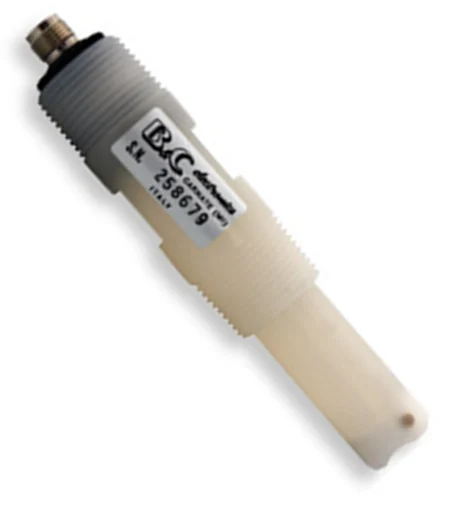
The SZ1140 of B&C Electronics It is a combined type industrial pH sensor with a GX-1 glass membrane and reference system. Measurement range: 0 to 12 pH. PVDF body, polymer gel electrolyte, and PTFE double junction.
It belongs to the family of flat electrodes with a self-cleaning effect. Its geometry facilitates the removal of loosely adhered particles and deposits through the tangential flow of the liquid across the sensitive surface. The effect is passive, flow-dependent, and does not replace regular cleaning and calibration.
Process temperature: 0 to 100 °C. Maximum pressure: 10 bar. Chemical compatibility must be checked for each application.
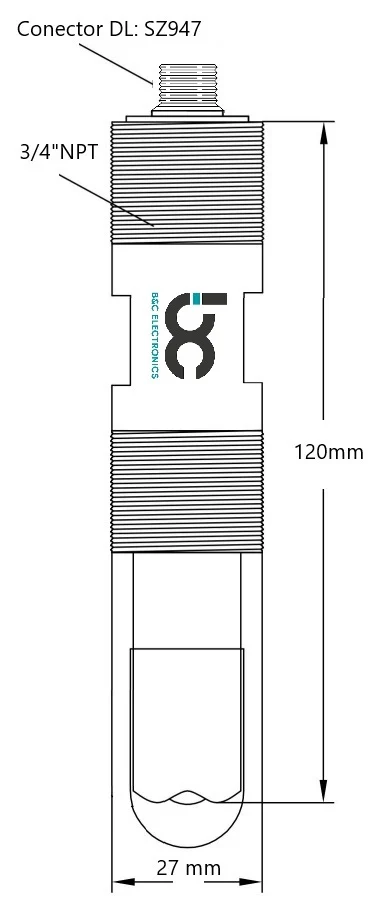
3/4″ NPT threaded connection. Total length: 140 mm. Body: 120 mm excluding connector. Immersion depth: 45 mm. When replacing another electrode, check dimensions and mounting type.
Electrical connection: DL (Detachable Lead) coaxial connector, allowing the cable to be disconnected without replacing the electrode. Compatible cables, supplied separately: 8-meter SZ947 and 2-meter SZ9471 with BNC termination. The SZ1140 does not include a Pt100 and requires an analyzer or transmitter with a dedicated pH electrode input.
Applications of the SZ1140 industrial pH sensor
Measurement and continuous monitoring of pH in industrial facilities.
Water treatment
- pH monitoring in water treatment facilities.
- Control of neutralization processes of acidic or alkaline waters.
- pH monitoring in tanks, pipes and recirculation circuits.
- pH measurement in water conditioning processes.
- Integration into water quality control systems.
Industrial processes
- pH control in industrial liquid circuits.
- Monitoring of chemical processes compatible with electrode materials.
- Integration with analyzers, transmitters and industrial automation systems.
- Applications that require electrode with PVDF body and double junction reference.
Selection considerations: In addition to pH range, temperature and pressure, the chemical composition of the liquid, the presence of solids or scale, and the installation conditions should be evaluated.
Self-cleaning and double PTFE bonding
Self-cleaning by liquid circulation
The measurement geometry facilitates cleaning of the sensitive surface through the tangential flow of the liquid. The fluid movement generates a drag force that can dislodge loosely adhered particles and deposits.
It is a passive effect: the electrode has no brushes, ultrasound or mechanical cleaning systems and does not generate liquid circulation.
In tanks without circulation or with practically stagnant water, the effect is very limited. Limescale, adhered biofilm, and other persistent deposits may require manual cleaning.
Double PTFE junction
A combined pH electrode incorporates a glass sensing element and an electrochemical reference system. The analyzer measures the potential difference between the two to determine the pH.
The double PTFE junction provides an additional barrier between the process fluid and the reference system. It reduces electrolyte contamination by certain substances present in the water. Service life depends on the fluid's chemical composition and operating conditions.
Polymer gel electrolyte
Sealed polymer gel electrolyte, no periodic refilling required. Electrode calibration, inspection, and cleaning are still necessary as needed.
DL connector, SZ947 and SZ9471 cables and connection to the analyzer
DL connector
DL (Detachable Lead) coaxial connector. Allows the connection cable to be detached without replacing the electrode. The DL designation identifies the connection used by B&C Electronics and is not equivalent to BNC, TNC, or S7 connectors.
Cables compatible with the SZ1140
- SZ947: 8-meter coaxial cable with DL connector on the probe end.
- SZ9471: 2-meter coaxial cable with DL connector on the probe end and BNC connector on the analyzer end.
Both cables are accessories and must be ordered separately. They are also compatible with the B&C Electronics SZ2060 Redox electrode. The SZ947 cable must be tested to ensure the instrument's end termination is checked before installation.
Coaxial cable
pH electrodes generate a small-amplitude electrical signal and have a very high output impedance. They require cables and connections for electrochemical instrumentation, with electrical insulation and protection against moisture and interference.
Improper wiring, moisture in the connectors, or insulation leaks can cause measurement errors and instability in pH readings.
PLC connection
It does not connect directly to a conventional 4–20 mA or 0–10 V analog input. The SZ1140 is a passive electrochemical electrode that generates a potential difference related to the pH of the liquid.
The signal must be interpreted by an analyzer or transmitter with a dedicated high-impedance pH input. Depending on the model, the instrument may provide analog outputs or communication capabilities to a PLC, SCADA, or other control system.
B&C Electronics offers the pH transmitter PH3630, with high-impedance pH input and 4–20 mA output. For automatic temperature compensation with the SZ1140, a compatible external Pt100 sensor must be connected. The pH cable is installed according to the transmitter's connection diagram.
Pipe installation, immersion and temperature compensation
In-line or immersion mounting
3/4″ NPT threaded connection for pipe housings or, with fittings and extension tubes, for immersion.
Total length: 140 mm. Body without connector: 120 mm. Immersion length: 45 mm. In replacement installations, the mounting dimensions must be checked.
The measuring surface must remain in contact with the liquid. Avoid air pockets, areas where the sensor could dry out, and conditions that promote persistent deposits.
Process temperature and pressure
Operating range specified by B&C Electronics: 0 to 100 °C, with a maximum pressure of 10 bar. Selection should take into account the actual process conditions, mounting materials, and temperature and pressure variations.
Temperature compensation
The electrical response of pH electrodes depends on the temperature. With variable liquid temperatures, an analyzer with automatic compensation is recommended.
The SZ1140 does not include a Pt100 sensor. For automatic compensation, an external temperature sensor compatible with the analyzer is installed. Some instruments allow manual input of the process temperature.
Compensation corrects the electrical response of the electrode, but does not eliminate the actual variations in the pH of the liquid with temperature.
pH electrode calibration and maintenance
The SZ1140 requires periodic verification, calibration, and maintenance.
Calibration
It is performed using buffer solutions of known pH and a compatible analyzer, usually at two points depending on the working range.
Examples: pH 7.00 and 4.01 buffers for acidic media close to neutral pH; pH 7.00 and 10.01 buffers for alkaline media, depending on the instrument and application.
Maintenance
- Periodically check the slope and zero point of the electrode.
- Inspect and clean the measuring surface when there are deposits.
- Avoid impacts and handling that could damage sensitive components.
- Keep the DL electrical connection clean and protected from moisture.
- Prevent the sensitive membrane from drying out during prolonged storage.
- Use the recommended storage solutions and procedures for pH electrodes.
Maintenance frequency depends on water quality, temperature, circulation, and the presence of substances that may contaminate the reference system. Self-cleaning by circulation does not replace calibration or cleaning.
Differences between the B&C SZ1140, SZ1150 and SZ2060 sensors
SZ1140: GX-1 glass, pH range 0–12
GX-1 glass membrane, 0 to 12 pH. Without Pt100. Detachable DL coaxial connection with SZ947 or SZ9471 cables.
SZ1150: GX-V glass, pH range 0–14 and integrated Pt100
He SZ1150 It has a low alkali error GX-V glass membrane, a pH range of 0 to 14, and an integrated Pt100 sensor for measuring liquid temperature.
Four-contact multipolar DL connection, with the specific SZ9441 cable, different from the coaxial cables of the SZ1140.
SZ2060: Redox potential measurement
Same design family. Measures oxidation-reduction potential (ORP/Redox) with a platinum electrode. Does not measure pH. Shares the DL connection system and SZ947 and SZ9471 cables.
Selection of the B&C Electronics SZ1140 pH sensor
The SZ1140 is an industrial pH electrode with a PVDF body, PTFE double junction reference, flat end, and detachable coaxial connection.
Before selecting the assembly, the characteristics of the liquid, the pH range, the temperature, the pressure, the type of assembly, and the analyzer that will receive the signal must be defined.
B&C Electronics is an Italian manufacturer of electrochemical instrumentation since 1974, with products for pH, Redox, conductivity and other water quality parameters.
Properties
| TECHNICAL SPECIFICATIONS B&C ELECTRONICS SZ1140 | |
|---|---|
| Manufacturer | B&C Electronics |
| Model | SZ1140 |
| Sensor type | Combined pH electrode, glass and reference |
| Measuring membrane | GX-1 Glass |
| Measuring range | 0–12 pH |
| Process temperature | 0 to 100 °C |
| Maximum pressure | 10 bar |
| Reference system | Double PTFE junction |
| Electrolyte | sealed polymeric gel |
| Body material | PVDF |
| Electrode design | Flat end with self-cleaning effect by tangential flow |
| Process connection | 3/4″ NPT Thread |
| Total length | 140 mm, including the connector |
| Body length | 120 mm, not including the connector |
| Dive length | 45 mm |
| Integrated temperature sensor | Does not incorporate Pt100 |
| Type of electrical connection | Detachable coaxial connector DL |
| SZ947 cable | Coaxial, 8 m, DL connector |
| SZ9471 Cable | Coaxial, 2 m, DL + BNC |
| Cable included | No, it is requested separately. |
| Facility | Online or by immersion with suitable accessories |
| Applications | Water treatment and industrial process control |
Related documentation, cases, and guides
Other products