SZ1150 pH sensor with integrated Pt100 | B&C Electronics
- Manufacturer: B&C Electronics
- Category: Water quality, SENSORS, pH and Redox Probes
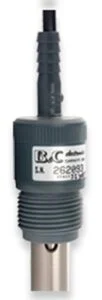
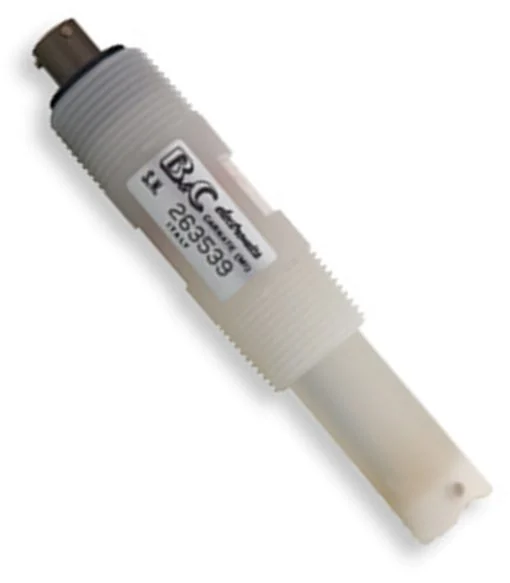
He SZ1150 of B&C Electronics it's a industrial pH sensor with integrated Pt100, Designed to measure pH and temperature at the same point in the process. It uses a GX-V glass membrane, suitable for measuring also in highly alkaline media, with a pH measurement range 0 to 14.
The choice of GX-V glass is one of the features that sets the SZ1150 apart: it is formulated to reduce alkaline error which can appear on glass electrodes when the pH is high. The accuracy of the measurement depends on the process conditions, especially the sodium concentration and temperature. In applications with concentrated alkalis, it is important to consider these interferences when selecting the electrode.
The electrode incorporates a PVDF body, a reference system of double PTFE junction and a polymer gel electrolyte. The Pt100 allows the analyzer to determine the liquid temperature and compensate for the electrode's thermal response. Furthermore, the design of the sensing tip facilitates particle removal via water flow, without replacing periodic cleaning and calibration.
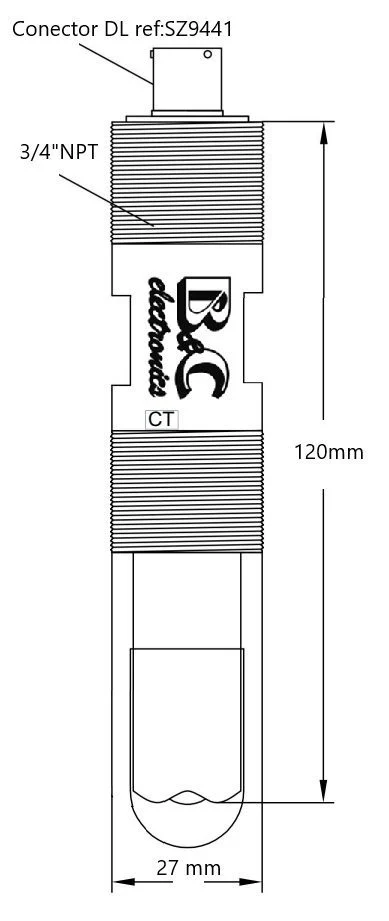
It has 3/4″ NPT process thread For in-line or immersion mounting using suitable accessories. Operates at temperatures of 0 to 100 °C and it can withstand a maximum pressure of 10 bar at 25 °C. The electrical connection is DL multipolar four-contact and use the cable SZ9441 of 10 meters, Supplied separately. A pH and Pt100 compatible analyzer is required; the sensor does not directly provide a 4–20 mA output.
GX-V glass: measurement up to pH 14 and alkali error
What does the GX-V membrane contribute?
The pH is determined from the potential difference between the hydrogen ion-sensitive glass membrane and the reference system. The SZ1150 incorporates a glass membrane. GX-V with Semi-Dome geometry and a measuring range of 0 to 14 pH.
In highly alkaline liquids, sodium ions and other components can interfere with the response of some pH glasses. This phenomenon, known as alkaline error or sodium error, This can cause the analyzer to indicate a lower pH than the actual pH. GX-V glass is designed to limit this interference, making it advantageous when the process can operate above pH 12.
In media with high concentrations of sodium hydroxide, the alkaline error It can influence the reading even when using a low-alkali error glass. The 0–14 pH range describes the sensor's measurement interval, while the accuracy obtained also depends on the liquid's composition and temperature.
Electrochemical reference system
The electrode uses a reference Ag/AgCl (silver/silver chloride). This data describes the reference electrochemical system; double PTFE junction Describe the joints that separate it from the process fluid. These are complementary, not alternative, characteristics.
Integrated Pt100 and temperature compensation
Why measure pH and temperature together?
The electrical response of a pH electrode changes with temperature. The SZ1150 integrates a Pt100 next to the electrode so that the analyzer knows the actual temperature at the point where the measurement is taken.
A Pt100 is a platinum resistive sensor whose nominal value is 100 Ω at 0 °C. The analyzer measures its resistance, calculates the temperature, and can use it to apply thermal compensation to the electrode's response.
This avoids having to install a second temperature probe next to the pH sensor and facilitates the monitoring of processes with thermal changes, provided the analyzer is compatible.
It is important to distinguish between two effects: Compensation corrects the electrical response of the electrode; it does not eliminate the actual chemical changes that the pH of the liquid may undergo when its temperature changes.
DL four-pin connector and cable SZ9441
Connecting the electrode to the analyzer
The SZ1150 incorporates a four-contact multipolar DL connector. Unlike an electrode that only delivers a pH signal, this model also needs to transmit information from the integrated Pt100 sensor.
The compatible cable is the SZ9441 from B&C Electronics, 10 meters, and not included in the sensor supply. At the electrode end, it uses a four-pin female DL connector. The instrument end connects to the pH and Pt100 inputs according to the cable and analyzer electrical diagram.
This four-pin connector should not be confused with the SZ1140 coaxial DL. The SZ947 and SZ9471 cables for that model are not replacements for the SZ9441.
B&C Electronics PH3630 pH Transmitter
To complete the measurement system, B&C Electronics offers the PH3630, a DIN rail pH transmitter that works on the scale 0–14 pH and admits Three-wire Pt100. It features an LCD screen, automatic temperature compensation and isolated output 4–20 mA via a two-wire loop powered by 10–30 VDC.
The set is formed by connecting the SZ1150 using cable SZ9441 to the electrode and Pt100 inputs of the PH3630. In this way, the transmitter can display the pH and temperature, and send the analog pH signal to a PLC or SCADA system. The connections and installation recommendations for both devices must be followed, especially those relating to insulation and cable length.
Does it connect directly to the PLC?
Not to a conventional 4–20 mA or 0–10 V input. The SZ1150 is a passive electrochemical electrode. It requires a pH analyzer with high impedance input and compatibility with Pt100. Depending on the analyzer chosen, the measurement can then be sent to a PLC or SCADA system via analog signals or communications.
Due to the high impedance of the pH signal, suitable cables must be used and connections must be kept dry, clean and well insulated.
Pipe mounting, immersion, and operating limits
Dimensions and process connection
The body incorporates a thread 3/4″ NPT, suitable for in-line mounting or for immersion installations using the corresponding housing or extension tube.
The The total length is 140 mm, including the top connector; the The body length indicated on the drawing is 120 mm, excluding that connector. The specified immersion length is 45 mm.
Temperature, pressure, and chemical compatibility
The process temperature range is 0 to 100 °C. The The maximum pressure is 10 bar at 25 °C. The temperature limit of 100 °C and the pressure limit of 10 bar do not represent simultaneous maximum operating conditions.
PVDF exhibits good chemical resistance to numerous liquids, but the compatibility of all wetted materials with the composition, concentration, and temperature of the process must be checked.
The sensitive area must remain properly moistened. Avoid air pockets, mountings where the electrode could dry out, and positions that make it difficult to remove the sensor for calibration.
Applications and selection for alkaline processes
The SZ1150 is designed for continuous pH and temperature measurement in water treatment, chemical processes and industrial circuits. Its extended range allows it to be considered even when the process can reach high pH values, provided that the chemical composition is compatible and the measurement error is acceptable.
- Water treatment: neutralization, dosage control and pH monitoring with temperature measurement.
- Alkaline processes: bathrooms and circuits where it is important to measure above pH 12 and evaluate the behavior of the glass against the alkaline error.
- Chemical industry: monitoring of process liquids compatible with PVDF and the reference system.
- Processes with variable temperature: installations where it is useful to obtain pH and temperature at the same point.
In concentrated caustic solutions, it is advisable to define the type of base—for example, sodium or potassium hydroxide—, its concentration, the temperature, and the required accuracy before selecting the electrode.
SZ1150 vs. SZ1140: Technical Differences
Both models belong to B&C Electronics' range of industrial electrodes and share a PVDF body, double PTFE union, and 3/4″ NPT threaded mounting, but They are not equivalent.
- SZ1150: glass membrane GX-V, range 0–14 pH, Integrated Pt100 and a four-pin multipolar DL connector. Uses SZ9441 cable.
- SZ1140: range 0–12 pH, without integrated Pt100, coaxial DL connection and SZ947 or SZ9471 cables.
Therefore, the SZ1150 offers a double functional advantage: a wider pH range thanks to the GX-V glass and the ability to measure temperature without installing an additional probe. The final choice depends on the process chemistry, the analyzer, and the type of cabling.
Double union, self-cleaning, calibration and maintenance
Reference system protection
The double PTFE junction It introduces an additional barrier between the liquid and the Ag/AgCl reference system, helping to limit electrolyte contamination. sealed polymeric gel It does not need periodic refilling.
Passive self-cleaning effect
The geometry of the tip facilitates the flow of liquid over the measuring surface and the removal of loosely attached particles. It does not generate turbulence nor does it incorporate an active cleaning mechanism. Manual cleaning will still be necessary in stagnant or persistently scaled tanks.
Calibration and preservation
The electrode must be calibrated periodically with buffer solutions appropriate to the working range, following the analyzer's procedure. For highly alkaline measurements, it is especially important to check the response in the range close to the process pH.
To remove salt deposits, cleaning with water and a 3.1% HCl solution for five minutes is recommended; for oil or grease films, use water and detergent. These maintenance operations should be carried out by qualified personnel, with appropriate chemical protective measures.
If the membrane dries out, the conditioning procedure includes an initial 30-minute immersion in tap water. For long-term storage, the protective cap with pH 4 buffer and KCl preservation solution should be used. The glass membrane must be kept hydrated.
Selection of the B&C Electronics SZ1150 pH Sensor
B&C Electronics GUEMISA is an Italian manufacturer specializing in electrochemical instrumentation for water analysis and industrial processes. At GUEMISA, we sell their electrodes and analyzers and offer consulting services to help you select the right sensor based on pH range, temperature, liquid composition, and integration requirements.
We can help you select the SZ1150 with GX-V glass and integrated Pt100, its SZ9441 cable and a compatible transmitter such as the PH3630, to integrate the measurement into a control panel or SCADA system.
Contact us for technical information, availability, and pricing.
Properties
| TECHNICAL SPECIFICATIONS B&C ELECTRONICS SZ1150 | |
|---|---|
| Manufacturer | B&C Electronics |
| Model | SZ1150 |
| Electrode type | Combined pH electrode with integrated Pt100 |
| Measuring membrane | GX-V Semi-Dome Glass; Low Alkali Error formulation |
| Measuring range | 0–14 pH |
| Electrochemical reference | Ag/AgCl (silver/silver chloride) |
| Reference system | PTFE double junction; polymer gel electrolyte |
| Membrane resistance | <250 MΩ |
| Integrated temperature | Pt100 |
| Process temperature | 0 to 100 °C |
| Maximum pressure | 10 bar at 25 °C |
| Body material | PVDF |
| Measurement design | Extreme with passive self-cleaning effect through liquid circulation |
| Process connection | 3/4″ NPT thread; in-line or plunge mount |
| Electrical connector | DL multipolar four-contact |
| Compatible cable, not included | SZ9441, 10 meters, DL four-contact connector |
| Total length | 140 mm, including the connector |
| Body length | 120 mm, not including the connector |
| Dive length | 45 mm |
| Electrode signal | Passive pH and Pt100 resistance signal; requires compatible analyzer |
Related documentation, cases, and guides
Other products