




















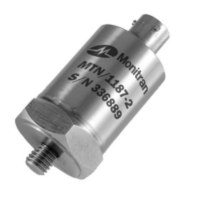
MTN/1187 Acceleration Transducer
- Manufacturer: Monitran
- Category: Accelerometers and Vibration Sensors, SENSORS
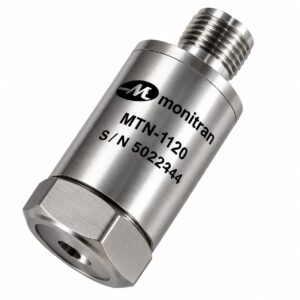
The MTN/1187 acceleration transducer integrates a piezoelectric sensing element and a conditioning circuit to generate a 4-20mA current loop output proportional to the RMS acceleration (g). This technical configuration allows for continuous vibration monitoring directly via a PLC or industrial data acquisition system, eliminating the need for intermediate load amplifiers or signal conditioners.
The device is designed for detecting vibration phenomena across a frequency spectrum of 2 Hz to 1 kHz, a range that covers the fundamental and harmonic frequencies of medium- and high-speed rotating machinery. Factory calibration allows for the selection of specific measurement ranges between 0-1g and 0-20g RMS. Operating on a two-wire current loop standard, the equipment ensures signal transmission immune to voltage drops over long cable runs, facilitating installation in large-scale plants.
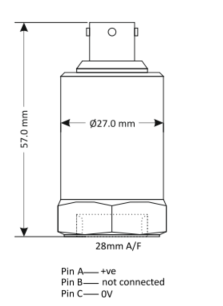
The mechanical construction is based on a hermetically sealed stainless steel housing rated IP67. The sensor base is galvanically isolated from the internal circuitry, a critical technical feature to prevent ground loops and induced noise in environments with high electromagnetic load. The MTN/1187 is suitable for monitoring bearings and mechanical components where acceleration is the determining parameter for identifying fatigue or lubrication failures.
- 4-20mA proportional RMS output for integration into SCADA/PLC systems.
- Frequency response 2Hz-1kHz for industrial machinery diagnostics.
- IP67 stainless steel body with an isolated mass base.
- Modular configuration with options for integral cable or industrial connectors.
Technical Frequently Asked Questions
1. What is the maximum load impedance supported by the loop?
The maximum load impedance depends on the applied supply voltage. For a 24V DC supply, the maximum load resistance (including cable and PLC resistance) is approximately 600 Ohms, ensuring linearity of the 4-20mA output.
2. What technical differences exist compared to the MTN/1185 series?
The 1185 series incorporates an integrator circuit to deliver a signal proportional to speed (mm/s), while the MTN/1187 delivers a signal proportional to gross acceleration (g). The 1187 is preferable for analyzing high-frequency components and bearing conditions.
3. Is the MTN/1187 suitable for continuous immersion?
The standard model has IP67 protection (temporary immersion). For pumping applications or permanently flooded areas, the MTN/1187W variant must be specified, which incorporates IP68 sealing and a reinforced polyurethane cable.
Properties
| Feature | Technical Specification |
| Transducer Type | RMS Acceleration (Current Loop) |
| Models of the Series | MTN/1187 (Connector), MTN/1187C (Cable), MTN/1187W (IP68) |
| Configurable Ranges | 0-1, 0-2, 0-5, 0-10 or 0-20 g RMS |
| Exit Signal | 4-20 mA DC |
| Frequency Response | 2 Hz to 1 kHz (±10%) |
| Supply Voltage | 12V to 32V DC (24V Nominal) |
| Operating Temperature | -25 °C to +90 °C |
| Housing Material | Stainless steel |
| Electrical Insulation | Galvanically Isolated Base |
| Degree of Protection | IP67 (IP68 optional) |
| Mounted Resonance | 5 kHz |
| Maximum Dynamic Range | 50 g (Peak) |
| Mounting Torque | 8 Nm |
| Electrical Connection | Top Entry |
| Certified Versions | MTN/1187IC (ATEX / IECEx) |
Other products