



















TEX with Novotechnik stem | Linear position sensor
- Manufacturer: Novotechnik
- Category: Displacement, SENSORS, Potentiometric linear sensors
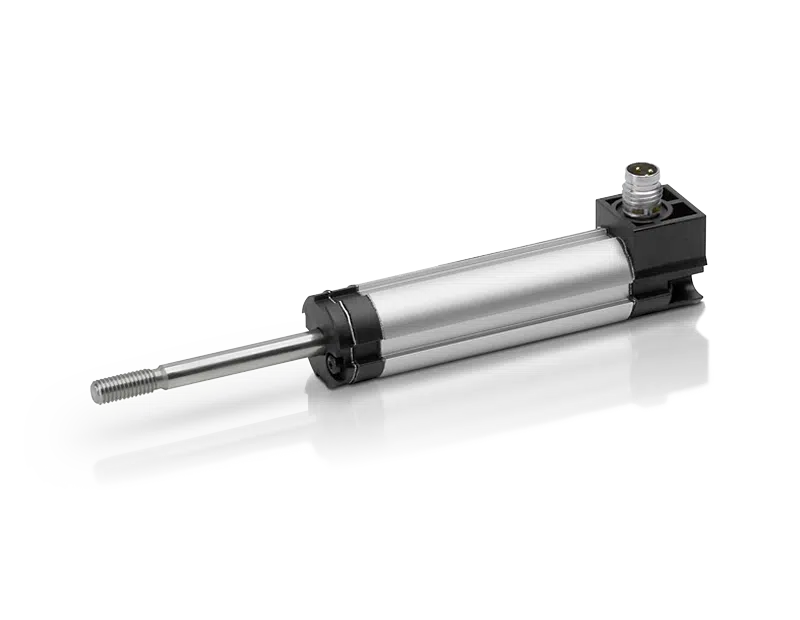
He TEX with stem of Novotechnik it's a potentiometric linear position sensor Designed to measure the absolute and direct displacement, position, or stroke of a mechanism. It is available with defined travels of 10 to 300 mm and provides a ratiometric signal via a resistive track of conductive plastic.
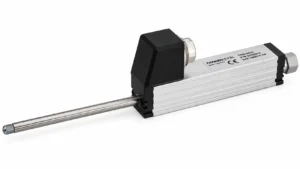
Physically, this implementation of TEX consists of a longitudinal metal casing made of anodized aluminum and a single straight stem that moves axially at one of its ends. The stem is rotatable, made of 1.4305 / AISI 303 stainless steel, and terminates in a M5 external thread to perform the mechanical connection with the moving element. It is not a block or square box type sensor.: the position is mechanically transmitted to the sensor by means of the axial displacement of the stem.
This page specifically corresponds to version TEX with free stem. It does not incorporate a return spring or fixing ball joints at its ends; these features are found in other versions of the TEX family. The model with a stem can be installed using two adjustable clamps or by M10 threaded center fixing, the latter available up to 150 mm of travel.
The series combines a compact construction with independent linearity of up to ±0.05 % FS, repeatability of 0.01 mm, better resolution than 0.01 mm, maximum travel speed of 10 m/s and protection IP54. Its typical lifespan exceeds 100 million movements, depending on the application conditions.
- Technology: conductive plastic potentiometric.
- Type of measurement: absolute linear position and displacement.
- Moving element: Straight axial stem, rotatable, with M5 external thread.
- Defined routes: 10 / 25 / 50 / 75 / 100 / 125 / 150 / 175 / 200 / 250 / 300 mm.
- Exit: voltage divider · ratiometric signal.
- Mounting: adjustable clamps or M10 center fixing up to 150 mm.
- Independent linearity: up to ±0.05 % FS depending on the route.
- Repeatability: 0.01 mm.
- Resolution: better than 0.01 mm.
- Maximum speed: 10 m/s.
- Protection: IP54.
- Operating temperature: −40…+85 °C.
- Connection: M8x1 connector or 2 or 5 m shielded PUR cable, with radial or axial output depending on the reference.
Applications of the TEX linear position sensor with stem
The TEX is ideal for applications where the displacement of the moving element can be transmitted directly to the sensor stem. By providing an absolute measurement, the position is defined directly by the mechanical position of the potentiometric cursor.
Machinery and automation
- Absolute measurement of position and linear displacement.
- Control and supervision of mechanical races.
- Position feedback of mechanisms and actuators.
- Measurement of openings, displacements and linear movements.
- Integration into control and data acquisition systems.
Test benches and laboratory
- Displacement recording during mechanical tests.
- Simultaneous measurement of position with force, pressure, torque, or other variables.
- Cycle and repetitive motion tests.
- Checking initial, final and intermediate positions.
When there is misalignment between the axis of movement and the axis of the sensor, it is recommended to use a ball coupling to reduce lateral loads on the stem.
Construction, stem, and mounting options
The TEX uses a elongated anodized aluminum casing with the stem positioned on the same longitudinal axis as the sensor. The stem is made of 1.4305 / AISI 303 stainless steel, can rotate on its axis, and has a M5 external thread.
There are two mechanical executions for this version:
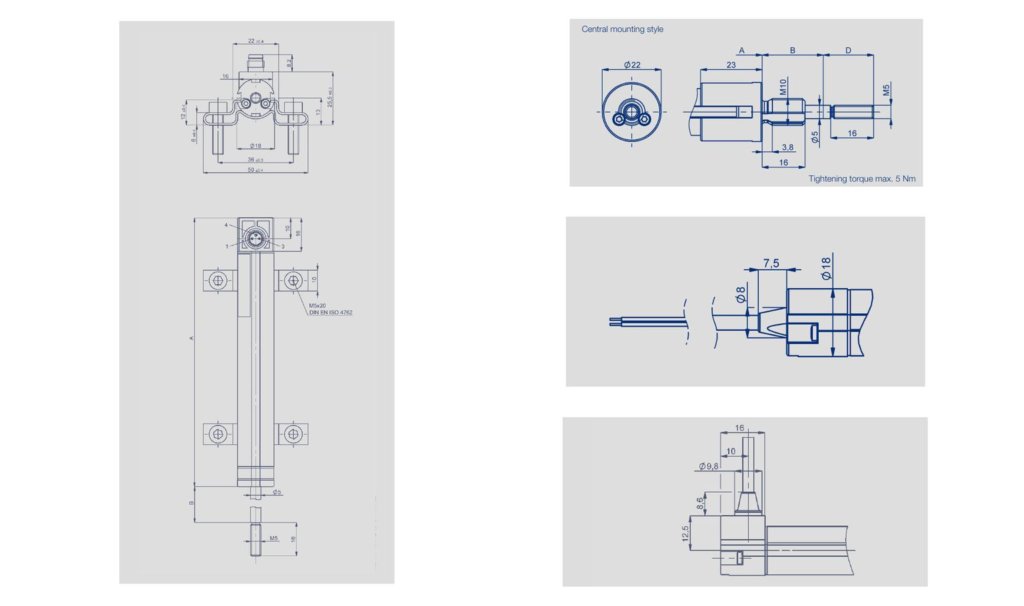
- 411 · Mounting using clamps: Available for all travel distances from 10 to 300 mm. Two clamps and four M5x20 screws are supplied.
- 418 · M10 Central Mounting: Mounting via M10 center thread, available for travels from 10 to 150 mm. The maximum tightening torque on the collar is 5 Nm.
Clamp mounting allows the housing to be attached directly to the structure. The M10 center-mount version allows the sensor to be installed by passing it through a bracket or mounting plate.
The stem should not be used to absorb significant lateral forces. If the moving element and the sensor are not perfectly aligned, the Novotechnik Z-301-M5/M5 ball coupling can be used.
Potentiometric output and absolute position measurement
The TEX is a linear potentiometric transducer. Inside the casing, there is a resistive track made of conductive plastic and a multi-wire cursor made of precious metal mechanically attached to the stem.
The sensor should be used as voltage divider with virtually no load on the cursor. The signal obtained is proportional to the position of the stem and, therefore, to the distance traveled.
Depending on the selected path, the nominal resistance is between 1 and 12 kΩ. The recommended current across the cursor is less than 1 µA and the maximum permissible voltage applied to the sensor is 42 VDC.
It does not directly incorporate a standard industrial output of 0–10 V or 4–20 mA. When the PLC, indicator, or acquisition system requires one of these signals, a compatible signal conditioner can be used.
Since it is an absolute potentiometric measurement, the position is obtained directly when the circuit is powered and it is not necessary to perform a search for origin process as occurs with certain incremental systems.
M8x1 connector and versions with PUR cable
The type of electrical connection is defined by the last three digits of the reference:
- 101: M8x1 3-pole radial connector.
- 202: 2m shielded PUR cable, radial output.
- 205: 5m shielded PUR cable, radial output.
- 302: 2m shielded PUR cable, axial output.
- 305: 5m shielded PUR cable, axial output.
Electrical allocation
- End of track 1: pin 1 / BN · brown.
- Cursor signal: pin 4 / WH · white.
- End of track 3: pin 3 / GN · green.
To reverse the increasing or decreasing direction of the signal, the power supply between terminals 1 and 3 of the resistive trace can be swapped. In versions with an integrated cable, the display must be grounded.
References and configuration of the Novotechnik TEX with stem
The reference is constructed following the format:
TEX-RRRR-MMM-002-CCC
- RRRR: Defined route: 0010 / 0025 / 0050 / 0075 / 0100 / 0125 / 0150 / 0175 / 0200 / 0250 / 0300.
- MMM = 411: Single-sided stem with clamp mounting.
- MMM = 418: Single-sided stem with M10 center mounting, available up to 150 mm.
- 002: linearized resistive element, standard version.
- CCC: electrical connection code 101 / 202 / 205 / 302 / 305.
Example: TEX-0150-411-002-101 corresponds to a TEX sensor with a 150 mm stroke, single-sided stem, clamp mounting and M8x1 radial connector.
Example: TEX-0100-418-002-202 corresponds to a TEX sensor of 100 mm, M10 central fixing and 2 m shielded radial PUR cable.
Frequently Asked Questions about the TEX with stem
What differentiates this version of the TEX with spring return?
This version uses a stem that must be mechanically attached to the element whose position is to be measured. It does not incorporate a spring that automatically returns the probe. The TEX version with spring return is designed to perform contact measurements without a fixed mechanical connection to the moving element.
What is the difference compared to the TEX with ball joints?
The TEX with stem uses a straight stem with an M5 thread and secures the housing using clamps or an M10 center thread. The version with ball joints incorporates articulated heads at the mounting points to accommodate angular misalignments.
Does the TEX directly deliver 0–10 V or 4–20 mA?
No. The TEX is a passive potentiometric sensor used as a voltage divider. To obtain a standardized output of 0–10 V or 4–20 mA, a suitable signal conditioner must be added.
What tours are available?
The defined travel distances are 10, 25, 50, 75, 100, 125, 150, 175, 200, 250 and 300 mm.
When is it appropriate to use a ball coupling?
When there is a small parallel or angular deviation between the sensor axis and the actual direction of movement, the coupling allows for a reduction of the lateral loads transmitted to the stem.
Selection of the TEX with stem
He Novotechnik TEX with stem It is suitable when it is necessary to directly measure a linear displacement using a compact, absolute potentiometric sensor with high displacement speed.
To select the reference, the required travel distance, the clamping system or M10 central mounting, the type and length of the electrical connection, the available space, and the possible existence of mechanical misalignments must be defined.
Consult us for the application to select the most suitable TEX execution and reference.
Properties
| NOVOTECHNIK TEX TECHNICAL SPECIFICATIONS WITH STEM | |
|---|---|
| Model | Novotechnik TEX |
| Sensor type | Linear potentiometric position sensor/transducer with stem |
| Measurement principle | Potentiometric · conductive plastic · absolute measurement |
| Construction | Longitudinal anodized aluminum housing with unilateral axial stem |
| Defined routes | 10 / 25 / 50 / 75 / 100 / 125 / 150 / 175 / 200 / 250 / 300mm |
| Electric circuits | 12 / 27 / 52 / 77 / 102 / 130 / 155 / 180 / 205 / 255 / 305mm |
| Exit | Voltage divider · ratiometric signal |
| Nominal resistance according to travel | 1 / 1 / 2 / 3 / 4 / 5 / 6 / 7 / 8 / 10 / 12 kΩ |
| Resistance tolerance | ±20 % |
| Independent linearity | 10 mm: ±0.25 % FS · 25 mm: ±0.20 % FS · 50–100 mm: ±0.10 % FS · 125–300 mm: ±0.05 % FS |
| Repeatability | 0.01 mm |
| Resolution | Better than 0.01 mm |
| Recommended cursor current | < 1 µA |
| Maximum cursor current in case of failure | 10 mA |
| Maximum allowable voltage | 42 VDC |
| Effective thermal coefficient | Typ. 5 ppm/K |
| Insulation resistance | > 10 MΩ at 500 VDC |
| Dielectric strength | < 100 µA at 500 VAC / 50 Hz |
| MECHANICAL DATA | |
| Housing | Anodized aluminum |
| Stem | Stainless steel 1.4305 / AISI 303 · swivel · M5 external thread |
| Bearing | Sliding bearing / bushing |
| Resistive element | Conductive plastic |
| Cursor | Precious metal multi-strand |
| Horizontal drive force | < 3 N at 20 °C |
| Body length A according to path | 63 / 78 / 103 / 128 / 153 / 194 / 219 / 244 / 269 / 319 / 369 mm · tolerance ±2 mm |
| Mechanical Engineering B | 14 / 29 / 54 / 79 / 104 / 132 / 157 / 182 / 207 / 257 / 307 mm · tolerance ±2 mm |
| Assembly 411 | Two adjustable clamps · available from 10 to 300 mm |
| Assembly 418 | M10 center fixing · available from 10 to 150 mm · maximum torque 5 Nm |
| ENVIRONMENTAL DATA | |
| Working temperature | -40…+85 °C |
| Working humidity | 0…95 % HR, non-condensing |
| Vibration · IEC 60068-2-6 | 20 g · 5…2000 Hz · maximum amplitude 0.75 mm |
| Shock · IEC 60068-2-27 | 50 g · 6 ms |
| Typical useful life | > 100 × 106 movements, depending on the application |
| Maximum speed | 10 m/s |
| Degree of protection | IP54 according to DIN EN 60529 |
| ELECTRICAL CONNECTION | |
| Code 101 | M8x1 3-pole radial connector |
| Code 202 | 2m shielded PUR cable · radial exit |
| Code 205 | 5m shielded PUR cable · radial exit |
| Code 302 | 2m shielded PUR cable · axial output |
| Code 305 | 5m shielded PUR cable · axial output |
| REFERENCE CONFIGURATION | |
| Format | TEX-RRRR-MMM-002-CCC |
| RRRR · route | 0010 / 0025 / 0050 / 0075 / 0100 / 0125 / 0150 / 0175 / 0200 / 0250 / 0300 |
| MMM · assembly | 411 · clamps / 418 · M10 center fixing up to 150 mm |
| 002 · electric version | Linearized resistive element, standard |
| CCC · connection | 101 / 202 / 205 / 302 / 305 |
| Mechanical accessories | Z-301-M5/M5 coupling · Z-G01 ball joint |
Other products