




















Dual Range Torque Sensor DF Dual 4 | 4,000-5,000 Nm | 15,000 RPM
- Manufacturer: CENSORED
- Category: Very high torque (10,000-150,000 Nm), Rotary, Torque sensor
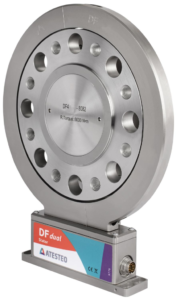
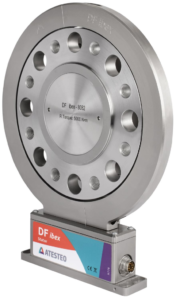
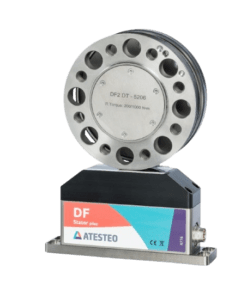
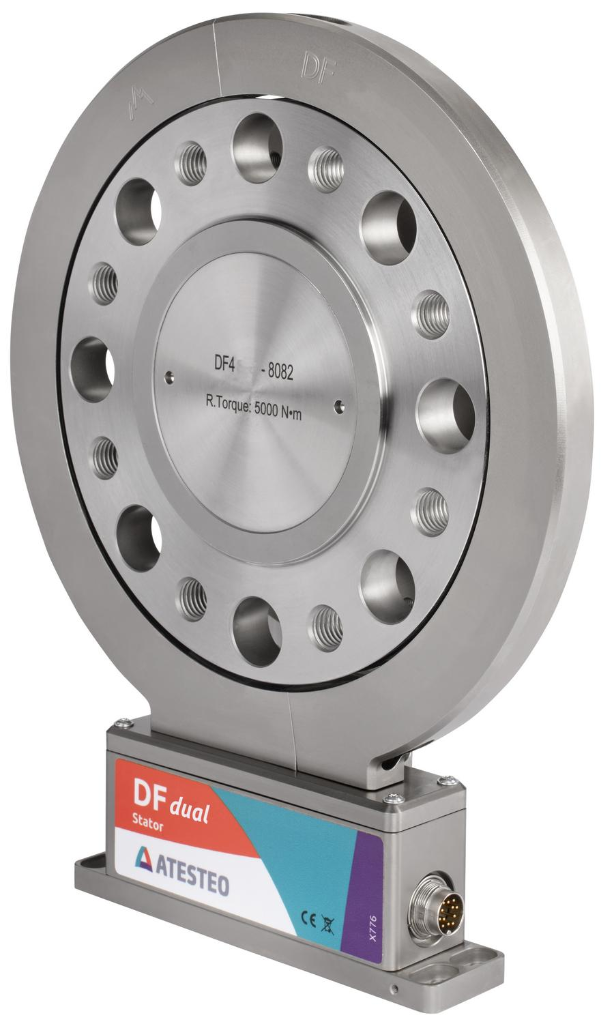
The Atesteo DF Dual 4 torque sensor is a dual-range transducer designed for measuring torsional variations in test benches and demanding industrial applications. Its innovative architecture, based on a split-ring stator, simplifies installation by allowing mounting around shafts already integrated into the system. Data acquisition is performed using strain gauges (DMS) coupled to the rotor, ensuring a high-integrity signal and maintenance-free, wear-free operation. Data and power transfer between the rotor and stator is inductive, protecting the signal from electromagnetic interference.
The Atesteo TCU5 control unit processes rotor readings, centralizing outputs via industrial CAN-Bus connectivity, frequency (RS422), or scalar analog signals, enabling seamless integration into control cabinets or advanced automation systems. This DF Dual 4 model incorporates two independently calibrated torque measurement ranges, providing redundancy and the ability to acquire high- and low-load data simultaneously without changing mechanical components on the test bench.
Dual Engineering Audit (FAQ)
How does harmonic expansion affect the accuracy of the DF Dual 4 sensor?
Harmonic expansion can affect the accuracy of the DF Dual 4 sensor, especially in extreme thermal environments. To mitigate this effect, a strain gauge system (DMS) is used to compensate for temperature variations, ensuring consistent accuracy across the entire operating range. The split-ring stator design also helps minimize thermal disturbances, guaranteeing accurate and reliable measurements.
What is the importance of reactive inertia in the performance of the DF Dual 4?
Reactive inertia plays a crucial role in the performance of the DF Dual 4, as it affects the sensor's ability to respond to rapid changes in torque. A rotor design with low reactive inertia allows for greater sensitivity and measurement accuracy, especially in high-speed applications. The DF Dual 4 rotor's inertia is optimized to minimize reactive inertia, ensuring optimal performance and a fast response to torque variations.
Properties
| Nominal Pair Range (Mnom) | 4,000-5,000 Nm |
| Analytical Precision Class | 0.05% (0.04% optional) |
| Maximum Speed Continuous Acceleration | 15,000 RPM |
| Measurement Principle | Parallel Strain Gauges (DMS) and Inductive Transmission |
| Primitive Circle Diameter (PCD) | Rigid ISO 155.5 mm fixing |
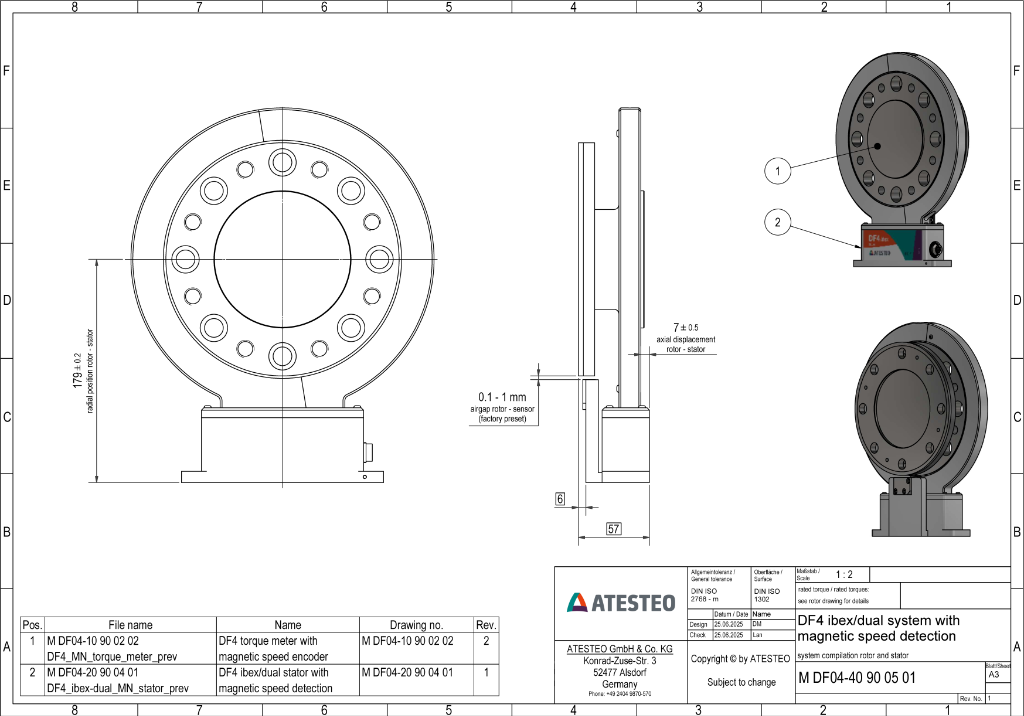
| Outer Diameter of the Magnetic Rotor | 187 mm |
| Transverse Length Axis | 50 mm |
| Geometric Drag Inertia | 0.0165 kg·m² (Restricted Rotational Mass) |
| Dynamic Structural Weight (Rotor/Stator) | 3.9 kg / 1.12 kg |
| Analytical Telecommunications Outputs | Raw RS422 Frequency, Analog Base, CAN 2B Bus Network |
| Voltage Operating Electrical Power | 24 V DC Parametric |
| Functional Operating Thermal Band | Continuous evaluation from 0 °C to +80 °C in plant |
| Insulating Enclosure Regulations | IEC/NEMA IP54 |
Other products