




















Schreiber SM22 – LVDT SM220 and SM222 probes
- Manufacturer: Schreiber Messtechnik
- Category: Displacement, LVDT Unamplified, SENSORS, LVDT Sensors
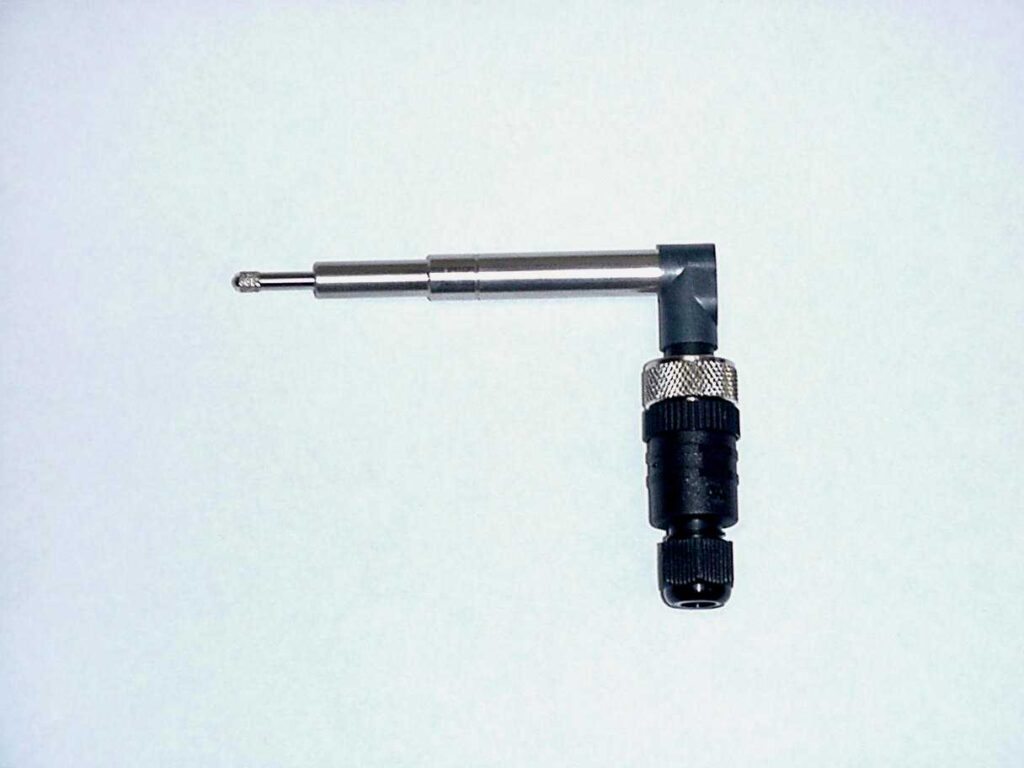
The series Schreiber's SM22 It consists of LVDT probes for measuring small linear displacements in machines, control fixtures, and test benches. The range includes the SM220, with LEMO connection, and the SM222, available with M12 connection or various cable outputs.
The probe is fixed by a clamping zone of Ø8 h8 The tip rests on the part or mechanism being monitored. When the surface moves, the stem follows that movement, and the sensor continuously monitors its position.
According to the model, distances can be measured from 4 to 20 mm. The series is offered with a linearity of 0,5 % or of the 0,25 %, and Schreiber specifies a repeatability of ±6 µm.
The SM22 does not incorporate conditioning electronics within the probe. External electronics, such as the SM22, are used to connect the measurement to a PLC, data acquisition system, or indicator. Schreiber SM12, which allows obtaining industrial signals such as 4–20 mA or 0–10 V.
SM22 Series at a Glance
- Models: SM220 and SM222.
- Routes: from 4 to 20 mm depending on the model.
- Body: Ø10 mm.
- Subjection: Ø8 h8.
- Linearity: 0.5 % or 0.25 % depending on the reference.
- Repeatability: ±6 µm.
- Protection: IP66.
- Connection: LEMO, M12 or cable depending on the version.
- Electronics: external conditioning.
Differences between SM220 and SM222
Both models use the same measurement principle. The choice depends primarily on the required distance and the desired method of electrical connection.
| Model | Tours | Connection | When to choose it |
|---|---|---|---|
| SM220 | 4 / 8 / 10 / 15 mm | LEMO | When a compact and detachable connection is preferred using LEMO. |
| SM222 | 4 / 5 / 8 / 10 / 15 / 20 mm | M12 or cable | When a greater variety of routing options or more wiring possibilities are needed. |
How the Schreiber SM22 works
Inside the sensing element is a Ni-Fe alloy core that moves axially within a coil system. When the core's position changes, the inductance distribution between the two halves of the sensing element also changes.
External electronics excite the sensor and transform that variation into a signal proportional to the displacement. The SM22 works on an inductive principle of half bridge, Therefore, it should be used with a compatible conditioner.
The measurement is obtained continuously throughout the probe's travel. This allows it to be used both to check a specific position and to track the movement of a mechanism during a machine cycle or during a test.
Mounting the probe on a measuring machine or tool
The SM22 is installed similarly to a comparator. The body is fixed in the area of Ø8 h8 and the tip of the probe rests on the part or mechanism whose displacement is to be measured.
The movement must occur in the same direction as the probe axis. Properly aligned mounting prevents lateral stress on the stem and helps maintain a repeatable measurement.
The tip uses a M2.5 thread, Therefore, it can be replaced by different contact geometries depending on the surface or part to be measured.
Schreiber also offers specific mounting blocks to facilitate the installation of the probe and its body in the tool or machine.
Example in dimensional control
In a checking fixture, the probe can be positioned facing a reference surface. When the workpiece is inserted, the probe tip moves, allowing verification that the dimension is within the specified range.
Example in machinery
It can also be installed next to a moving mechanism to check an end position, control a stroke, or measure small position variations during machine operation.
Electrical and electronic connection of conditioning
SM220 with LEMO connection
The SM220 uses a LEMO 3-pole connector. Schreiber offers straight and angled connectors, as well as versions with pre-assembled cable.
SM222 with M12 connection
The SM222 can be supplied with M12x1 4-pole connector. The electrical assignment indicated by Schreiber is as follows:
| Pin | Sign |
|---|---|
| 1 | WP |
| 2 | Not connected |
| 3 | WM |
| 4 | MS |
Wired versions
The SM222 is also available in versions with flat cable, axial cable, radial cable, and PUR cable. In the cable versions, Schreiber identifies the connections as WP green, MS white, and WM brown.
Schreiber SM12 Conditioner
The probe does not connect directly to a conventional PLC analog input. It requires electronics to excite the sensor and condition the signal. One of the available solutions is the Schreiber SM12 LVDT converter.
The SM12 can be configured for one or two channels and, depending on the version, provides outputs of 0/4–20 mA, ±20 mA, 0–10 VDC or ±10 VDC. In this way, the probe can remain at the measuring point and the electronics can be installed in the electrical panel or next to the acquisition system.
How to choose the right SM22
To define the correct reference, it is advisable to start with the distance to be measured and then continue with the linearity, the type of connection, and the signal that the control system needs.
1. Route
The SM220 is currently available in 4, 8, 10, and 15 mm. The SM222 offers a choice of 4, 5, 8, 10, 15, and 20 mm.
2. Linearity
The series includes references with linearity of 0.5 % and 0.25 %. The appropriate option will depend on the accuracy required for the application.
3. Connection type
The SM220 uses a LEMO connection. The SM222 allows working with M12 or different cable configurations, thus offering greater freedom when available space or cable exit constraints limit the mounting.
4. Mechanical assembly
The available space for the sensor, the Ø8 h8 clamping, and the ability to work correctly aligned with the movement of the part must be checked.
5. Signal for the control system
If the measurement is to be sent to a PLC, indicator, or DAQ system, the conditioning electronics must also be selected. Schreiber SM12 It allows you to obtain the most common analog signals in automation.
References and order code
The reference identifies the model, the path, and the linearity class. In Schreiber's current rate, the suffix .1 corresponds to the class of 0.25 % and the suffix .2 to the 0.5 % class.
References SM220
| Route | Linearity 0.25 % | Linearity 0.5 % |
|---|---|---|
| 4 mm | SM220.4.1 | SM220.4.2 |
| 8 mm | SM220.8.1 | SM220.8.2 |
| 10 mm | SM220.10.1 | SM220.10.2 |
| 15 mm | SM220.15.1 | SM220.15.2 |
References SM222
| Route | Linearity 0.25 % | Linearity 0.5 % |
|---|---|---|
| 4 mm | SM222.4.1 | SM222.4.2 |
| 5 mm | SM222.5.1 | SM222.5.2 |
| 8 mm | SM222.8.1 | SM222.8.2 |
| 10 mm | SM222.10.1 | SM222.10.2 |
| 15 mm | SM222.15.1 | SM222.15.2 |
| 20 mm | SM222.20.1 | SM222.20.2 |
Current options for the SM222
| Code | Execution |
|---|---|
| .K | Output via flat cable. |
| .KA | Output via axial cable. |
| .L | Output via radial cable. |
| .LP | Output via PUR radial cable. |
| .S | Execution with connector. |
| .X | Special tour available upon request. |
Variants with defined cable length and special executions must be confirmed for the requested reference.
Where is an SM22 probe used?
Machinery manufacturers
- Checking the final position of mechanisms.
- Control of small linear strokes.
- Position measurement in automated assembly systems.
- Control of the movement of carts, stops and other moving elements.
- Opening and closing check.
Dimensional control
- Height measurement.
- Thickness control.
- Checking dimensions on machined parts.
- Comparison between a part and a reference.
- Control of tolerances in verification tools.
- Classification of parts according to dimension.
Test benches
- Force-displacement tests.
- Characterization of springs and actuators.
- Measurement of deformations.
- Stroke control during mechanical tests.
- Displacement recording along with force, pressure, torque, or other variables.
Related accessories and electronics
The range of accessories allows the connection, mounting and contact geometry of the probe to be adapted to each application.
| Reference | Description | Application |
|---|---|---|
| SM901.220 | LEMO straight connector. | SM220. |
| SM901.220.K10 | LEMO connector with 10m cable. | SM220. |
| SM901.222 | LEMO angled connector. | SM220. |
| SM901.210 | Straight M12 connector. | SM222. |
| SM901.212 | M12 angled connector. | SM222. |
| SM901.211.3.K5 | M12 cable, 5 m. | SM222. |
| SM901.211.3.K10 | M12 cable, 10 m. | SM222. |
| SM906.200 | MB8 mounting block. | Clamping on Ø8 mm. |
| SM906.202 | MB10 mounting block. | Mounting on Ø10 mm. |
| SM906.203 | D10 mounting block. | Mounting on Ø10 mm. |
| SM906.300 | M2.5 carbide tip. | Contact measurement. |
| SM907.220 | Standard tip M2.5. | General use. |
| SM907.222 | M2.5 spherical tip in carbide. | Prompt contact. |
| SM907.224 | Flat tip M2.5, Ø4.8 mm. | Flat surfaces. |
| SM907.225 | Roller measuring M2.5. | Measurement on surfaces with relative movement. |
| SM907.226 | Flat tip M2.5 in PEEK. | When a non-metallic contact element is required. |
| SM907.227 | Flat tip M2.5, Ø1.5 mm. | Small measurement points. |
| SM907.228 | Flat tip M2.5, Ø10 mm. | Large surfaces. |
| SM907.229.10 / .20 / .50 | Extensions of 10, 20 or 50 mm. | Access to measurement points away from the body. |
| SM12 | Schreiber LVDT Conditioning Electronics. | Conversion to industrial signals for PLC and acquisition. |
Frequently Asked Questions about the Schreiber SM22
What is the difference between the SM220 and the SM222?
The measurement principle is the same. The SM220 uses a LEMO connection, while the SM222 offers an M12 connection and various wired output options. The range of available travel distances also differs.
Can it connect directly to a PLC?
No. The probe needs excitation and conditioning electronics. One option is the Schreiber SM12, with which signals such as 4–20 mA, 0–10 V or ±10 V can be obtained.
What tours are available?
The SM220 is available in 4, 8, 10, and 15 mm. The SM222 is available in 4, 5, 8, 10, 15, and 20 mm.
How is the sensor attached?
The probe has a clamping area of Ø8 h8. It must be mounted so that the displacement of the part is aligned with the axis of the stem.
What is the linearity of SM22?
The series is available with a linearity class of 0.5 % and, depending on the selected reference, with an option of 0.25 %.
Can the probe tips be changed?
Yes. The M2.5 connection allows the use of different measuring tips. Schreiber offers standard, spherical, flat, and various diameter tips, as well as tips made of PEEK and other configurations to adapt the contact to the workpiece.
What data does GUEMISA need to select the reference?
The path to be measured, the required linearity, the available space, the mounting method, the type of connection, and the signal that the PLC or acquisition system must receive.
Schreiber SM22 Selection
GUEMISA can help you select the SM220 or SM222 appropriate and jointly define the path, linearity, assembly, connection and conditioning electronics.
If the measurement needs to be integrated into a PLC or acquisition system, the following can also be selected: Schreiber SM12 more suitable for the required signal.
The complete technical specifications are detailed in the Properties table on this sheet.
Properties
| Specification | Schreiber SM22 |
|---|---|
| Sensor type | LVDT type inductive displacement probe |
| Models | SM220 / SM222 |
| Electrical principle | Half-bridge differential inductive |
| Integrated electronics | No; it requires external stimulation and conditioning |
| SM220 Routes | 4 / 8 / 10 / 15 mm |
| SM222 Routes | 4 / 5 / 8 / 10 / 15 / 20 mm |
| Body diameter | Ø10 mm |
| Clamping diameter | Ø8 h8 |
| Standard linearity | <0.5 % |
| Linearity option | 0.25 % according to reference |
| Repeatability | ±6 µm |
| Sensitivity | 300–440 mV/mm depending on model and travel |
| Degree of protection | IP66 |
| Working temperature | -20…+85 °C |
| Derivative of zero | <0.005 %/°C |
| Vibration | 20 g RMS, 50 g peak |
| Shock | 250 g SRS, 20…2000 Hz |
| Weight | Approx. 40 g |
| Housing | Stainless steel |
| Axis | Stainless steel |
| Guided | PTFE-coated sliding bearings |
| Measuring tip | M2.5 thread, compatible with DIN 878 bits |
| SM220 connection | LEMO 3-pole |
| SM222 Connection | M12x1 or cable as per execution |
| Compatible electronics | Schreiber SM10 / SM12 |
| Outputs via air conditioner | 0/4–20 mA, ±20 mA, 0–10 VDC or ±10 VDC depending on electronics |

Other products