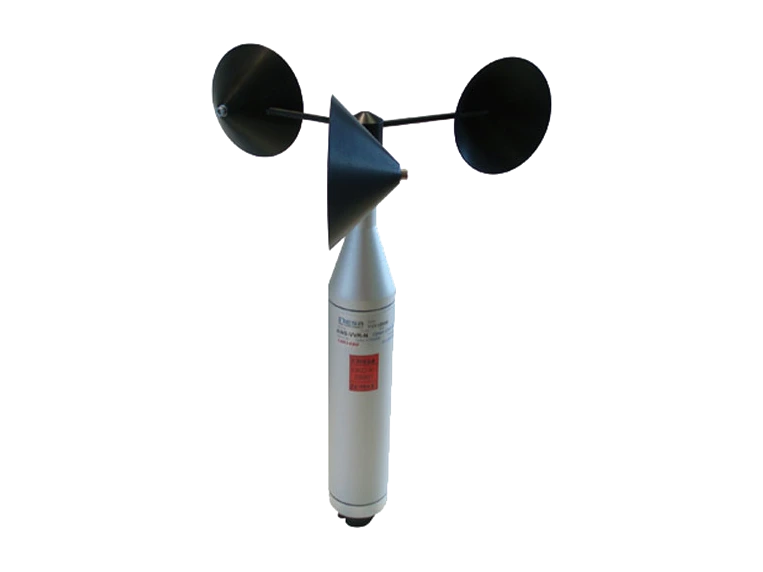
Anemómetro de cazoletas de primera clase VV1 / VV1R
- Manufacturer: Nesa
- Category: Meteorology – Climatology, SENSORS, Wind
El NESA VV1 es un anemómetro de cazoletas de primera clase (First Class), fabricado según la norma IEC 61400-12 para la monitorización eólica y certificado MeasNet. Clasificación IEC 61400-12-1 y EN 15518-3:2011, conforme a WMO. Hecho en metal (aluminio anodizado y acero inoxidable), con rotor de 3 cazoletas sobre rodamientos de alta velocidad y larga duración (MIL-L-6085 C).
Range 0.28 ÷ 50 m/s (up to 80-100 m/s with frequency output only), linearity r > 0.99998 and start-up threshold < 0.3 m/s. Frequency, 0÷2Vdc, 4÷20mA or RS485/Modbus outputs, IP68 quick connection and heated version VV1R (5W @ 12Vdc).
Key points
- Clasificación de primera clase (First Class) según IEC 61400-12-1 (Clase A: 1,96 · Clase B: 3,05 · Clase S: 2,42)
- Linearity r > 0.99998 with a standard error of 0.02 m/s
- Range from 0.28 to 50 m/s (up to 80-100 m/s with frequency output only)
- MeasNet and ISO17025 calibrations
- Heated version VV1R (5W @ 12Vdc): -40 ÷ +70 °C
- Outputs: frequency (N), 0÷2Vdc (A), 4÷20mA (B) or RS485/Modbus (C)
Technical Frequently Asked Questions
What measurement outputs does the VV1 anemometer offer?
VV1-N: frequency 0÷150Hz (50 Ω) or 0÷300Hz. VV1-A: 0÷2Vdc = 0÷50 m/s. VV1-B: 4÷20mA = 0÷50 m/s, not self-powered. VV1-C: RS485/Modbus (9600 baud, N, 8, 1; function 0x03; standard ID 009).
What calibrations does it have?
It comes with a calibration report. NESA indicates MeasNet and ISO17025 calibrations.
What is the difference between VV1 and VV1R?
The VV1R has a low-consumption heater (5W @ 12Vdc) with a temperature control system and operates from -40 to +70 °C; the VV1, from -10 to +70 °C. Both can withstand gusts of 0 to 100 m/s.
Properties
| Feature | Specification |
|---|---|
| Wind speed measurement | |
| Measured magnitude | Wind speed |
| Speed range | 0.28 ÷ 50 m/s (up to 80-100 m/s, frequency output only) |
| Resolution | 0.05 m/s wind travel |
| Average accuracy | < 0.1 m/s (0.4 ÷ 30 m/s); 30m/s) |
| Linearity | r > 0.99998 (standard error 0.02 m/s; (m/s) = (Hz x 0.30) + 0.3) |
| Start-up threshold | < 0.3 m/s |
| Stopping threshold | 0.1 m/s |
| IEC 61400-12-1 Classification | Primera clase: Clase A 1,96 · Clase B 3,05 · Clase S 2,42 |
| Standards | IEC 61400-12-1, WMO and EN 15518-3:2011; EC |
| Output signals and interface | |
| Output frequency (N) | 0÷150Hz (50 Ω at 20 mA max.) or 0÷300Hz |
| Output voltage (A) | 0÷2Vdc |
| Current output (B) | 4÷20mA |
| Serial digital output (C) | RS485 / Modbus |
| Connector | IP68 Quick Connect |
| Power supply and mechanical characteristics | |
| Feeding | 10 ÷ 28Vdc (10 ÷ 16Vdc for N version) |
| Consumption | < 0.1 W (5 W @ 12Vdc heated version VV1R) |
| Operating conditions | -10 ÷ +70 °C (-40 ÷ +70 °C heated version VV1R); gusts 0 ÷ 100 m/s |
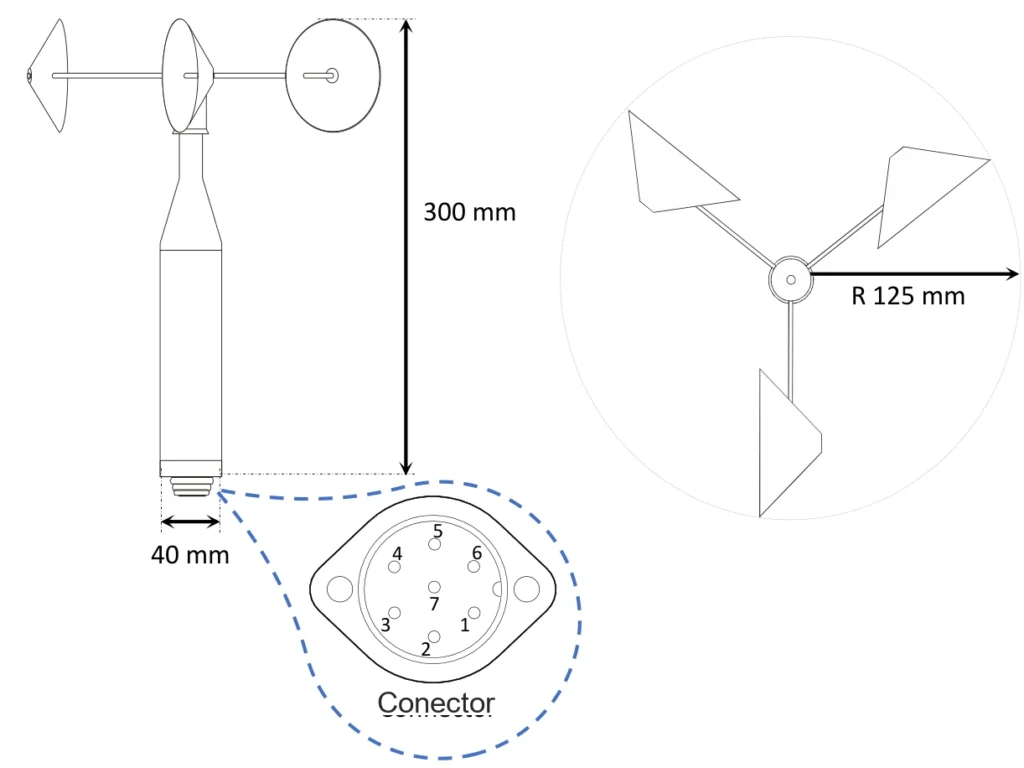
| Dimensions | 300 mm; R 125 mm (see drawing) |
| Weight | < 390 g |
| Materials | Anodized aluminum and stainless steel |
| Reference | Configuration |
|---|---|
| VV1-AVV1A | Model: VV1 · Heating: Standard · Output signal: 0÷2Vdc |
| VV1-BVV1B | Model: VV1 · Heating: Standard · Output signal: 4÷20mA |
| VV1-CVV1C | Model: VV1 · Heating: Standard · Output signal: RS485/Modbus (Standard ID 009) |
| VV1-NVV1N | Model: VV1 · Heating: Standard · Output Signal: Frequency 0÷150Hz or 0÷300Hz |
| VV1R-AVV1RA | Model: VV1R · Heating: Heated (Pw<5W) · Output signal: 0÷2Vdc |
| VV1R-BVV1RB | Model: VV1R · Heating: Heated (Pw<5W) · Output signal: 4÷20mA |
| VV1R-CVV1RC | Model: VV1R · Heating: Heated (Pw<5W) · Output signal: RS485/Modbus (Standard ID 009) |
| VV1R-NVV1RN | Model: VV1R · Heating: Heated (Pw<5W) · Output signal: Frequency 0÷150Hz or 0÷300Hz |
Related documentation, cases, and guides
Other products