




















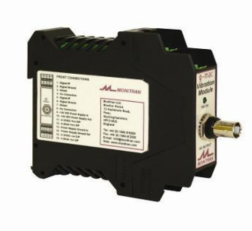
MTN/8066 Signal Converter
- Manufacturer: Monitran
- Category: Signal converters, SENSORS
Monitoring critical assets in complex industrial environments is often limited by the inability to obtain multiple diagnostic parameters from a single measurement point. The MTN/8066, known as the "g-mac" system, overcomes this limitation by acting as a triple-output vibration signal converter that processes the input from a single IEPE accelerometer to simultaneously deliver three independent data streams. This device is capable of capturing both general low-frequency vibration and high-frequency variations that are typically hidden in conventional signals, facilitating the early detection of bearing and gear failures.
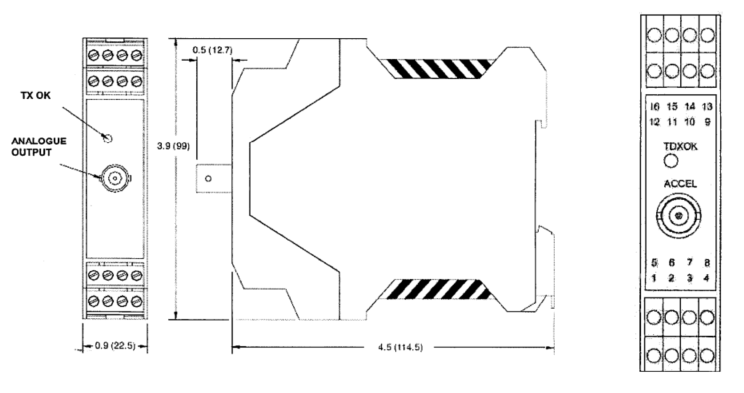
The device provides an analog output (configurable to 4-20 mA or 0-10 V) proportional to RMS velocity according to ISO 10816-3, a second analog output proportional to RMS acceleration, and a third buffered AC output. This last output is available on both screw terminals and a front-panel BNC connector, allowing the connection of portable analytical equipment without interfering with continuous PLC monitoring. Its architecture includes configurable 12 dB/octave filters and a bias voltage monitoring LED on the front panel, enabling instant verification of wiring and sensor integrity without the need for additional instrumentation.
With a 22.5mm DIN rail format and a design that allows for power bridging, the MTN/8066 is the most robust engineered solution for plants that require multivariable monitoring (speed and acceleration) and a real-time raw signal analysis interface.
- Multivariable monitoring: Independent outputs for Speed, Acceleration and AC signal.
- Dual output standard: 4-20 mA and 0-10V DC signals available simultaneously.
- Visual diagnosis Bias: Front LED for quick sensor status check.
- Selectable built-in filters: Low-pass and high-pass adjustment to optimize the signal.
Technical Frequently Asked Questions
1. What does the "g-mac" output allow you to monitor compared to standard vibration?
The g-mac system is designed to amplify high-frequency variations that are often masked by general machine vibration. This allows for the detection of incipient problems in gears and bearings that would go unnoticed by a conventional speed sensor, providing a much wider window for preventative maintenance.
2. How does the front LED facilitate system diagnostics?
The Bias Voltage LED monitors the accelerometer's power supply. If the LED changes state or turns off, it indicates an immediate problem in the sensor loop (open or short circuit), eliminating the need for manual multimeter measurements to rule out wiring faults.
3. Can the 4-20mA and 0-10V outputs be used simultaneously?
Yes, the MTN/8066 design allows both output signals to be used in parallel. This is extremely useful in installations where the signal needs to be sent to a control PLC using 4-20mA and, simultaneously, to a local display or recorder that only accepts 0-10V inputs.
Properties
| Feature | Technical Specification |
| Device Type | Vibration Signal Converter (g-mac System) |
| Processing Function | IEPE Conditioning and Multivariable Integration |
| Signal Input | ICP® / IEPE accelerometer (50 or 100mV/g) |
| Exit 1 (Speed) | 4-20 mA or 0-10V DC (ISO 10816-3) |
| Exit 2 (Acceleration) | 4-20 mA or 0-10V DC (RMS) |
| Output 3 (Gross) | Buffered AC (BNC Front and Terminals) |
| Speed Ranges | 10, 25, 50 and 100 mm/s (Selectable) |
| Acceleration Ranges | 10, 20, 40 and 80g pk-pk (Selectable) |
| Signal Filters | 12dB/octave (Low pass up to 5kHz) |
| Module Power Supply | 24V DC (With pin duplication for loop) |
| LED Indicators | Bias Voltage Monitoring (Sensor Status) |
| Temperature Range | 0 °C to +70 °C |
| Mechanical Assembly | DIN rail (22.5mm format) |
| Connections | Screw terminals (16 pins) + BNC Front |
| Approximate Weight | 150 grams |
Other products