



















High Sensitivity Accelerometer Monitran MTN/1800
- Manufacturer: Monitran
- Category: Accelerometers and Vibration Sensors, Amplified, SENSORS
Performing modal analysis and vibration testing on lightweight structures, such as printed circuit boards (PCBs) or scale prototypes, presents the critical challenge of the mass effect. If the sensor used is heavy, its own weight alters the natural resonant frequency of the object being measured, invalidating the results. Furthermore, in these research environments, vibration amplitudes are often so low that a standard 100 mV/g sensor lacks sufficient resolution to detect them.
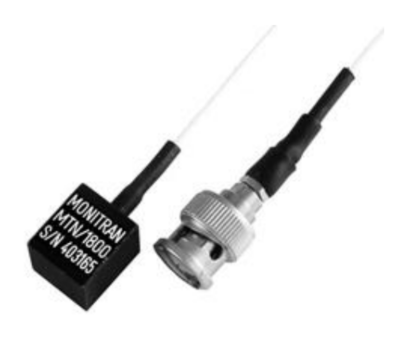
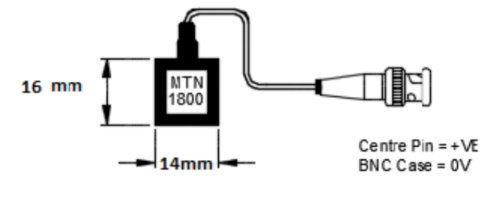
This ultra-lightweight accelerometer solves this problem with an anodized aluminum chassis weighing only 11 grams. It provides extremely high sensitivity of 1000 mV/g, enabling the detection of micro-vibrations with exceptional clarity. Its 16 mm cube form factor with a side cable exit facilitates mounting with adhesives or technical wax on surfaces where drilling is not possible, ensuring that the sensor does not interfere with the dynamic behavior of the tested part.
Although it offers a wide temperature range (-55 °C to 120 °C) and IP65 protection, the MTN/1800 is specifically designed for laboratory environments and R&D centers. Its 5-meter integral ETFE cable terminates in a standard BNC connector, allowing direct connection to oscilloscopes and spectrum analyzers without the need for complex industrial adapters.
- minimum dynamic mass of only 11 grams to avoid loading effects.
- Ultra-high sensitivity of 1000 mV/g for detecting weak signals.
- Linear frequency response of 5 Hz to 12 kHz with resonance at 25 kHz.
- Cubic body of 16 x 14 x 14 mm Made of black anodized aluminum.
Technical Frequently Asked Questions
1. Why is this sensor not recommended for heavy industrial environments?
Due to its ultra-lightweight design and aluminum housing, the MTN/1800 lacks the mechanical strength to withstand the constant impacts, chip projections, or aggressive fluids found in a production plant. Its use is optimized for laboratories, test benches, and controlled environments.
2. How should the sensor be mounted if it does not have a thread?
As a sensor for modal analysis, it is typically mounted using fast-setting adhesives (cyanoacrylate) or technical beeswax. This ensures perfect vibration transmission up to 12 kHz without the added weight of bolts or threaded adapters.
3. What advantage does the standard BNC connector offer?
The BNC connector is the standard in laboratory instrumentation. This allows the sensor to be connected directly to high-end portable data acquisition (DAQ) cards or FFT analyzers without the need for manual wiring or adapters that could introduce noise into the 1000 mV/g signal.
Properties
| Feature | Technical Specification |
| Sensor Type | Ultra-light Piezoelectric Accelerometer |
| Standard Sensitivity | 1000 mV/g (±5% at 80 Hz) |
| Measuring Range | ±10g (Peak) |
| Frequency Response | 5 Hz to 12 kHz (±10%) |
| Resonance Frequency | 25 kHz (Nominal) |
| Electrical Insulation | Isolated Base |
| Operating Temperature | -55 °C to +120 °C |
| Transversal Sensitivity | 5% (Maximum) |
| Body Material | Black Anodized Aluminum (HE30) |
| Dynamic Mass | 11 grams (Nominal) |
| Sensor Dimensions | Cube of 16 x 14 x 14 mm |
| Electrical Connection | ETFE Integral Cable (5m) with BNC |
| Assembly Method | Technical adhesive or wax (Beeswax) |
| Configurable Models | MTN/1800 (High Sensitivity 1000mV/g) |
| Degree of Protection | IP65 (Laboratory Use) |
Other products