




















MTN/1310 High Temperature Triaxial Accelerometer
- Manufacturer: Monitran
- Category: Accelerometers and Vibration Sensors, SENSORS
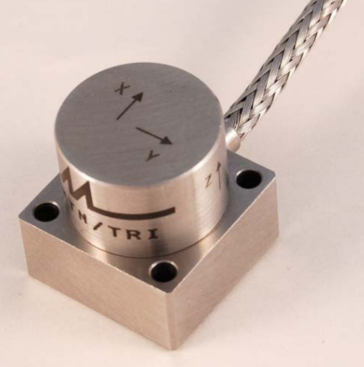
Comprehensive vibration characterization in critical assets often requires simultaneous data capture on all three spatial axes. The MTN/1310 triaxial accelerometer addresses this need with its compact and robust design, integrating three independent piezoelectric crystals into a single stainless steel body. This enables precise monitoring on the X, Y, and Z axes under extreme thermal conditions up to 250°C.
Like other high-temperature sensors from Monitran, the MTN/1310 is a pure charge (pC) device with no internal electronics in its sensor head to ensure its survival in extreme heat environments. This architecture requires the sensor to be connected to three independent charge amplifiers, which convert the 5pC/g output signal into analog voltage signals interpretable by high-speed data acquisition systems. Its wide dynamic range of up to ±2000g and frequency response up to 30 kHz make it ideal for impact analysis, aerospace testing, and turbine monitoring.
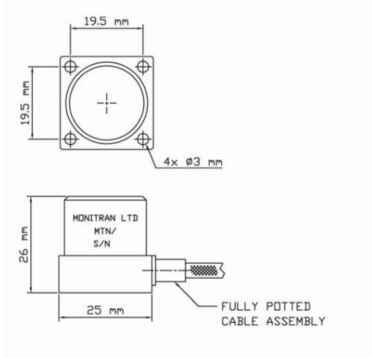
Designed for installations where space and weight are critical factors, the sensor weighs only 35 grams and is secured using a 4-point mounting system with M3 screws, ensuring a perfect mechanical fit with the measuring surface. Its integral, shielded, 4-core cable guarantees the integrity of the signals on all three axes, minimizing interference and simplifying cable routing in complex industrial environments.
- Simultaneous triaxial measurement for a complete 3-axis dynamic analysis.
- Superior thermal resistance operating temperature from -55°C to 250°C.
- High frequency response up to 30 kHz for impact detection.
- Ultra-lightweight and compact design made of stainless steel with IP64 protection.
Technical Frequently Asked Questions
1. Why is triaxial measurement necessary instead of three uniaxial sensors?
The MTN/1310 ensures that the measurement center of mass is the same for all three axes, eliminating phase errors and drastically simplifying installation. Furthermore, because all three axes are housed in a single solid block, internal sensor resonances are prevented from interfering with measurements.
2. What type of signal conditioning does this sensor require?
As a charge output sensor, it requires three charge amplifiers (one per axis). Monitran offers enclosures that house all three amplifiers in a single cast box, facilitating the conversion of the charge signal to 100mV/g before sending it to the acquisition system.
3. Is it suitable for shock and random vibration testing?
Yes, its dynamic range of ±2000g and its high mounted resonant frequency make it the perfect instrument for shock and broadband vibration testing on automotive, aerospace and defense components where reliability in extreme temperatures is critical.
Properties
| Feature | Technical Specification |
| Axis Configuration | Triaxial (Simultaneous measurement in X, Y, Z) |
| Operating Temperature | -55 °C to +250 °C |
| Sensitivity per Axis | 5 pC/g ±10% (Charge Output) |
| Acceleration Range | ±2,000 g (Dynamic range) |
| Frequency Response | 1 Hz to 30 kHz (Resonance 35 kHz) |
| Housing Material | Stainless Steel |
| Weight | 35 grams (excluding cable) |
| Degree of Protection | IP64 (Industrial Sealing) |
| Nominal Capacitance | 300 pF |
| Cable Type | Integrated 4-core shielded |
| Conditioning | Requires 3 independent load amplifiers |
| Mounting System | 4-point fixing using M3 screws |
| Transversal Sensitivity | Lower than 5% |
| Electrical Insulation | Non-insulated base (Body to ground) |
| Models of the Series | MTN/1310 (Standard), Versions with special cable lengths |
Other products