




















MTN/8302 Accelerometer Simulator
- Manufacturer: Monitran
- Category: Calibrators and Simulators, INSTRUMENTATION
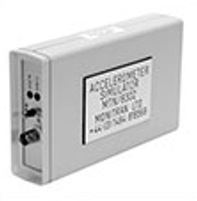
Verifying the measurement chain in vibration monitoring systems is critical to ensuring the reliability of shutdown alarms and trend data. The MTN/8302 is a portable accelerometer simulator designed to emulate the behavior of a constant current sensor. This device allows instrumentation engineers to quickly test and calibrate monitoring equipment by injecting accurate signal levels without subjecting machinery to actual vibrations or using expensive mechanical shakers.
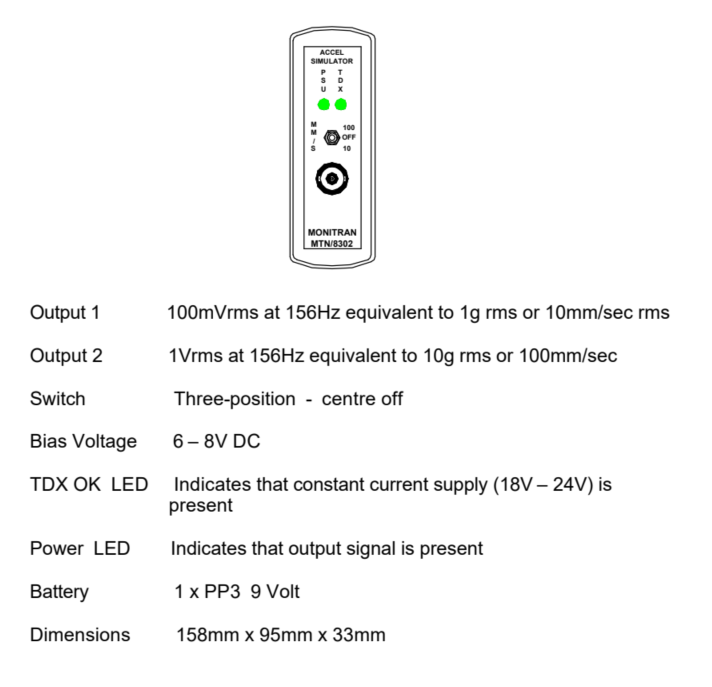
The unit generates a stable 156 Hz signal and offers two selectable output levels via a front panel switch: a 100 mVrms output (equivalent to 1 g or 10 mm/s) and a 1 Vrms high-intensity output (equivalent to 10 g or 100 mm/s). Additionally, the simulator emulates a bias voltage between 6 V and 8 V DC, allowing the monitoring system to detect an "OK" sensor condition. Two LED indicators on the front panel confirm the presence of external power (TDX OK) and the correct generation of the output signal, ensuring complete validation of the loop's integrity.
Manufactured in an ergonomic housing and powered by a standard 9V battery, the MTN/8302 is the ultimate field tool for commissioning and preventive maintenance of asset surveillance infrastructures.
- Simulation of two vibration levels: Outputs of 1g/10mm/s and 10g/100mm/s.
- Stable reference frequency at 156 Hz for precise calibration.
- Power supply verification using LED "TDX OK" for voltages of 18V-24V.
- Full portability with 9V battery and universal BNC connection.
Technical Frequently Asked Questions
1. What signal levels can the simulator generate?
The MTN/8302 features a three-position selector. In position "10", it generates a 100mVrms signal, equivalent to a vibration level of 1g or 10 mm/s depending on the monitor settings. In position "100", the signal increases to 1Vrms, simulating 10g or 100 mm/s, ideal for verifying high-severity alarm thresholds.
2. How can you tell if the monitoring system is supplying power to the sensor correctly?
The device includes an LED labeled "TDX OK". This indicator illuminates only when the simulator detects that the connected system (such as an MTN/6000 rack or a PLC) is supplying the necessary constant current (typically between 18V and 24V). If the LED does not light up, there is a fault in the loop's power supply.
3. Why does the simulator use a fixed frequency of 156 Hz?
The 156 Hz frequency is a reference standard in vibration instrumentation that allows for a direct mathematical equivalence between acceleration and velocity (RMS). By using a fixed and known frequency, it is easier to verify the accuracy of signal conditioning cards without ambiguity in data interpretation.
Properties
| Feature | Technical Specification |
| Device Type | Portable Accelerometer Simulator |
| Function | Testing and Calibration of Monitoring Systems |
| Signal Simulation | Constant Current Accelerometer (IEPE) |
| Low Level Exit (10) | 100mVrms (Equivalent to 1g or 10mm/s) |
| High Level Exit (100) | 1Vrms (Equivalent to 10g or 100mm/s) |
| Output Frequency | 156 Hz (Stable reference signal) |
| Simulated Bias Voltage | 6V to 8V DC |
| "TDX OK" indicator« | Power presence LED (18V – 24V) |
| Exit Indicator | simulation signal presence LED |
| Mode Selector | 3-position switch (OFF / 10 / 100) |
| Connection Interface | BNC socket on front panel |
| Internal Nutrition | 1 x 9V Battery (Type PP3) |
| Housing Material | Heavy Duty Industrial Plastic Housing |
| Dimensions | 158 mm x 95 mm x 33 mm |
| Compatibility | Monitran MTN/6000 systems and similar instrumentation |
Other products