




















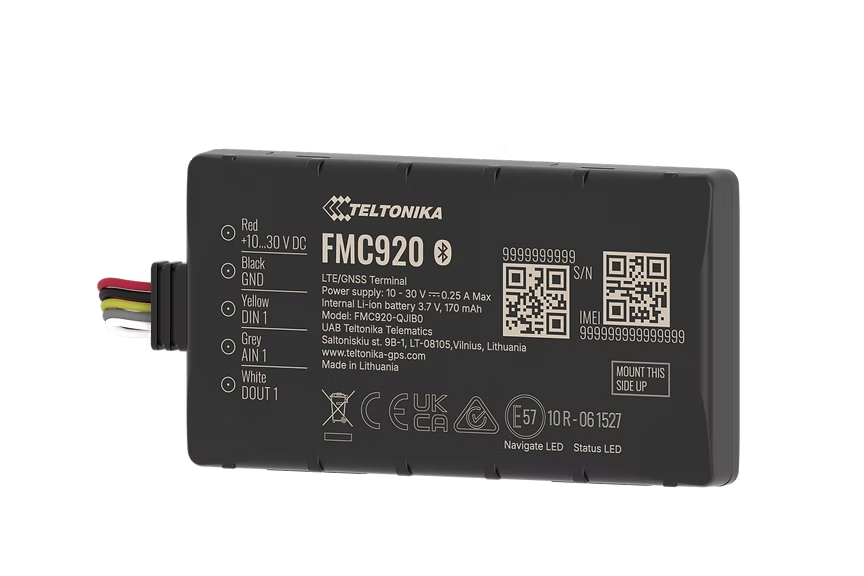
Teltonika FMC920 | 4G Cat 1 GPS Tracker for Vehicles
- Manufacturer: Teltonika GPS
- Category: GPS, INSTRUMENTATION
Teltonika FMC920 it's a 4G GPS tracker for vehicles Compact and reliable, designed for tracking, tracing, and basic fleet management applications. It incorporates connectivity. 4G LTE Cat 1 with 2G backup, GNSS positioning, Bluetooth 4.0 LE, accelerometer, internal backup battery and inputs and outputs to connect vehicle signals or external devices.
Due to its small size and configuration possibilities, the FMC920 GPS Teltonika It is especially suitable for cars, vans, motorcycles, light commercial vehicles, and delivery fleets. It can be used to track vehicle position and routes, detect driving events, monitor ignition status, receive alerts in case of power failure, and expand the system with compatible sensors or accessories.
The FMC920 is geared towards projects that need a professional 4G GPS tracker Without the complexity of telematics equipment with multiple interfaces or direct CAN Bus reading. Its combination of mobile connectivity, GNSS, Bluetooth LE, and inputs and outputs covers the usual vehicle tracking needs and allows the installation to be adapted to different applications.
4G GPS tracker for vehicles and fleets
He Teltonika FMC920 uses technology LTE Cat 1 for data transmission and maintains compatibility with 2G networks as a backup. Compared to trackers based solely on 2G, 4G connectivity provides a more suitable solution for new installations and long-term vehicle tracking projects.
Positioning is performed using a 33-channel GNSS receiver compatible with GPS, GLONASS, Galileo, BeiDou and QZSS. The equipment incorporates high-gain internal GNSS and cellular antennas, so it does not require external antennas in a standard installation.
Once installed and configured, the device obtains the vehicle's position and data and transmits it via the mobile network to the configured tracking server or platform. The transmission frequency, recorded events, and transmission conditions can be customized to the needs of each project.
What is the Teltonika FMC920 used for?
The FMC920 can be used as GPS tracker for cars, vans, motorcycles and light fleets. Its typical applications include:
- GPS tracking and location of vehicles.
- Fleet management for light vehicles and commercial vehicles.
- Control of delivery, courier and logistics vehicles.
- Tracking of company cars and vans.
- Rental vehicles, renting and leasing.
- Detection of unauthorized movement or towing.
- Detection of loss or disconnection of power.
- Record of driving routes and events.
- Bluetooth LE sensor integration.
- Monitoring of external signals through its inputs.
The device can generate and record various events based on GNSS position, accelerometer readings, physical inputs, and configured parameters. Available functions include detection of speeding, excessive idling, towing, disconnection, accidents, routes, and geofences.
FMC920 Entries and Exits
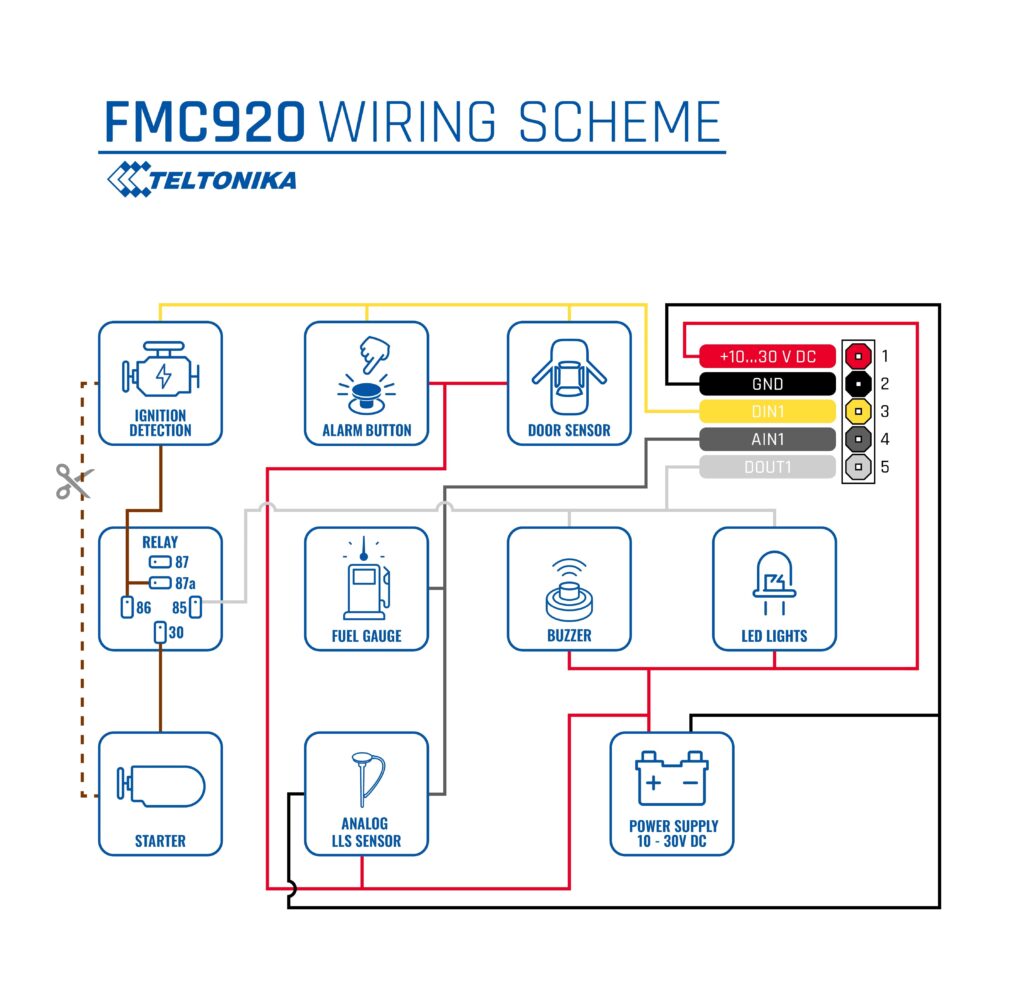
Despite its compact size, the Teltonika FMC920 GPS It incorporates the necessary interfaces for a basic vehicle tracking installation: 1 digital input, 1 digital output, and 1 analog input.
Digital entry
The digital input can be used to detect the status of a signal from the vehicle or an external device. One of its most common applications is detecting the ignition switch, although it can also be used to monitor the status of a door, an alarm button, or another compatible signal.
Digital output
The digital output allows control of an external relay or actuator. It can be used for remote control or vehicle immobilization functions when the installation design allows it. To perform an ignition cutoff or similar function, the appropriate electrical components must be used and the installation must be carried out according to the vehicle's specifications.
Analog input
The analog input expands the locator's capabilities and allows monitoring of a compatible external signal. It can be used, for example, in applications for measuring liquid levels or other variables using a suitable sensor and signal.
This combination of inputs and outputs allows the FMC920 to not only transmit a GPS position, but also to be part of a more complete monitoring solution.
Bluetooth LE for sensors and accessories
He Teltonika FMC920 incorporates Bluetooth 4.0 + LE, This allows communication with compatible external devices. Depending on the configuration and peripherals used, the tracker can work with beacons, Bluetooth Low Energy sensors, temperature and humidity sensors, and certain OBDII accessories.
This connectivity allows for the expansion of an installation without adding cabling for certain variables. For example, a project can combine vehicle position with information from BLE sensors installed in the vehicle itself or associated with transported assets.
The specific compatibility between the FMC920 and a sensor or accessory should be verified before defining the solution, especially in projects that require the reading of specific variables.
Internal backup battery of 170 mAh
The FMC920 incorporates a 170 mAh internal Li-Ion battery. Its main function is to provide backup to the locator when the vehicle's external power supply is lost or disconnected.
The battery should not be interpreted as a power source designed for prolonged autonomous operation of the equipment. The FMC920 is primarily designed to operate when connected to a power source. 10 to 30 Vdc. The battery allows for temporary maintenance of operation and management of events related to a power loss or an attempted disconnection.
This point is especially important when selecting a GPS tracker: for applications that require long periods of operation without connection to a vehicle's battery, there are other devices specifically designed for autonomous asset tracking.
Motion detection, towing and accident detection
The integrated accelerometer allows the FMC920 to detect vehicle movement and use that information in various configurable scenarios. Available functions include: Crash Detection, Towing Detection, Unplug Detection, Green Driving, Excessive Idling and Over Speeding.
These functions allow you to record events related to driving or vehicle status. Their operation depends on the equipment configuration, the established thresholds, and the platform or system used to receive and display the information.
The accident detection function uses accelerometer data to identify events that meet the configured conditions. It should not be confused with an approved vehicle safety system or an automatic emergency call device.
Teltonika FMC920 Installation
The FMC920 has dimensions of only 79 × 43 × 12 mm and weighs 54 g, making it easy to install discreetly in the vehicle. It integrates the GNSS and cellular antennas inside the casing.
The device's location must allow for adequate reception of GNSS and mobile signals. Installation should be avoided in positions where it is completely shielded by metallic elements or where it may be exposed to environmental conditions exceeding those specified by the manufacturer.
The equipment has protection IP54. Therefore, it is not a submersible locator and should not be installed directly in areas permanently exposed to water. For applications on motorcycles, machinery, or outdoor locations, the necessary mechanical and environmental protection should be considered.
The power supply supports a range of 10 to 30 Vdc with overvoltage protection. The installation of additional functions via digital input, digital output, or analog input must be carried out taking into account the electrical diagram and device specifications.
What does the FMC920 need to perform remote monitoring?
To use the Teltonika FMC920 as a real-time GPS locator Simply installing the device physically is not enough. The complete solution requires:
- The Teltonika FMC920 locator.
- Powering from the vehicle.
- A SIM card with the appropriate communications service.
- Device settings.
- A compatible tracking server or platform.
The FMC920 obtains and processes vehicle information and transmits it to the configured destination. Functions such as map display, route history, user management, reports, and certain notifications depend on the... tracking platform used and not only of the locator.
This distinction is important: the device generates, records, and transmits information, while the platform allows the user to view, manage, and use it.
FMC920 Configuration and Update
The equipment can be configured using Teltonika's compatible tools and methods, including Teltonika Configurator, USB or Bluetooth connection, FOTA Web, SMS and data commands.
Configurable parameters allow you to adapt aspects such as data acquisition, events, power-up detection, low power modes, and sending information to the server.
The FMC920 offers several power-saving modes, including GPS Sleep, Online Deep Sleep, Deep Sleep, and Ultra Deep Sleep. The appropriate setting depends on the necessary balance between tracking frequency, communication availability, and power consumption.
Teltonika FMC920 vs FMB920: What's the difference?
The main difference between the FMC920 and FMB920 It is mobile communication technology. The FMC920 uses 4G LTE Cat 1 with 2G backup, while the FMB920 is based on 2G connectivity.
Both models are geared towards basic vehicle tracking and share a compact product concept. However, for new installations requiring a solution with more up-to-date mobile connectivity, the FMC920 is generally the better choice.
When should I choose a different Teltonika GPS tracker?
The FMC920 is a good choice when you need a compact vehicle tracking device with essential inputs and outputs. However, it's not the right model for every application.
If the project requires a greater number of inputs and outputs, CAN data reading from the vehicle, advanced engine information, connection to FMS or tachograph, or specific functions for heavy vehicles, it may be necessary to select another model from the Teltonika range.
The choice of locator should be made based on the vehicle, the variables that need to be monitored, the type of communications, the platform used, and the functions that the installation will have to perform.
Why choose the Teltonika FMC920?
He Teltonika FMC920 It offers a balanced combination of size, connectivity, and integration possibilities. It is especially suitable for applications that require:
- A compact GPS tracker for installation in vehicles.
- 4G LTE Cat 1 connectivity with 2G backup.
- Tracking of cars, vans, motorcycles or light fleets.
- Internal backup battery.
- Bluetooth LE for compatible sensors and accessories.
- One digital input, one digital output, and one analog input.
- Event detection using an accelerometer.
- Remote configuration and updates using compatible tools.
Its compact design and basic telematics functions make the FMC920 a suitable solution for professional tracking projects that do not require the additional interfaces of higher-end equipment.
Price and supply of the Teltonika FMC920
Contact Gemisa to apply Teltonika FMC920 price, availability, technical documentation or advice on the most suitable solution for your project.
We can help you determine if the FMC920 is the right model based on your vehicle type, the signals you need to monitor, external sensors, communications, and required functions. We can also evaluate other Teltonika GPS trackers when your application requires more inputs and outputs, CAN reading, FMS, tachograph functionality, or specific features for fleets and heavy vehicles.
Properties
| Feature | Specification |
|---|---|
| Model | Teltonika FMC920 |
| Device type | 4G GPS locator for vehicles / vehicle GPS tracker |
| Main application | GPS tracking of vehicles, light fleets, logistics, rental, leasing and anti-theft protection |
| Cellular technology | LTE Cat 1, GSM and GPRS |
| Mobile connectivity | 4G LTE Cat 1 with 2G backup |
| LTE data speed | Up to 10 Mbps download and 5 Mbps upload |
| 4G LTE Bands Europe | LTE FDD B1/B3/B7/B8/B20/B28 |
| 2G Bands | GSM B2 / B3 / B5 / B8 |
| GNSS | GPS, GLONASS, Galileo, BeiDou, QZSS and AGPS |
| GNSS Receiver | 33 channels |
| Monitoring sensitivity | -165 dBm |
| GNSS Accuracy | < 3 m |
| Hot GNSS boot | < 1 s |
| Tempered GNSS Start | < 25 s |
| Cold GNSS Start | < 35 s |
| Bluetooth | Bluetooth 4.0 + LE |
| Compatible Bluetooth peripherals | BLE sensors, beacons, temperature and humidity sensors, OBDII dongle and compatible accessories |
| Digital tickets | 1 digital input for contact, door, alarm or other compatible signals |
| Digital outputs | 1 digital output for relay, actuator or remote control functions |
| Analog inputs | 1 analog input for compatible external sensors |
| GNSS antenna | High-gain internal |
| Cellular antenna | High-gain internal |
| USB | Micro-USB 2.0 |
| SIM | Micro-SIM |
| Internal memory | 128 MB Flash |
| Indicators | 2 status LEDs |
| Feeding | 10–30 Vdc with overvoltage protection |
| Internal battery | Li-Ion 170 mAh / 0.63 Wh |
| Battery function | Backup in case of loss or disconnection of external power |
| Consumption in Ultra Deep Sleep | < 2 mA at 12 V |
| Consumption in Deep Sleep | < 3 mA at 12 V |
| Consumption in Online Sleep | < 8 mA at 12 V |
| GPS Sleep Consumption | < 12 mA at 12 V |
| Nominal consumption | < 28 mA at 12 V |
| Internal sensors | Accelerometer |
| Driving functions | Green Driving, speeding, excessive idling and route detection |
| Security features | Accident detection, towing, disconnection, automatic geofencing, and manual geofencing |
| Remote control | Digital output control via call, SMS, GPRS commands or compatible platform |
| Ignition detection | Digital input, accelerometer, external supply voltage or RPM via compatible OBDII dongle |
| Fuel monitoring | LLS sensor via analog input or compatible OBDII dongle |
| Low power modes | GPS Sleep, Online Deep Sleep, Deep Sleep and Ultra Deep Sleep |
| Configuration | Teltonika Configurator via USB/Bluetooth, FOTA Web, SMS and GPRS commands |
| Firmware update | FOTA Web, FOTA and Teltonika Configurator |
| Time synchronization | GPS, NITZ and NTP |
| Dimensions | 79 × 43 × 12 mm |
| Weight | 54 g |
| Protection | IP54 |
| Battery operating temperature | -20 ºC to +40 ºC |
| Operating temperature without battery | -40 ºC to +85 ºC |
| Storage temperature without battery | -40 ºC to +85 ºC |
| Operating humidity | 5 % to 95 % non-condensing |
| Battery charging temperature | 0°C to +45°C |
| Battery discharge temperature | -20 ºC to +60 ºC |
| Certifications and compliance | CE/RED, E-Mark, RoHS, REACH and other certifications depending on the region |
| Available documentation | Technical data sheet, quick start guide, wiring diagram and official Teltonika documentation |
Other products