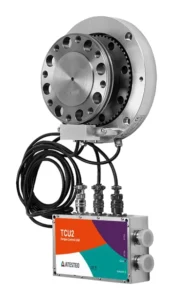
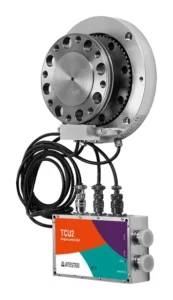
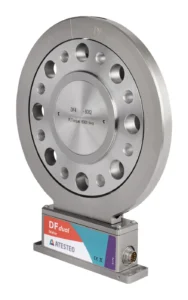
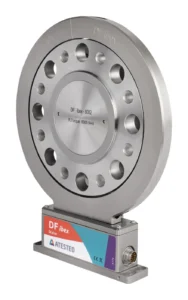
ATESTEO Dual Range DF5 Torque Sensor
- Manufacturer: ATESTEO
- Category: High torque (1,000-10,000 Nm), SENSORS, Torque sensors, Rotary torque sensors
Description
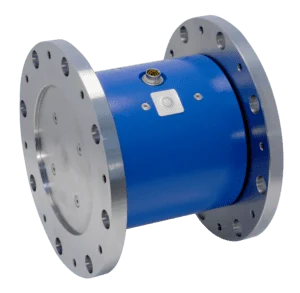
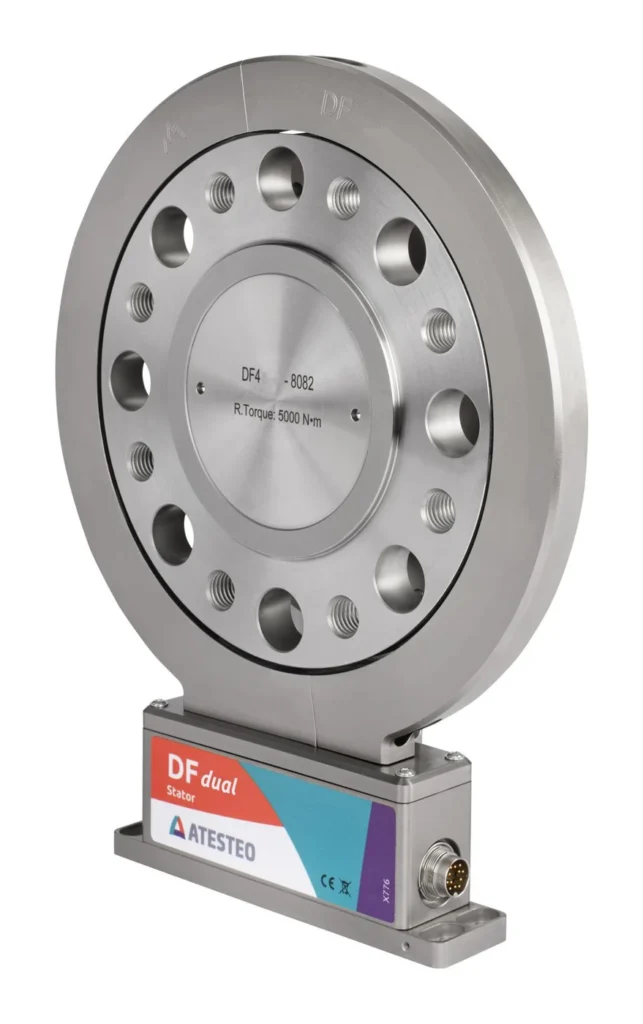
The ATESTEO DF5 dual-range torque clamp is a 10 kN·m dual-range rotary torque clamp from the DF family, with an accuracy class of 0.04% and a maximum speed of 12,000 rpm (14,000 rpm with the extended speed option; 6,500 rpm with speed measurement). It features a Ø230 mm rotor and a 196.0 mm bore circle. Outputs include frequency (RS422), voltage, CAN bus, and alarm.
- Nominal torques: 10 kN·m · second range from 2000 N·m
- Accuracy class 0.04% (frequency and CAN outputs)
- Maximum speed 12,000 rpm (14,000 rpm with extended speed option; 6,500 rpm with speed measurement)
- Rotor Ø230 mm · drill circle 196.0 mm · length 60 mm
- Outputs: frequency (RS422), voltage, CAN bus, alarm · TCU5 evaluation unit
- Operating temperature -20 to 85 °C · IP54
Properties
Applications
Two ranges in one sensor
Each range with a class of 0.04%: very different tests on the same bench, without changing the sensor.
Two torque ranges in a single sensorDrag torque
It is not its application: for such fine measures, the DF5 ibex, with class 0.02%.
Efficiency measures with the DF ibex24-hour banks
The TCU5 reports the status via CAN bus and checks the measurement chain with the test signal.
Automated banks with the TCU5Traceable calibration
DAkkS accredited laboratory according to DIN 51309, with 0.02% uncertainty. Also sensors from other brands.
Torque sensor calibrationSectors
Automotive, construction, agriculture, wind power, railway and shipbuilding.
Applications by sectorOperation and calibration
How it works
The DF Dual measures with two ranges on the same flange: the nominal range and a reduced range, both with a class of 0.04. It is useful when the transducer cannot be changed during testing and small torques still need to be measured accurately. Externally, it is identical to the DF Ibex, also featuring a split-ring stator.
Calibration and supply
It is delivered calibrated in ATESTEO's calibration laboratory, with DAkkS accredited calibration according to DIN 51309 available as an option. ATESTEO develops and manufactures the mechanics and electronics of its transducers in Germany and uses them in more than 200 of its own test benches worldwide. Guemisa is ATESTEO's distributor in Spain.
Frequently Asked Questions
Which size of ATESTEO DF5 dual should I choose?
Choose the nearest rated torque above the maximum working torque of your test (10 kN·m in this size). The limiting torque is 175% of the rated torque, and the overload channel records up to 300%, so momentary spikes will not damage the rotor or be lost.
What are the differences between DF plus, DF ibex and DF dual?
Choose DF dual when the same test requires precise measurement of both nominal torque and small torques without changing transducers. If only one range is needed, choose DF plus (class 0.04) or DF ibex (class 0.02). All three share the same DIN hole pattern.
What outputs does it have and how does it connect?
Frequency (RS422), voltage (±5 V, ±10 V, 0 to 5 V or 0 to 10 V), CAN bus and alarm. The signal is digitized in the rotor and reaches the TCU5 evaluation unit via the stator, which can be installed in a cabinet outside the test bench; it is configured from its web interface.
Flat
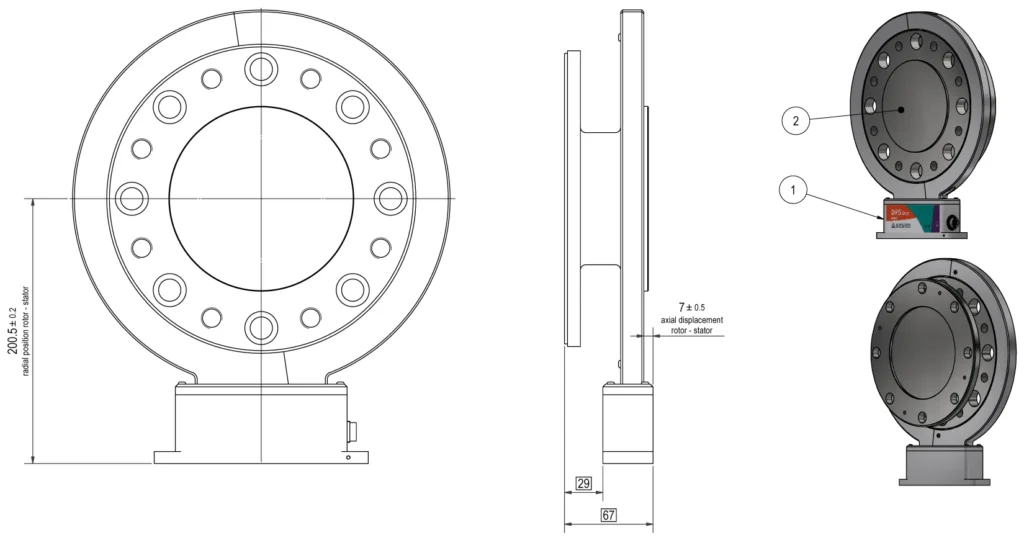
System diagram, measurements in mm.
Documentation and order
Properties
| Feature | Specification |
|---|---|
| Extent | |
| Nominal pairs | 10 kN·m |
| Second rank (minimum) | 2000 N·m |
| Measuring range | 110% of nominal torque |
| Accuracy class | 0,04 % |
| Linearity with hysteresis | ≤ ±0.015% (0 to 30% of nominal torque), ≤ ±0.030% (30 to 60%), ≤ ±0.040% (60 to 100%) in frequency and CAN; ≤ ±0.04% in voltage |
| Reproducibility (DIN 1319) | ≤ ±0.006% in frequency and CAN; ≤ ±0.03% in voltage |
| Influence of temperature every 10 K (sensitivity and zero) | ≤ ±0.04% |
| Exits (TCU5 assessment unit) | |
| Frequency (RS422) | 10 ± 5 kHz, 60 ± 20 kHz, 60 ± 30 kHz or 240 ± 120 kHz (zero torque value ± variation up to nominal torque) |
| Strain | ±5 V, ±10 V, 0 to 5 V or 0 to 10 V (from negative to positive nominal pair) |
| CAN Bus | Type 2B, up to 2000 values per second |
| Alarm | Torque alarm; also speed alarm with optional speed measurement |
| Bandwidth | up to 6 kHz (frequency and voltage) |
| Signal delay | 300 µs in frequency and voltage; 800 µs in CAN |
| Speed | |
| Maximum speed without speed measurement | 12,000 rpm; 14,000 rpm with the extended speed option |
| Speed measurement | Optional: magnetoresistive sensor, 1448 pulses per revolution |
| Maximum speed with speed measurement | 6500 rpm |
| Angle measurement | With optional speed measurement: 0.062° resolution, CAN bus output and voltage |
| Mechanics | |
| Rotor outer diameter | 230 mm |
| Rotor length (without centering) | 60 mm |
| Diameter of the drill circle | 196.0 mm |
| Drill circle screws | 8 × M16, class 12.9 |
| Material | Steel |
| Limit pair | 175% of nominal torque |
| Approximate breaking torque. | 312% of nominal torque |
| Torsional stiffness | 4410 kNm/rad |
| Rotor moment of inertia | 0.0463 kg/m² |
| Degree of balance (DIN ISO 1940) | G2,5 |
| Rotor weight | 7.8 kg |
| Stator weight (without speed measurement) | 1.22 kg |
| Environment and food | |
| Nominal temperature range (rotor and stator) | 0 to 80 °C |
| Nominal temperature range (TCU5) | 0 to 70 °C |
| Operating temperature (rotor and stator) | -20 to 85 °C |
| Service temperature (TCU5) | -20 to 70 °C |
| Degree of protection (rotor and stator) | IP54 |
| Feeding | 24 V DC (23 to 25 V), consumption less than 24 W |
| Configuration | Via Ethernet (TCU5 web interface) |
Values from the current ATESTEO technical data sheet. Details by size (linearity, drift, stiffness, load limits and plans) are in the technical data sheet in Spanish.
| Reference | Configuration |
|---|---|
| 1001614510016145 | DF5 dual test · nominal torque 10 kN·m |
Other products