



















SZ173 industrial pH sensor | B&C Electronics
- Manufacturer: B&C Electronics
- Category: Water quality, SENSORS, pH and Redox Probes
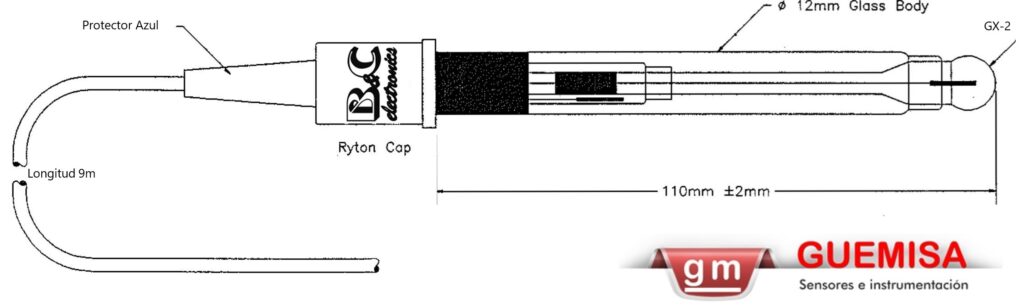
He SZ173 of B&C Electronics it's a combined glass/reference industrial pH electrode, Designed specifically for pH measurement in contaminated liquids and demanding process applications. It utilizes a glass body, GX2 membrane, and a system of double annular union which helps protect the reference electrode from contamination from the process fluid.
The SZ173 operates within a range of 0 to 13 pH, supports process temperatures of 0 to 100 °C and can be used in online installations with pressures up to 10 bar. The electrode has dimensions of 110 mm in length and Ø 12 mm and incorporates a 9 meter cable, facilitating its installation when there is a certain distance between the measurement point and the instrumentation.
The SZ173 is a electrochemical pH electrode, It is not a transmitter. Therefore, it does not directly provide an industrial 4-20 mA, 0-10 V output or digital communication. To obtain a usable pH measurement, it must be connected to a pH analyzer, controller or transmitter with high impedance input. For industrial applications, it can be used, for example, in conjunction with the B&C PH3630 to obtain an isolated 4-20 mA signal, or with the B&C PH3436 when RS485 Modbus RTU communication is also required.
- Guy: combined glass pH electrode / reference.
- Measuring range: 0 … 13 pH.
- Operating temperature: 0 … 100 °C.
- Maximum pressure: up to 10 bar in in-line installation.
- Body material: glass.
- Membrane: GX2.
- Membrane resistance: 50 MΩ at 25 °C.
- Union: double annular union.
- Reference system: Ag/AgCl + KNO3.
- Wire: 9 m.
- Dimensions: 110 mm × Ø 12 mm.
- Main applications: contaminated liquids, amplified probes, industrial instrumentation and demanding applications.
- Required instrumentation: pH analyzer, controller or specific transmitter.
Applications of the SZ173 industrial pH electrode
The SZ173 is specifically designed for the industrial pH measurement in contaminated liquids installations where a double-junction glass electrode, long cable and in-line installation are required.
Water and wastewater treatment
- pH control in process water.
- Wastewater treatment.
- Neutralization and reagent dosing.
- pH control in tanks and pipes.
- Processes with contaminated liquids.
Industry and process control
- Continuous pH measurement in industrial processes.
- Fixed installations with pH transmitters.
- Integration of the measurement into PLC or SCADA systems.
- Processes where there is a large distance between the electrode and the instrumentation.
- Applications where a 9m cable is needed.
Contaminating liquids and demanding applications
- Processes where contamination can affect a conventional electrode.
- Applications where it is convenient to use a double junction.
- Amplified probes.
- Continuous service industrial facilities.
- Online measurement up to 10 bar using the appropriate installation system.
Double ring joint for contaminated liquids
The reference frame is one of the fundamental parts of a pH electrode. To perform the measurement, there must be ionic contact between the internal reference and the process liquid through the electrode junction.
When working with contaminated liquids, certain compounds present in the process can gradually migrate into the reference system. This can cause signal instability, zero point shift, calibration difficulty, or reduced electrode lifespan.
The SZ173 uses a double annular union. This construction introduces additional separation between the process fluid and the internal reference system, reducing the reference's direct exposure to contaminants.
For this reason, B&C Electronics specifically targets the SZ173 to Contaminating liquids, industrial instrumentation and demanding applications.
How does the SZ173 pH electrode work?
The SZ173 uses a glass membrane sensitive to hydrogen ion activity. Upon contact with the liquid, an electrical potential difference is generated between the glass electrode and the reference system.
This voltage varies depending on pH and temperature. The generated signal is of a low electrical level and very high impedance, Therefore, it should not be connected directly to a conventional voltage or current input of a PLC.
It is necessary to use a specific pH instrument that conditions the electrode signal, allows calibration, and converts the electrochemical measurement into a pH value.
When the system needs to be integrated into industrial automation, this instrument can subsequently relay the measurement by 4-20 mA, RS485 Modbus or other process signals.
Installation of the SZ173 in industrial processes
The SZ173 has a cylindrical glass body Ø 12 mm and 110 mm in length. The electrode must be mounted using a electrode holder or suitable installation assembly to the conditions of the process.
It can be used in both submerged and in-line installations. B&C Electronics specifies the following usage for the SZ173: online up to 10 bar.
The following must be taken into account in an industrial facility:
- Maximum process pressure.
- Liquid temperature.
- Chemical compatibility with the glass body and the reference system.
- Electrode position and accessibility for calibration and maintenance.
- Mechanical protection of the glass electrode.
- Distance between the electrode and the transmitter.
- Need for automatic temperature compensation.
The SZ173 It does not incorporate a built-in temperature sensor.. When the transmitter used allows automatic temperature compensation by means of Pt100, the corresponding temperature probe must be installed independently.
What equipment does the SZ173 electrode require?
The SZ173 needs a specific analyzer, controller or transmitter for pH electrodes. The measuring electronics provide the high impedance input necessary to correctly read the signal generated by the glass membrane.
The selection of the instrument depends primarily on the signal that will be needed later for the automation system.
4-20 mA Transmission: B&C PH3630
For installations where the pH measurement must be sent to a PLC, recorder or control system via an analog signal, the following can be used: B&C PH3630.
The PH3630 is a pH transmitter for DIN rail mounting which uses pH electrodes and provides a isolated 4-20 mA output in two-wire current loop. It is powered by between 10 and 30 Vdc.
The equipment also has an input for Pt100. When an external Pt100 probe is connected, it can automatically perform temperature compensation and display the measured temperature on the display.
SZ173 → PH3630 → 4-20 mA → PLC / recorder / control system
4-20 mA and RS485 Modbus: B&C PH3436
When digital communication is needed in addition to an analog signal, the following can be used: B&C PH3436.
The PH3436 is a microprocessor-based transmitter for pH and Redox that accepts glass pH electrodes and simultaneously has isolated 4-20 mA output and isolated RS485 interface.
Communication can be carried out using the B&C ASCII protocol or Modbus RTU, This facilitates the integration of pH measurement into PLCs, SCADA systems, computers, and monitoring platforms.
The team also admits a External Pt100 for automatic temperature compensation. Analog output and digital communication can be used simultaneously.
SZ173 → PH3436 → 4-20 mA + RS485 Modbus → PLC / SCADA
Does the SZ173 have a 4-20 mA or Modbus output?
No. The SZ173 is solely the pH electrode. Its function is to convert the chemical activity of the hydrogen ions in the liquid into an electrochemical signal.
To obtain an industrial signal, it is necessary to add the corresponding electronics:
- 4-20 mA: A transmitter such as the B&C PH3630 can be used.
- 4-20 mA + RS485 Modbus RTU: The B&C PH3436 can be used.
- Regulating relays: A controller or analyzer with the necessary control outputs must be used.
- PLC integration: It is done through the transmitter or analyzer, not by directly connecting the electrode to the PLC.
This separation between electrode and measuring electronics It allows you to replace the sensor when it runs out without having to replace the transmitter or the automation system.
Differences between the SZ171 and SZ173 pH electrodes
The models SZ171 and SZ173 B&C Electronics use the same basic technology: combined glass/reference electrode, GX2 membrane, glass body and double annular union.
The main difference lies in the wiring and the type of installation for which each model is most appropriate.
- SZ171: Includes 1.5 m cable with BNC connector. B&C focuses especially on contaminating liquids, amplified probes and portable instrumentation.
- SZ173: It incorporates a 9m cable and is specifically designed for contaminant liquids, industrial instrumentation, and demanding applications. It can be installed in-line up to 10 bar.
Therefore, for a fixed industrial installation, Especially when there is some distance between the measurement point and the transmitter, the SZ173 is usually the most appropriate alternative within this pair of electrodes.
pH electrode calibration and maintenance
pH electrodes need a Periodic calibration using buffer solutions of known value. The calibration frequency depends on the process, the required accuracy, the temperature, the level of contamination, and the operating hours.
Typically, at least two calibration points are used to cover the usual working range. For example, buffer solutions of pH 7 and pH 4 for acidic or pH 7 and pH 9 for alkaline applications.
In addition to calibration, it is important to keep the glass membrane and the bonding zone. Deposits present in the process can slow down the electrode response, cause measurement errors, or hinder calibration.
Maintenance should be performed using procedures and products compatible with the type of contamination present, avoiding damage to the glass membrane.
Frequently asked questions about the B&C SZ173
What pH range can the SZ173 measure?
The SZ173 is specified for a measurement range of 0 to 13 pH.
What temperature can it withstand?
B&C Electronics specifies an operating range for the SZ173 of 0 to 100 °C.
Can it be installed in a pressurized pipe?
Yes. B&C Electronics specifies the SZ173 for inline installation up to 10 bar, using an assembly system suitable for the process.
Does the SZ173 have a 4-20 mA output?
No. The SZ173 is an electrochemical pH electrode. To obtain a 4-20 mA output, a transmitter, such as the B&C PH3630.
Is it possible to get RS485 Modbus?
Yes, by adding a compatible transmitter. B&C PH3436 simultaneously provides Isolated 4-20 mA output and RS485 Modbus RTU communication.
Can the SZ173 be directly connected to a PLC?
Not a conventional analog input. The electrode signal is high impedance and requires a specific pH transmitter, analyzer or controller. The PLC then receives the 4-20 mA signal or digital data from this instrument.
Does the SZ173 incorporate temperature compensation?
The SZ173 is a pH electrode and It does not include an integrated Pt100 sensor.. If automatic temperature compensation is required, an external Pt100 probe must be installed and connected to a compatible instrument, such as the PH3630 or PH3436.
Is it suitable for contaminated liquids?
Yes. The SZ173 is specifically recommended by B&C Electronics for polluting liquids. Its construction uses a double annular union.
How long is the SZ173 cable?
The SZ173 is supplied with a 9 meter cable, designed especially for instrumentation and industrial installations.
What is the difference between SZ171 and SZ173?
He SZ171 It includes a 1.5 m cable with BNC connector and is especially suitable for portable instrumentation and amplified probes. The SZ173 has a 9m cable and is specifically geared towards industrial instrumentation and demanding applications, including online installations up to 10 bar.
Selection of the industrial pH measurement system
He B&C Electronics SZ173 It is especially suitable when a Industrial pH electrode with glass body, double ring junction and 9 m cable for working with contaminated liquids or in demanding process facilities.
To correctly select the complete system, the following must be defined:
- Typical pH range of the process.
- Minimum and maximum liquid temperature.
- Process pressure.
- Chemical composition and level of contamination.
- Installation type: immersion or in-line.
- Distance between the electrode and the instrumentation.
- Need for automatic temperature compensation using Pt100.
- Output requirement 4-20 mA.
- RS485 Modbus communication required.
- Need for relays or regulating functions.
For an industrial installation with signal 4-20 mA can be used B&C PH3630. When it is also needed RS485 Modbus RTU, he PH3436 It allows simultaneous digital communication and 4-20 mA output.
If the application only requires a short cable terminated in BNC, the following may be more appropriate: SZ171 with 1.5m cable and BNC connector.
Consult our application to select the most suitable electrode, installation system, and pH transmitter or controller.
Properties
| TECHNICAL SPECIFICATIONS B&C SZ173 pH SENSOR | |
|---|---|
| Model | B&C Electronics SZ173 |
| Sensor type | Combined glass pH electrode / reference |
| Measurement technology | Electrochemistry using a glass membrane |
| Measuring range | 0 … 13 pH |
| Temperature range | 0 … 100 °C |
| Maximum pressure | 10 bar in line installation |
| Body material | Glass |
| Membrane | GX2 |
| Membrane resistance | 50 MΩ at 25 °C |
| Joining system | Double annular joint |
| Reference system | Ag/AgCl + KNO3 |
| Wire | 9 m |
| Electrode length | 110 mm |
| Diameter | 12 mm |
| Electrode outlet | Electrochemical signal in mV proportional to pH |
| Required instrumentation | Analyzer, transmitter or controller with pH electrode input |
| Applications | Water treatment, contaminated liquids, industrial instrumentation, amplified probes and demanding applications |
| Facility | Online or by immersion using a suitable probe holder |

Other products