




















EDS-20V/21V Vibrating Wire Extensometer
- Manufacturer: Encardio Rite
- Category: Structural monitoring, SENSORS
Vibrating wire extensometer for structural monitoring
He Encardio Rite EDS-20V/21V Vibrating Wire Extensometer It is a strain sensor designed for applications of structural monitoring, infrastructure monitoring e geotechnical instrumentation in concrete, steel and other civil works structures.
It is used when it is necessary to record micro-deformations (µε) in a stable and reliable manner over long periods of time. Based on the measured deformations and the mechanical properties of the material, the engineer can evaluate the stress state of the structural element and analyze its behavior during construction, load testing, or operation of the infrastructure.
What is a vibrating string extensometer?
A vibrating string extensometer It is an instrument used to measure deformations in structural elements. Its measurement principle is based on a tensioned steel wire whose natural frequency of vibration changes when the deformation of the element where it is installed varies.
In civil engineering, these sensors are used in structural monitoring systems where precise, repeatable, and long-term stable measurements are required. They are commonly found in bridges, dams, tunnels, piles, diaphragm walls, segments, deep foundations, and loaded steel structures.
Operating principle
The sensor incorporates a high-strength steel magnetic wire, The wire is pre-tensioned between two anchor points. An electromagnetic excitation coil induces the wire to vibrate at its natural resonant frequency.
When the structure undergoes deformation, the mechanical tension of the wire changes, and consequently, so does its vibration frequency. The reading equipment, data logger, or datalogger It measures this frequency and converts it into micro-strain values using the specific calibration factor of each sensor.
Unlike sensors based on analog signals, vibrating wire technology works with a output signal in frequency. This reduces the influence of cable resistance, improves immunity to electromagnetic interference, and allows the signal to be transmitted over long distances without appreciable loss of accuracy.
Applications in civil engineering, tunnels, bridges and foundations
- Bridges and viaducts: control of deformations during construction, load testing, rehabilitation and operation.
- Concrete and masonry dams: monitoring of long-term structural behavior.
- Tunnels and underground works: monitoring of linings, supports and voussoirs.
- Piles and deep foundations: Measurement of deformations during load tests and evaluation of stress distribution.
- Diaphragm walls and retaining structures: control of the structural response to ground thrusts.
- Voussoirs and prefabricated elements: integration of the sensor into concrete elements during manufacturing or installation.
- Metal structures: Measurement of deformations in beams, struts, supports, stressed pipes or elements subjected to tension, compression or bending.
- Critical infrastructures: permanent structural monitoring with historical data and alarm records.
Available versions: EDS-20V-AW, EDS-20V-E and EDS-21V-SW
The EDS-20V/21V series has three main versions to suit the installation method required on site.
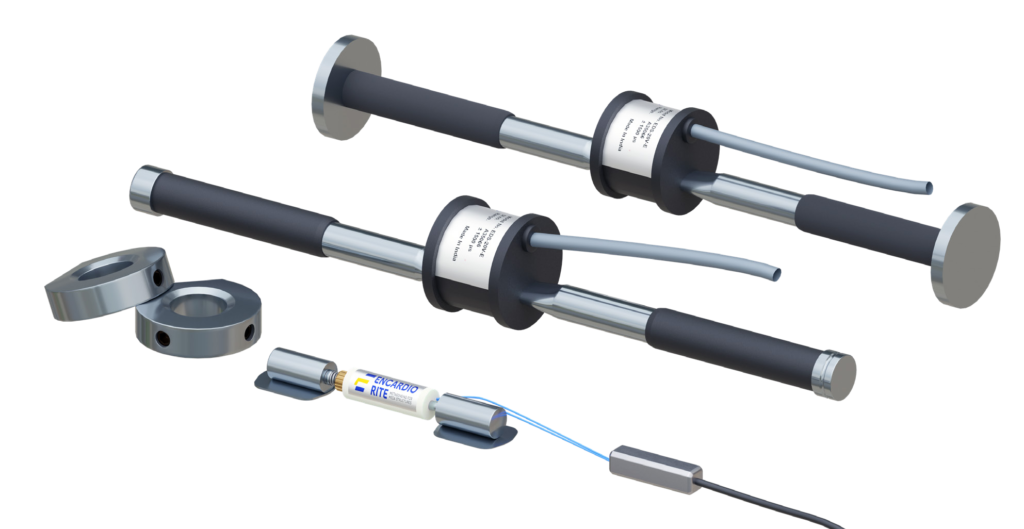
- EDS-20V-AW: Vibrating wire extensometer for surface mounting by arc welding on metal structures. It can also be installed on concrete using specific anchor blocks.
- EDS-20V-E: Version for installation embedded directly in fresh concrete. It is suitable for piles, deep foundations, diaphragm walls, dams, precast segments, and concrete structures where internal deformation measurement is required.
- EDS-21V-SW: Compact version for surface mounting using spot welding or structural adhesive. It is suitable for applications with limited space or for installation on existing metal elements, struts, plates, pipes, or structures.
Why use vibrating string technology?
Vibrating wire technology is widely used in geotechnical instrumentation because it offers a combination of stability, robustness, and reliability well-suited for permanent monitoring systems. It is especially useful in installations where sensors must remain operational for years and transmit data from hard-to-reach locations.
- Precise measurement of deformations in microstrain (µε).
- Excellent long-term measurement stability.
- Low drift and high repeatability.
- High immunity to electrical noise and electromagnetic interference.
- Signal transmission over long distances without appreciable loss of accuracy.
- Less influence of wiring resistance compared to analog sensors.
- Integrated thermistor to record the temperature at the measurement point.
- Robust stainless steel construction for humid, corrosive or aggressive environments.
Compatibility with data loggers and remote monitoring
The EDS-20V/21V vibrating wire extensometers can be read manually using handheld units or integrated into automated data acquisition systems. In public works projects, concessions, tunnels, dams, bridges, or critical infrastructure, they are commonly combined with dataloggers and remote monitoring platforms.
Automating readings allows for recording periodic measurements, generating historical data, setting alarm thresholds, and monitoring the structure's evolution without relying solely on manual surveys. Depending on the acquisition system used, communication can be achieved through wired or wireless solutions, including radio, 4G, Ethernet, or industrial IoT systems.
Common aspects in technical specifications
In structural monitoring and geotechnical instrumentation projects, specifications typically differentiate between embedded and surface sensors. For piles, diaphragm walls, segments, slabs, or cast-in-place concrete elements, embedded extensometers are usually specified. For existing structures, metal elements, beams, struts, or infrastructure rehabilitation, surface extensometers are generally used.
It is also common to consider automating sensor readings using data loggers, remote data transmission, and visualization platforms. This integration facilitates measurement traceability, continuous monitoring, and the generation of alerts when thresholds defined by the technical management are exceeded.
Construction, temperature and compatibility
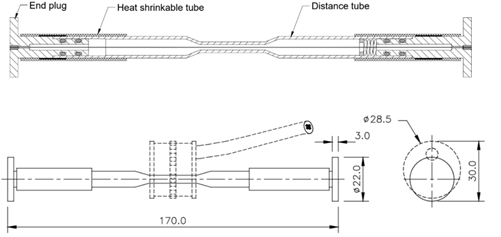
The extensometer is made of stainless steel It features double O-ring sealing and heat-shrink tubing protection. This construction provides resistance to humidity, corrosion, and other aggressive environments common in civil engineering projects.
Each sensor incorporates a integrated thermistor to record the temperature at the measurement point. This information allows for the analysis of thermal effects on the material and the application of compensations when required by the project.
The EDS-20V/21V vibrating wire extensometers are compatible with hand-held readout units, dataloggers, and automatic data acquisition systems prepared for vibrating wire sensors, from Encardio Rite and other manufacturers.
Main technical features
- Measuring range: ±1500 µε in EDS-20V-AW and EDS-20V-E; ±3500 µε in EDS-21V-SW.
- Resolution: 1 µε.
- Exit: frequency using vibrating string technology.
- Thermistor: YSI 44005 or equivalent, 3000 Ω at 25°C.
- Operating temperature: −20 °C to +80 °C.
- Level of protection: IP67.
- Wire: 4-conductor shielding.
- Material: stainless steel.
Frequently asked questions about vibrating wire extensometers
What is a vibrating string extensometer used for?
It is used to measure deformations in structural elements made of concrete or steel. From these deformations, the structural behavior, stress state, and evolution of the infrastructure over time can be evaluated.
When is an embedded extensometer used?
It is used when the sensor must be embedded in the concrete during construction. It is common in piles, foundations, retaining walls, dams, slabs, tunnel segments, and precast elements.
When is a surface extensometer used?
It is used on existing structures or metal elements where it is not possible to install the sensor within the concrete. Depending on the model, it can be fixed by welding, anchor blocks, spot welding, or structural adhesive.
Can it connect to a datalogger?
Yes. Vibrating wire extensometers can be connected to handheld readers, dataloggers, and automatic monitoring systems to take periodic readings, record historical data, and set alarms.
What advantage does a vibrating string have over an analog signal?
The frequency signal is more stable against electromagnetic interference and long cable lengths. Therefore, vibrating wire is a widely used technology in geotechnical instrumentation and continuous structural monitoring.
Technical documentation
You can download the PDF technical data sheet for the EDS-20V/21V vibrating wire extensometer For complete specifications, dimensions, available models and key technical data.
Properties
Technical specifications
| Parameter | EDS-20V-AW | EDS-20V-E | EDS-21V-SW |
|---|---|---|---|
| Measuring range | ±1500 µε | ±1500 µε | ±3500 µε |
| Precision1 | ±0.1 % FS. | ±0.1 % FS. | < ±0.25 % FS. |
| Nonlinearity | < 0.5 % FS. | < 0.5 % FS. | < ±0.25 % FS. |
| Resolution | 1 µε | 1 µε | 1 µε |
| Active length | 150 mm | 150 mm | 50 mm |
| Effective gauge factor2 | ≈ 4.051 × 10⁻³ µε/Hz² | ≈ 4.051 × 10⁻³ µε/Hz² | ≈ 3.896 × 10⁻⁴ µε/Hz² |
| Exit | Frequency (VW) | Frequency (VW) | Frequency (VW) |
| Thermistor type | YSI 44005 or equivalent (3000 Ω at 25°C) | YSI 44005 or equivalent (3000 Ω at 25°C) | YSI 44005 or equivalent (3000 Ω at 25°C) |
| Operating temperature | -20 °C to +80 °C | -20 °C to +80 °C | -20 °C to +80 °C |
| Storage temperature | -20 °C to +80 °C | -20 °C to +80 °C | -20 °C to +80 °C |
| Relative humidity | 0–100 % HR | 0–100 % HR | 0–100 % HR |
| Degree of protection | IP67 (IEC 60529) | IP67 (IEC 60529) | IP67 (IEC 60529) |
| Life of fatigue | 105 cycles at 2500 µε | 105 cycles at 2500 µε | 105 cycles at 2500 µε |
| Wire | 4-conductor shielded cable, standard length 1 m (other lengths available) | 4-conductor shielded cable, standard length 1 m (other lengths available) | 4-conductor shielded cable, standard length 1 m (other lengths available) |
| Dimensions | 174 × 28.5 × 30 mm | 170 × 28.5 × 30 mm | 64.5 × Ø8 mm |
1 Values determined under laboratory conditions.
2 The actual gauge factor value is listed on the calibration certificate supplied with each sensor.
Other products