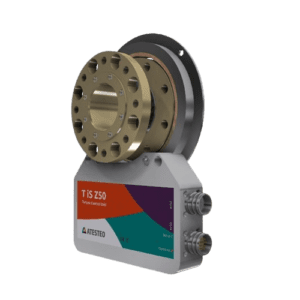





















Dual Range Torque Sensor DF Dual 1 | 500 Nm | 21,000 RPM
- Manufacturer: CENSORED
- Category: Half torque (100-1,000 Nm), Rotary, Torque sensor
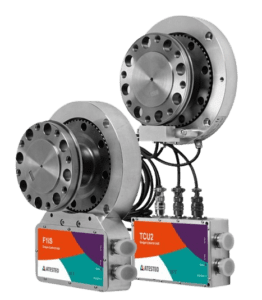
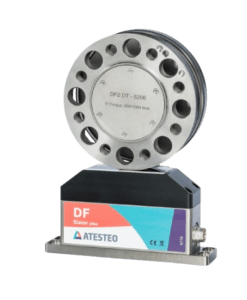
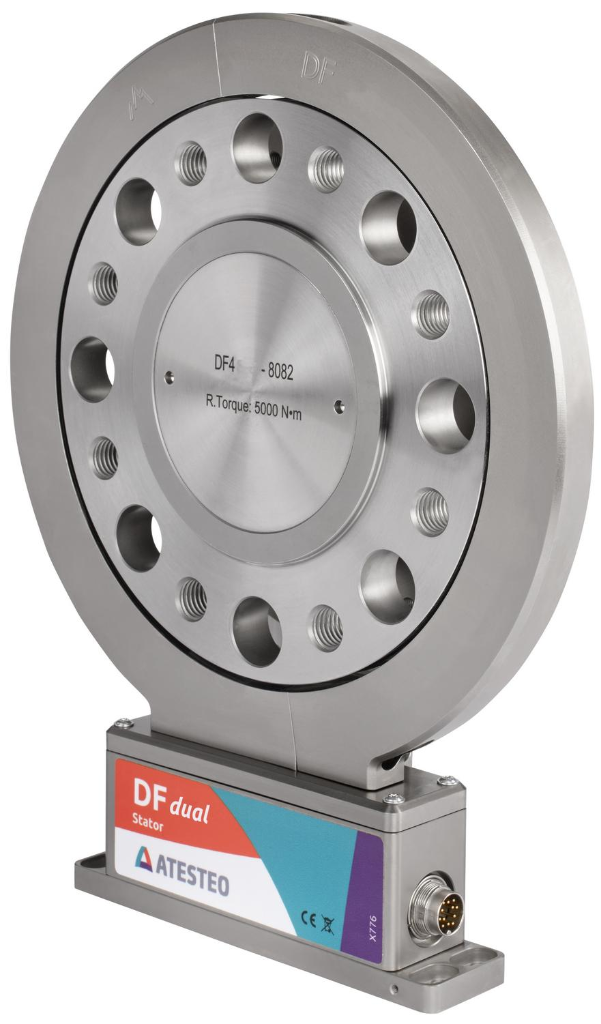
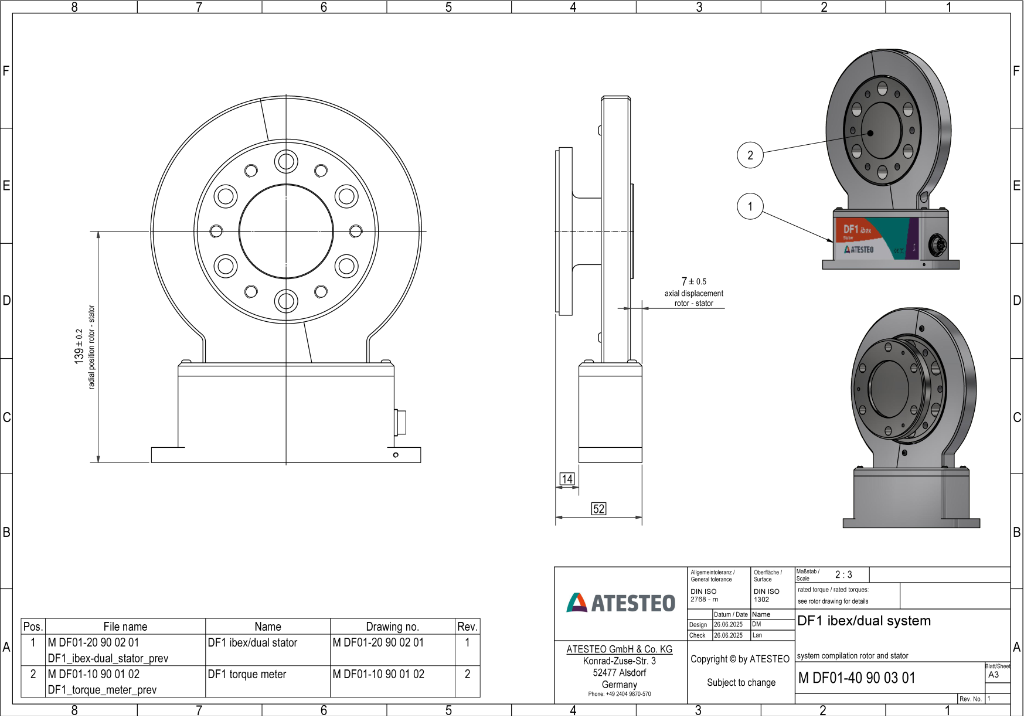
He Dual Range Torque Sensor DF Dual 1 It disrupts the spectrum of industrial dynamometry by integrating two independent calibration scales under a single physical architecture. Its split-ring stator design allows for radial concentric installation, eliminating the structural requirement to decouple the central shafts of the drive train. Permanently mounted on a strict 84.0 mm ISO PCD flange, the equipment simultaneously processes and digitizes macro-torsional variations (up to 500 N·m) and transient parasitic microvariations without sacrificing analytical fidelity or requiring sensor replacement during mixed asymmetric tests.
By eliminating the thermal and frictional bottlenecks of outdated bearing-based instrumentation, the DF Dual 1 operates entirely under telemetry-controlled inductive field transfer. The omission of rotational contact enables sustained stress cruising at 21,000 RPM without overheating or material wear. Combined with a microscopic rotational inertia of just 0.0017 kg·m², the unit mathematically purifies the torsional vector of centrifugal interference. Its dual strain gauge array sends parallel resolute fluxes of 0.04% to the powerful TCU5 evaluator node, routing them on dedicated RS422 and CAN 2B bus frequencies. To evaluate more multipurpose instrumentation, scan our catalog of Industrial Torque Sensors or delve deeper into integrated master controls from the Guemisa main platform.
Dual Engineering Audit (FAQ)
The Dual Range array allows the sensor to measure, within the same 84.0 mm PCD housing, a maximum nominal threshold (500 N·m) and, simultaneously, a secondary hypersensitive range to register minute variations beyond the macroscopic scale. At the production level, this eliminates the need to stop the test bench and insert different transducers when a single e-drive prototype transitions from a cruising cycle to a freewheeling test.
Under what paradigm does this Dual Range system maintain a unified accuracy of 0.04% at continuous speeds of 21,000 RPM?
Its reliability lies in parallel electromagnetic telemetry. By operating without mechanical friction links or rolling supports, and harboring only 0.0017 kg·m² of entrained reactive inertia, the air-source inductive stator prevents harmonic expansion. As a result, both DMS signals (high and low scale) flow in a pure and undisturbed state before being injected into the TCU5.
Properties
| Nominal Pair Range (Mnom) | 500 N·m (Independent Dual Calibration) |
| Analytical Precision Class | 0.05% (Optional assessment at 0.04%) |
| Maximum Speed Continuous Acceleration | 21,000 RPM |
| Measurement Principle | Parallel Strain Gauges (DMS) and Inductive Transmission |
| Primitive Circle Diameter (PCD) | Rigid ISO 84.0 mm fixing |
| Outer Diameter of the Magnetic Rotor | 107 mm |
| Transverse Length Axis | 45 mm |
| Geometric Drag Inertia | 0.0017 kg·m² (Restricted Rotational Mass) |
| Dynamic Structural Weight (Rotor/Stator) | 1.20 kg / 0.90 kg |
| Analytical Telecommunications Outputs | Raw RS422 Frequency, Analog Base, CAN 2B Bus Network |
| Voltage Operating Electrical Power | 24 V DC Parametric |
| Functional Operating Thermal Band | Continuous evaluation from 0 °C to +80 °C in plant |
| Insulating Enclosure Regulations | IEC/NEMA IP54 |
Other products