ANESB biaxial ultrasonic anemometer
- Manufacturer: Nesa
- Category: Meteorology – Climatology, SENSORS, Wind
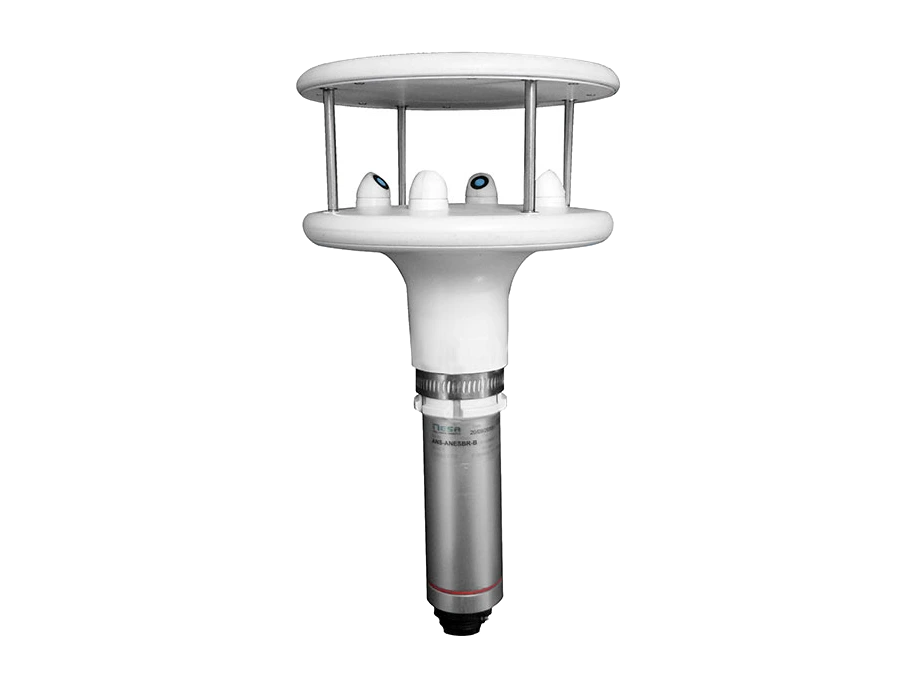
The NESA ANESB is a biaxial ultrasonic anemometer for measuring wind speed (0–90 m/s) and direction (0–360°) along two orthogonal X and Y axes in the horizontal plane, with 4 ultrasonic cells and an automatic compass for true north. Compliant with WMO and EN 15518-3:2011.
It has no moving parts. Body made of resin and anodized aluminum alloy (IP65). Power supply 10÷30Vdc and consumption less than 1 W; the heated version ANESBR (10 W) operates from -40 to +80 °C.
Key points
- Speed: 0 ÷ 90 m/s, resolution < 0.01 m/s, accuracy ± 2%
- Direction: 0 ÷ 360°, resolution 1°, accuracy ± 1°
- Outputs: 2 x 4÷20mA (B) or RS485/Modbus (C)
- No moving parts
- Heated version ANESBR (10 W): -40 ÷ +80 °C
Technical Frequently Asked Questions
What output signals does the ANESB ultrasonic anemometer offer?
ANESB-B: Two 4÷20mA outputs, one for speed and one for direction (not self-powered). ANESB-C: RS485/Modbus RTU (Half duplex), 19200 baud, parity E, 8 data bits, 1 stop bit, function 0x04 and default ID 1.
How is the ANESB order code structured?
Sensor (heated ANESB or ANESBR), output (B or C), sensor-datalogger cable (05, 10 or xx, length in meters to be specified) and SSU bracket of L = 700-750 mm. Manufacturer example: ANESB B 10 SSU. References: ANESB-B, ANESB-C, ANESBR-B and ANESBR-C.
What advantages does the absence of moving parts offer?
Having no moving parts, the sensor is suitable for continuous operation in harsh environmental conditions.
Properties
| Feature | Specification |
|---|---|
| Measurement and transducer | |
| Measured magnitude | Wind speed and direction on the horizontal plane |
| Speed range | 0 ÷ 90 m/s |
| Steering range | 0 ÷ 360° |
| Speed resolution | < 0.01 m/s |
| Address resolution | 1° |
| Speed accuracy | ± 2% |
| Steering accuracy | ± 1° |
| Transducer type | 4 ultrasonic cells |
| Anemometric parameters | Speed, direction, UV components, compass for true north |
| Regulatory compliance | WMO and EN 15518-3:2011 |
| Output signals and interface | |
| Analog output (version B) | 2 x 4÷20mA (speed and direction) |
| Digital output (version C) | RS485/Modbus |
| Connector pins | 7 pins |
| Nutrition and environmental conditions | |
| Feeding | 10÷30Vdc |
| Consumption | < 1 W (typical 30 mA @ 15Vdc); max. 10 W heated |
| Operating conditions | -20 to +80 °C (-40 to +80 °C heated version) |
| Degree of protection | IP65, protection against transients and polarity reversal |
| Materials | Aluminum alloy and thermoplastic resin |
| Dimensions | 320 x 162 mm (see drawing) |
| Weight | 1 kg |
| Reference | Configuration |
|---|---|
| ANESB-BANESBB | Model: ANESB · Heating: Not heated · Output signal: Dual 4÷20mA output (speed and direction) |
| ANESB-CANESBC | Model: ANESB · Heating: Not heated · Output signal: RS485/Modbus |
| ANESBR-BANESBRB | Model: ANESBR · Heating: Heated (10W) · Output signal: Dual 4÷20mA output (speed and direction) |
| ANESBR-CANESBRC | Model: ANESBR · Heating: Heated (10W) · Output signal: RS485/Modbus |

Related documentation, cases, and guides
Other products