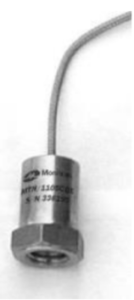





















MTN/P1100 Load Accelerometer
- Manufacturer: Monitran
- Category: Accelerometers and Vibration Sensors, SENSORS, Without amplification
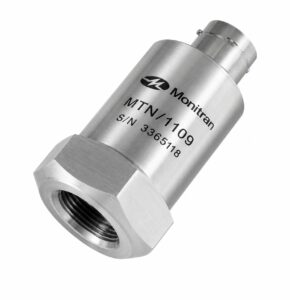
The transducer MTN/P1100 It is a high-sensitivity piezoelectric accelerometer with passive charge output (it lacks internal electronic circuitry). This "bare-die" architecture is designed for seismic applications, structural instrumentation, and underground leak detection where it is imperative to capture very low-amplitude vibrations without suffering thermal degradation, allowing continuous operation in environments up to 250 °C.
Technically, the sensor provides an extremely high nominal sensitivity of 1100 pC/g, maximizing the signal-to-noise ratio in low-frequency data acquisition. To achieve this passive gain, the device uses a larger seismic mass (250 grams), which places its mounted resonant frequency at 10 kHz and limits its dynamic range to ±100g. Due to its high-impedance passive nature, it is mandatory to integrate an external in-line charge amplifier (such as the MTN/CA003 module) to convert the electrical charge into a processable analog voltage.
In terms of construction, the housing is machined from stainless steel with an IP65 protection rating. Unlike the miniature models in the P Series, the P1100 abandons the Microdot connector in favor of a top-entry TNC coaxial connector, ensuring greater electromagnetic shielding (EMI) integrity and mechanical robustness in long cable runs. It is attached to the machine via a 1/4″-28 UNF female threaded base.
- Passive load output (pC/g) tolerant to extreme thermal gradients up to 250 °C.
- Extreme sensitivity of 1100 pC/g for micro-vibration detection and seismic monitoring.
- TNC coaxial connection High robustness to minimize induced noise in industrial environments.
- Non-galvanically isolated base (requires an external adapter if ground loops exist).
Technical Frequently Asked Questions
Not directly. As it's a load sensor (without an amplifier), its signal isn't pre-amplified. It requires an external load amplifier between the sensor and the measuring equipment to condition the pC/ga mV/g signal.
2. Why do you use a TNC connector instead of a MIL or Microdot type connector?
Given its application in seismic or underground monitoring, the TNC connector provides a mechanically superior threaded coupling to the BNC and more effective high-frequency shielding than the Microdot, protecting the weak load signal through longer cable runs.
3. Is the sensor base electrically insulated?
No, the MTN/P1100 housing is "Base non-isolated," meaning the sensor element shares mass with the machine. If the installation has potential differences (ground loops), an external mechanical isolation pad or adapter (e.g., accessory MS048) must be used.
Properties
| Feature | Technical Specification |
| Technology | Passive Piezoelectric (Without Internal Electronics) |
| Output Configuration | Charge Output |
| Nominal Sensitivity | 1100 pC/g ±10% (@ 80Hz) |
| Nominal Capacitance | 450 pF (4400 pF maximum) |
| Dynamic Range | ±100 g |
| Mounted Resonance (Base) | 10 kHz (Nominal) |
| Transversal Sensitivity | Lower than 5% |
| Operating Temperature | -55 °C to +250 °C |
| Electrical Insulation | Non-isolated base |
| Output Connector | Coaxial TNC (Top Entry) |
| Mechanical Assembly | Female Thread ¼"-28 UNF |
| Tightening Torque | 8 Nm |
| Housing Material | Stainless Steel |
| Degree of Protection | IP65 |
| Structural Mass | 250 grams (Nominal) |
| Required Conditioning | External Load Amplifier (e.g. MTN/CA003) |


Other products