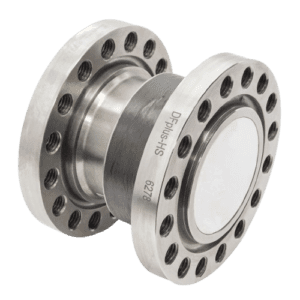



















Torque Sensor DF Ibex 4 | 5,000 Nm | 15,000 RPM
- Manufacturer: CENSORED
- Category: Torque sensor, SENSORS
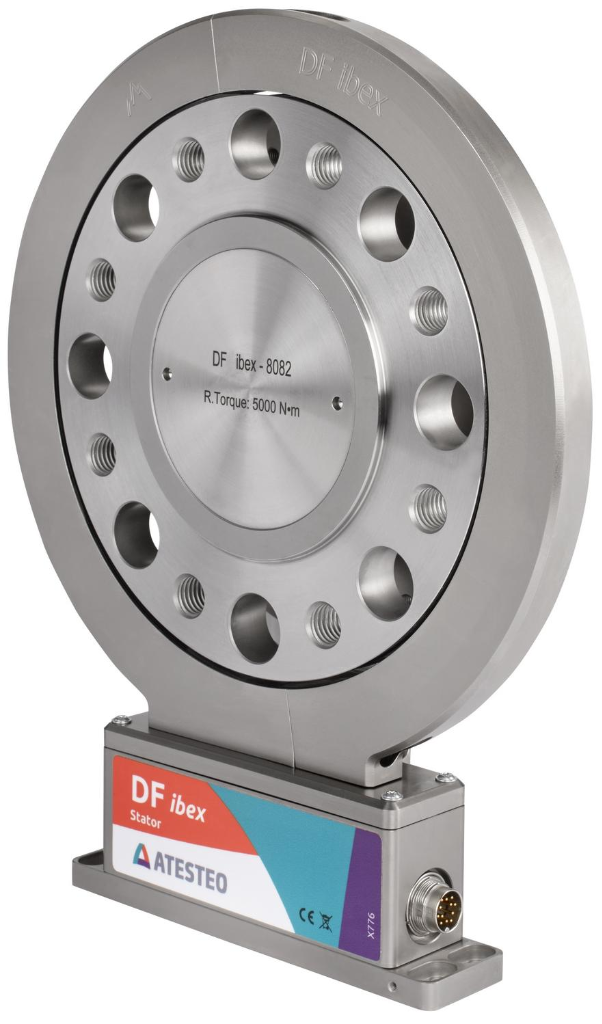
He Torque Sensor DF Ibex 4 It constitutes a priority metrological link for heavy dynamometer environments and naval or railway load banks. Built on a split-ring stator morphology, this transducer restructures assembly engineering by allowing radial concentric insertion onto the drive chain without requiring transverse decoupling of the cardan shaft. Robustly bolted to a 155.5 mm ISO PCD pattern, the device fatigue-free monitors permanent torsional demands of up to 5,000 N·m, absorbing high-frequency thermal and rotational vibrations.
Overcoming the operational decline of traditional instrumentation supported by rolling bearings, this unit shifts the metrological standard to electromagnetic fields, using purely inductive, frictionless telemetry. The complete elimination of physical friction eliminates both lifetime wear and thermal drift during critical tests sustained at 15,000 RPM. Additionally, a calibrated rotor concentrates a minuscule inertia of 0.0167 kg·m², neutralizing centrifugal turbulence and sending pure matrix torque profiles to the TCU5 computer unit. Ensure reliably traceable 0.02% by integrating multiple active CAN 2B or RS422 channels. Scale the potential of your control room by combining our offering of Industrial Torque Sensors or supplement the parametric tooling by going to the Gemisah basic instrumentation page.
Industrial Metrological Analysis (FAQ)
Its standardized 155.5 mm base provides unbreachable torsional rigidity, shielded against spatial bending during peak torques of 5,000 N·m. When combined with the radially inserted stator (split ring), plant engineers can integrate this unit without detaching the massive gimbals or altering the preliminary laser alignment of the motor bank.
Under what paradigm does the meter maintain a resolution spectrum of 0.02% while rotating continuously at 15,000 RPM?
The sensor eliminates heat drag by operating within an inductive parametric environment that avoids mechanical support bearings. Remote operation allows the rotor, dynamically weighing a mere 4.4 kg and projecting only 0.0167 kg·m² of inertia, to efficiently assimilate metal deformations without introducing rotary harmonics, providing a complete and refined reading to the higher control system.
Properties
| Nominal Pair Range (Mnom) | 5,000 N·m (Lower options 4,000 Nm) |
| Metrological Precision Class | 0.05% (Strict limit 0.02% optional) |
| Maximum Speed Continuous Acceleration | 15,000 RPM |
| Measurement Principle | Strain Gauges (DMS) and Digital Inductive Transmission |
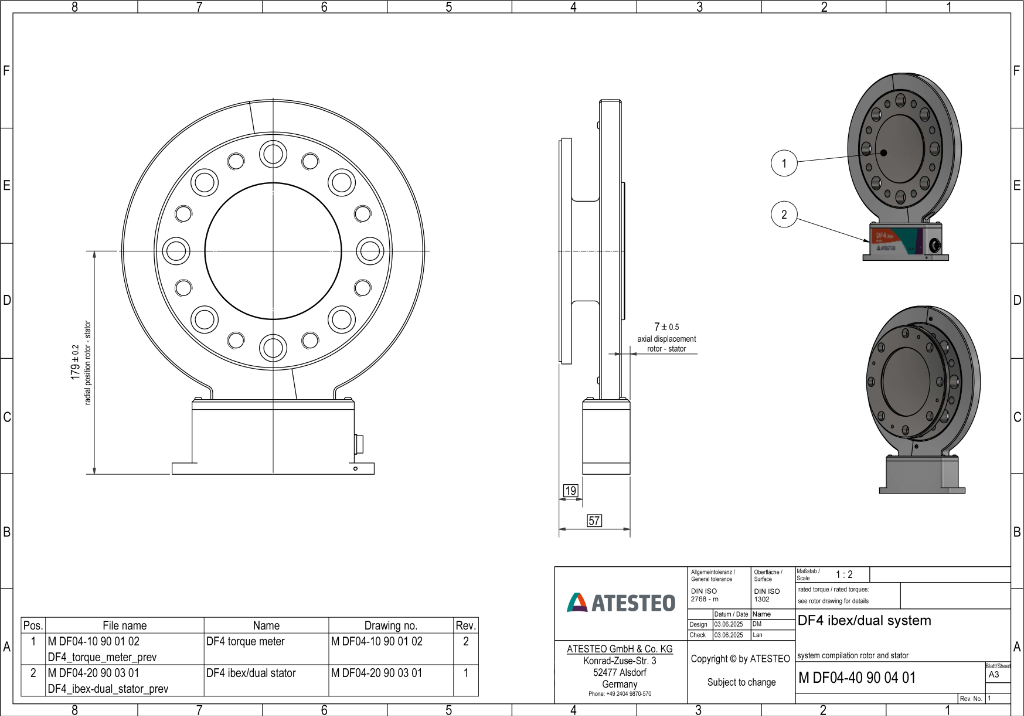
| Primitive Circle Diameter (PCD) | ISO standardized pattern 155.5 mm |
| Cylindrical Outer Diameter of Rotor | 187 mm |
| Transverse Construction Length | 50 mm |
| Geometric Drag Inertia | 0.0167 kg·m² (Reactive Rotational Mass) |
| Dynamic Structural Weight (Rotor/Stator) | 4.40 kg / 1.12 kg |
| Analytical Transmission Outputs (TCU5) | RS422 Fast Frequency, Analog Scalar (±10V), CAN 2B Connectivity |
| DC Voltage Gross Power | 24 V DC |
| Constant Thermal Operating Spectrum | It functionally covers from 0 °C to +80 °C |
| NEMA Environmental Isolation Class | NEMA/IEC IP54 Industrial Protection |
Other products