



















NOPUL – Turn and Underspeed Detector Relay
- Manufacturer: DPF Sensors
- Category: Signal converters, Frequency and Pulses, INSTRUMENTATION
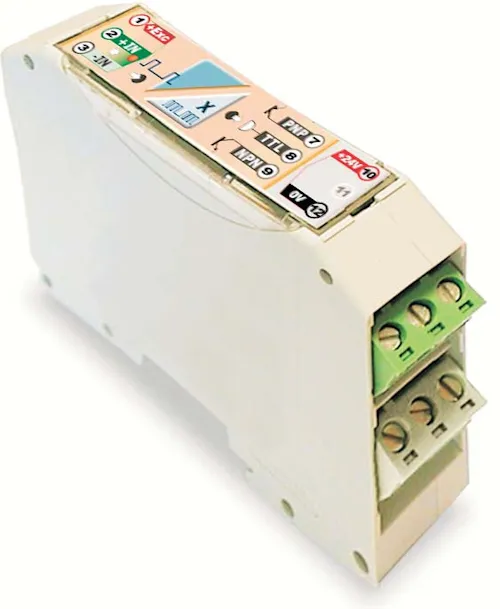
The NOPUL is a rotation and underspeed detector relay designed to check that a shaft, pulley, drum or other mechanical element continues to move during the operation of an installation.
It acts as a pulse evaluation unit: it receives pulses generated by an external sensor and measures the time elapsed between two consecutive pulses. If this time exceeds the programmed value, the NOPUL interprets this as the speed having dropped below the permitted limit or the movement having stopped, and switches its relay output to generate an alarm or halt the process.
In this way, it is not limited to checking that the motor is powered or that the drive shaft continues to rotate. It allows verification that the movement actually reaches the driven element of the machine.
Rotation detector for bucket elevators
One of the most common applications of NOPUL is the protection of bucket elevators used in feed mills, cereal facilities, flour mills, silos and bulk product handling plants.
In a bucket elevator, the motor normally drives the top pulley, or head pulley. However, the fact that the motor and drive pulley continue to rotate does not guarantee that the belt and buckets are moving correctly.
The belt can break, slip on the drive pulley, lose tension, or become blocked due to product buildup. In these situations, the motor can continue running while the lower pulley, also called the foot pulley or bottom drum, slows down or stops rotating.
To detect this situation, a sensor is installed on the lower shaft or drum. The sensor detects one or more screws, teeth, cams, or metal targets during each revolution and sends a sequence of pulses to the NOPUL, installed in the electrical panel.
If the lower pulley stops or its speed falls below the set value, the time between pulses increases. When the programmed time is exceeded, the NOPUL switches its output to activate an alarm, inform the PLC, or request the system to stop.
What faults can it detect?
The NOPUL allows the detection of loss of movement or an abnormal reduction in speed associated with different mechanical failures:
- Bucket elevator belt breakage.
- Belt sliding over the drive pulley.
- Locking of the lower pulley or return drum.
- Jam or accumulation of product.
- Loss of tension in a belt.
- Breakage of a chain or drive belt.
- Breakage or decoupling of a shaft.
- Failure of a coupling or clutch.
- Stopping of the driven element even though the motor continues to run.
NOPUL does not directly identify which of these faults has occurred. It detects its consequence: absence of pulses, stoppage or reduction of speed of the monitored element.
Universal input for different sensors
The NOPUL supports various types of sensors and pulse signals. The input is configured via side selectors, allowing the device to be adapted to existing sensors or different detection technologies.
- NPN sensors.
- PNP sensors.
- Push-Pull Sensors.
- NAMUR sensors.
- Potential-free contacts.
- 5V TTL signals.
- Magnetic sensors.
- Compatible alternate signals.
It can be connected to two- or three-wire sensors and has an excitation connection for powering compatible sensors.
Adjusting the underspeed limit
The minimum speed is not programmed directly in revolutions per minute. NOPUL allows you to adjust the maximum permissible time between two consecutive pulses.
As long as the pulses arrive before the programmed time expires, the machine is considered to be operating normally. If the interval between pulses exceeds that value, the relay activates the alarm state.
The time can be configured from 1 millisecond to 99 minutes, This allows for the control of both high-speed machines and very slow-moving mechanisms. The maximum input frequency is 1 kHz, equivalent to 1,000 pulses per second.
Timing during startup
During the start-up of a conveyor belt, elevator, fan, mill, or other machine, there may be a delay before the sensor begins to generate pulses normally.
To prevent false alarms, the NOPUL allows you to memorize an alarm inhibition time during startup. During this interval, the device waits for the machine to reach its normal operating speed before beginning to monitor the time between pulses.
Latchable or self-resetting alarm
The alarm can be configured in two operating modes:
- Memorized or latched alarm: The output remains in a state of alarm even if the pulses are restored. A reset is necessary.
- Alarm without memory: The output automatically returns to normal when movement is restored.
The latching mode is especially useful when the installation needs to be inspected before restarting it after a stop, a jam, or a loss of speed.
Fail-safe relay output
The relay remains energized during normal operation and is de-energized when an alarm occurs. A loss of power also causes the output state to change.
This logic allows a loss of voltage, a disconnection of the equipment, or a disappearance of pulses to generate a fault signal in the control circuit.
The standard output features a changeover contact with normally closed, common, and normally open terminals. Optionally, the device can be supplied with a PNP, NPN, or TTL transistor output.
Other industrial applications
Conveyor belts
The sensor can be installed on a return pulley or non-driven drum. If the belt breaks, slips, or becomes blocked, the drum speed decreases and the NOPUL generates the corresponding signal.
Screw conveyors
It allows the detection of movement losses caused by a jam, shaft breakage, decoupling, or transmission failure.
Chain conveyors and redlers
Monitoring the driven shaft allows for the detection of chain breaks, snags, blockages, and mechanical failures that cannot always be identified by only monitoring the motor.
Fans and extractors
In belt-driven fans, the motor can continue to rotate even if the belt breaks or slips. A sensor installed on the fan shaft allows verification that the impeller is still moving.
Mills, crushers and processing machinery
It can be used to monitor rollers, shafts and other rotating elements, detecting stops or speed reductions associated with blockages and overloads.
Agitators and mixers
It allows you to check that the agitator shaft is actually rotating and to detect a decoupling, a transmission break or a blockage of the mechanism.
Advantages of NOPUL
- Controls the actual movement of the driven element.
- Detects absence of turning, stopping and underspeed.
- Universal input compatible with different types of sensors.
- Time between pulses configurable from 1 ms to 99 minutes.
- Input frequency up to 1 kHz.
- Inhibition timing during startup.
- Lockable or self-resetting alarm.
- Switched relay output for connection to PLC, alarms or control circuits.
- Operation in the event of power loss.
- Narrow 17.5mm format for DIN rail mounting.
- Suitable for elevators, belts, screw conveyors, redlers and rotating machinery.
Selection and installation
To properly adjust the NOPUL, it is necessary to know the approximate speed of the shaft, the number of pulses generated per revolution, the machine start-up time, and the maximum permissible time without movement.
In slow-moving mechanisms, it may be advantageous to install several metal targets per revolution to reduce detection time. In fast-moving machines, a single screw, tooth, or detection element may suffice.
GUEMISA can help select the sensor, determine its position, calculate the number of pulses per revolution, and set the appropriate alarm time for each application.
Note: The NOPUL is a process monitoring and protection device. The available documentation does not demonstrate a certified safety function according to SIL or Performance Level, therefore it should not be used as the sole component of an emergency stop or safety interlock.
Properties
| Feature | Specification |
|---|---|
| Reference | NOPUL |
| Type of equipment | Pulse absence detector relay, rotation monitor, and low-frequency tachometer relay |
| Main function | Detection of absence of turning, stopping and underspeed by evaluating the time between pulses |
| Adjustment method | Programming the maximum permissible time between two consecutive pulses |
| Entry types | NPN, PNP, Push-Pull, TTL 5V, NAMUR, potential-free contact, AC signal, and magnetic pickup |
| Entry selection | Via side microswitch |
| Sensitivity for alternating signal or magnetic pickup | 20 mV to 30 V |
| Compatible sensors | Two or three wire collectors |
| Sensor excitation | Excitation connection available for compatible three-wire sensors |
| Maximum input frequency | 1 kHz |
| Maximum number of pulses | 1,000 pulses per second |
| minimum configurable time | 1 ms |
| Maximum configurable time | 99 minutes |
| Inhibition during startup | Programmable and memorable alarm inhibition time |
| Alarm memory | Selectable: latched alarm or automatic reset upon pulse recovery |
| Nominal supply | 24 VDC |
| Feed margin | 20 to 30 VDC |
| Maximum consumption | 1 W |
| Standard output | Switched relay contact, NC-C-NO terminals |
| Maximum contact intensity | 6 A |
| Maximum contact voltage | 250 VAC |
| Indicated electrical life of the relay | 100,000 transactions |
| Output operating logic | Relay energized during normal operation and de-energized in case of alarm or power loss |
| Optional exit | PNP, NPN or TTL transistor |
| Frontal signage | Power supply, operation, pulse reception, timing, and LED alarm |
| Maximum global error | 0,01 % |
| Thermal drift | 50 ppm |
| Mounting | DIN rail EN 50022 |
| Width | 17.5 mm |
| Dimensions | 95 × 70 × 17.5 mm |
| Degree of protection | IP20 |
| Box material | Polyamide PA6.6 |
| Flammability class | V0 according to UL94 |
| Connection | Coded plug-in terminals with screw connection |
| maximum cable cross-section | 2.5 mm² / 12 AWG |
| Tightening torque specified | 0.5 Nm |
| Weight | 100 g |
| Marked | CE, according to the manufacturer's documentation |
| Electromagnetic compatibility | Directive 2014/30/EU; immunity EN 61000-6-2 and emissions EN 61000-6-3 |
| Electrical safety indicated | Directive 2014/35/EU and EN 61010-1; installation category II and pollution degree 2 |
Other products