























4-20 mA to 4-20 mA signal isolators
Galvanic isolation of 4-20 mA current signals
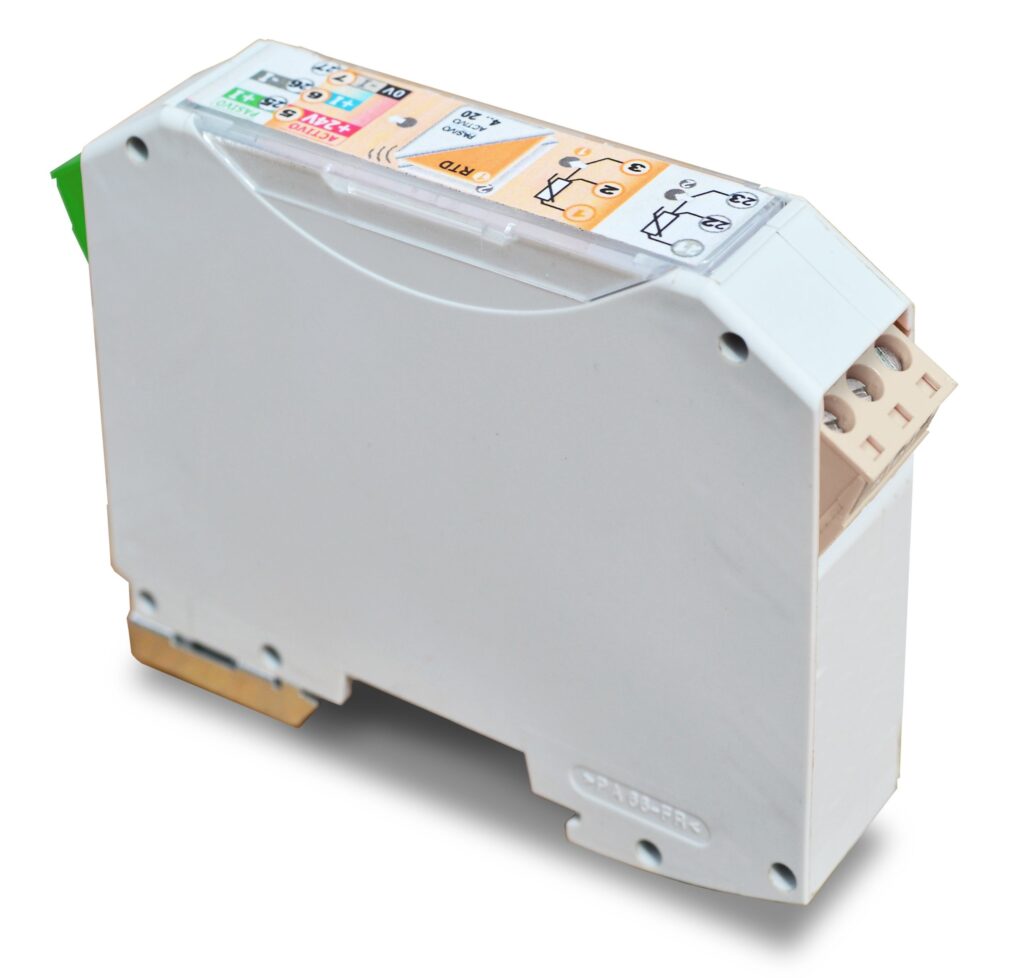
The 4-20 mA signal isolators to 4-20 mA They allow the transmission of an analog signal between a sensor, transmitter, PLC, or acquisition system while maintaining galvanic isolation between the input and output.
They are used to eliminate ground loops, reduce electrical interference, and protect control equipment from potential differences. The output signal reproduces the 4-20 mA input signal without establishing a direct electrical connection between the two circuits.
Available configurations
Depending on the application, different configurations can be used:
- 1 entrance and 1 exit: isolation of a 4-20 mA signal.
- 1 entrance and 2 exits: duplication of a signal to two independent devices or systems.
- 1 entrance and 4 exits: distribution of the same 4-20 mA signal to several receivers.
When is a 4-20 mA insulator needed?
- When there are mass loops between the sensor and the control system.
- When a signal exhibits noise, oscillations, or measurement errors.
- When it is necessary to protect the analog inputs of a PLC.
- When the same signal must be sent to two or more receivers.
- When the equipment is powered from different circuits.
How to select the right model
To select the isolator, you need to define the number of inputs and outputs, whether the signal should be active or passive, the power supply type, the required isolation level, and the mounting format. You may also need to check the accuracy, response time, and compatibility with HART signals.
GUEMISA offers technical advice for selecting the galvanic isolator 4-20 mA appropriate according to the installation, the sensor and the control system used.
Products: 14