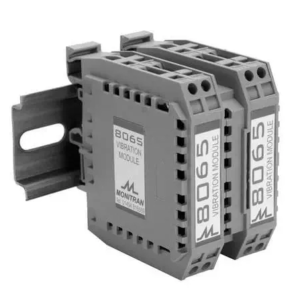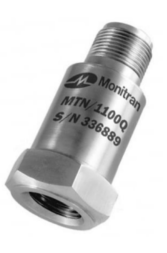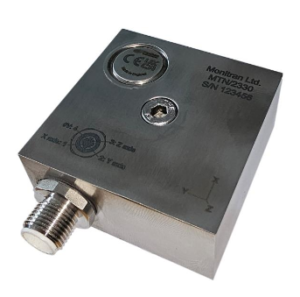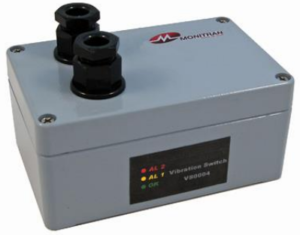




















Monitran MTN/8065 Triple Output Signal Converter
- Manufacturer: Monitran
- Category: Signal converters, INSTRUMENTATION
Advanced monitoring of rotating machinery often requires combining real-time data for the control system with access to the raw signal for in-depth diagnostic analysis. The MTN/8065 is a triple-output signal converter that acts as the processing core between a constant-current accelerometer and the plant infrastructure. Its electronic architecture allows the sensor to be powered using IEPE technology and the incoming signal to be processed to provide three independent and simultaneous outputs.
This converter delivers two 0-10V DC signals for PLCs: one proportional to the RMS speed (compliant with ISO 10816-1) and the other proportional to the g-envelope, a critical parameter for the early detection of wear in bearings and gears. Additionally, the device includes a third buffered and unfiltered AC output that replicates the sensor's raw signal, allowing direct connection of data collectors or spectrum analyzers without interfering with continuous monitoring.
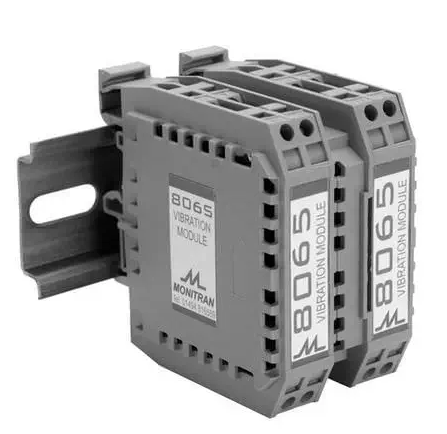
Housed in a compact DIN rail enclosure with screw terminals, the MTN/8065 uses two-pole Butterworth filters (12 dB/octave) to ensure a clean and accurate signal. It is the ultimate technical solution for plants requiring automatic alarm monitoring and, simultaneously, the ability to perform manual predictive diagnostics at the same measurement point.
- Triple simultaneous output: RMS speed, envelope, and raw AC signal.
- Analog outputs of 0-10V optimized for industrial PLC inputs.
- Integrated IEPE feed for 2-wire, constant current accelerometers.
- Front access to buffered output for external spectral analysis.
Technical Frequently Asked Questions
1. What is the output of "g-envelope" and what is it used for?
The enveloped acceleration (Enveloped g) is a processing technique that isolates the repetitive, high-frequency shocks generated by defective bearings. While speed indicates the overall mechanical condition of the machine, the envelope acts as a sensitive and preventative marker of internal bearing wear long before catastrophic failure occurs.
2. Can portable analytical equipment be connected to this converter?
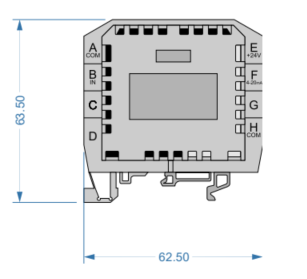
Yes. Thanks to the buffered AC output (Terminal C), a technician can connect a portable data collector to perform FFT or waveform analysis. Because it's a buffered output, connecting the external equipment doesn't introduce noise or voltage drops that could affect the 0-10V signals the PLC is using for continuous monitoring.
3. What filter configuration does the converter use for the DC outputs?
The MTN/8065 implements two-pole Butterworth filters with a 12 dB per octave roll-off. For velocity, the frequency range is between 10 Hz and 1 kHz. For the envelope, the system monitors an input band from 3 kHz to 6 kHz, processing it to deliver a usable signal in the 10 Hz to 1 kHz range, ideal for impact detection.
Properties
| Feature | Technical Specification |
| Device Type | Triple Output Vibration Signal Converter |
| Processing Function | IEPE Conditioning and Analog Integration |
| Signal Input | Constant current accelerometer (100mV/g) |
| Exit 1 (Speed) | 0-10V DC proportional to RMS Speed |
| Output 2 (Envelope) | 0-10V DC proportional to Enclosure g (Bearings) |
| Output 3 (AC Raw) | Unfiltered buffered output (100mV/g nominal) |
| Speed Range | 0-20 mm/s (Optional depending on application) |
| Envelope Range | 0-10 g (Optional depending on application) |
| Internal Filters | Two-pole Butterworth (12 dB/octave) |
| Sensor Power Supply | Built-in constant current (IEPE) |
| Module Power Supply | 24V DC (Typical consumption 15mA) |
| AC Frequency Response | 2 Hz to 10 kHz (-3dB) |
| Temperature Range | 0 °C to +85 °C |
| Mounting | Universal DIN Rail |
| Terminations | Screw terminals (Box 62 x 65 x 22 mm) |
Other products