




















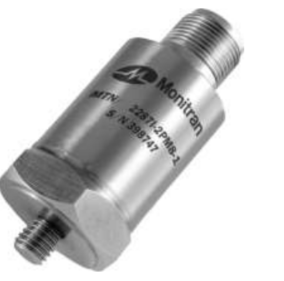
Intrinsically Safe Accelerometer MTN/2287
- Manufacturer: Monitran
- Category: Accelerometers and Vibration Sensors, Amplified, ATEX, SENSORS
Monitoring acceleration in mining and hydrocarbon extraction environments requires sensors that guarantee maximum safety against accidental ignition. In these classified atmospheres, any electrical component must be designed not to release enough energy to ignite surrounding gases or dust, even under fault conditions, which limits the use of conventional industrial sensors.
This intrinsically safe accelerometer addresses this challenge with its robust construction, certified to ATEX and IECEx (Group II) standards. It provides a 4-20 mA current signal directly proportional to the RMS acceleration (g), enabling simplified integration with PLCs and plant safety systems without the need for additional signal processing. Its top-entry design and Faraday cage-isolated electronics ensure stable and accurate measurements, even against the electromagnetic interference common in heavy machinery.
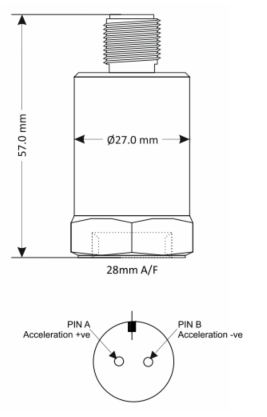
Constructed entirely of solid stainless steel with an IP67 hermetic seal, the MTN/2287 is capable of reliable operation in the harshest humidity and dirt conditions. The use of a 2-pin military-grade connector (MS series) ensures a firm and durable mechanical connection, facilitating predictive and preventive maintenance on critical compressors, fans, and pumps located in high-risk areas.
- Certification ATEX and IECEx for safe operation in Zones 0, 1 and 2.
- Loop output of 4-20 mA proportional ag RMS (configurable ranges).
- Linear frequency response of 2 Hz to 1 kHz for impact monitoring.
- armored corps of stainless steel with integral galvanic isolation.
Technical Frequently Asked Questions
1. What is the difference between measuring RMS acceleration (MTN/2287) and RMS velocity (MTN/2285)?
Speed (mm/s) is the best indicator for general mechanical faults such as imbalances or misalignments. However, acceleration (g), as measured by the MTN/2287, is superior for detecting high-frequency problems, such as premature bearing failures, pump cavitation, or gear tooth issues.
2. Can this sensor be installed without a safety barrier?
No. In areas classified as hazardous (Ex), it is mandatory by regulation to install the sensor in combination with a Zener barrier or a certified galvanic isolator that limits the electrical energy entering the risk area.
3. What acceleration ranges are available for the 4-20 mA output?
The sensor is factory-configured according to customer requirements, with standard ranges from 0-1g to 0-20g RMS. This flexibility allows the current scale to be adjusted to achieve maximum resolution in the control system.
Properties
| Feature | Technical Specification |
| Sensor Type | Intrinsically Safe Accelerometer (4-20mA) |
| Ex Certification | ATEX and IECEx Group II (Zones 0, 1, 2) |
| Analog Output | 4-20 mA DC (Proportional to RMS Acceleration) |
| Power Range | 12V to 32V DC |
| Frequency Response | 2 Hz to 1 kHz (±10%) |
| Resonance Frequency | 5 kHz (Nominal) |
| Electrical Insulation | Electronics in an isolated Faraday cage |
| Measuring Range | 0-1 to 0-20 g RMS (Configurable) |
| Operating Temperature | -55 °C to +65 °C (T6 Certified) |
| Body Material | Solid Stainless Steel |
| Dynamic Mass | 150 grams (Nominal) |
| Electrical Connection | Military 2-Pin Connector (MS Series) |
| Configurable Models | MTN/2287I (1/4″ UNF) and MTN/2287IQ (Quick Fit) |
| Tightening Torque | 8 Nm |
| Degree of Protection | IP67 |
Other products