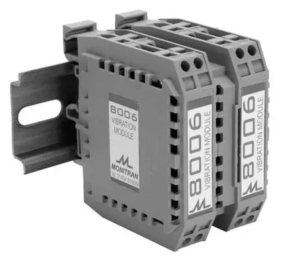





















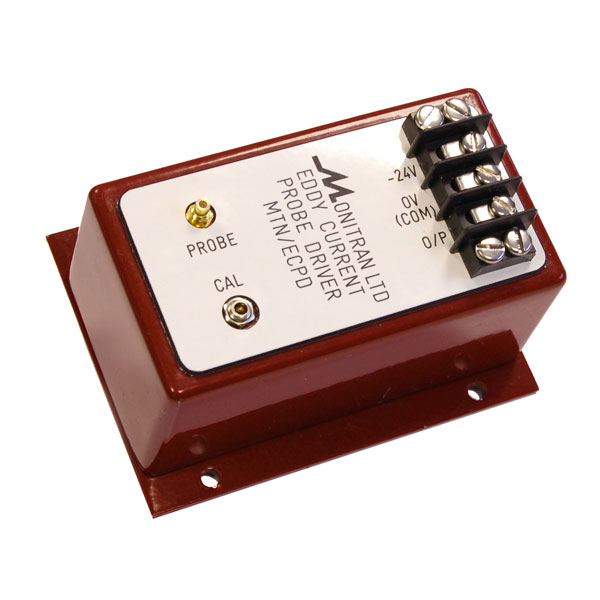
MTN/ECPD Signal Converter
- Manufacturer: Monitran
- Category: Signal converters, INSTRUMENTATION
Monitoring shaft position and vibration using proximity probes generates complex radio frequency signals that cannot be directly processed by conventional control systems. The MTN/ECPD acts as the critical signal converter, demodulating these high-frequency fluctuations, amplifying and linearizing them to provide an analog output directly proportional to the target's backlash or vibration. This device is the necessary bridge for integrating non-contact measurement technology into modern PLC or SCADA architectures.
This signal converter incorporates high-precision internal rectifier and linearization circuits that guarantee superior linearity compared to the 1% across the entire dynamic range of the connected probe. Depending on the specific model selected, the MTN/ECPD can deliver either a voltage output (0 to 16V or 0 to 10V) or an industrial current output of 4-20 mA, enabling continuous monitoring of both the static shaft position and its dynamic behavior at frequencies up to 10 kHz. This versatility makes it the standard for protecting critical turbines, compressors, and pumps.
Designed for installation in industrial electrical panels, this converter is housed in compact DIN rail enclosures with high-security screw terminals for easy plant integration. The system allows for cable runs of up to 9 meters between the unit and the probe, maintaining measurement integrity even in environments with high electromagnetic interference. As the unit is individually calibrated along with its probe and extension cable, it ensures absolute repeatability and accuracy in monitoring critical rotating assets.
- Multivariable signal processing: Gap (DC) and vibration (AC) outputs.
- High linearity and response: <1% error and bandwidth up to 10 kHz.
- Industrial output optionsConfigurable voltages and 4-20 mA loops.
- Extended cable management: Supports up to 9 meters total probe length.
Technical Frequently Asked Questions
1. Can an MTN/ECPD converter be interchanged between different probes?
It is not recommended. Proximity measurement systems are calibrated as a unit consisting of the probe, extension cable, and converter. Replacing any of these components individually will invalidate the system calibration, compromising the accuracy of the displacement measurement.
2. How is the DC output used for the initial probe adjustment?
The converter's DC output voltage is proportional to the distance between the probe tip and the shaft. This signal is crucial during mechanical assembly to position the probe at the optimal working distance (midpoint of the linear range), ensuring the system has sufficient dynamic range to measure displacements.
3. What is the difference between the standard model and the ECPD2 variants?
While the standard converter typically requires a three-wire power supply, the ECPD2 variants are designed as two-wire, loop-powered transmitters. This significantly simplifies wiring in installations where only 4-20 mA analog inputs are available on the PLC.
Properties
| Feature | Technical Specification |
| Device Type | Signal Converter for Proximity Probes |
| Main Function | Signal demodulation, amplification and linearization |
| Probe Compatibility | Monitran EP Series (EP080, EP200, EP340, EP480) |
| Standard Output (Voltage) | 0-10V or 0-16V DC (Proportional to gap/vibration) |
| Standard Output (Current) | 4-20 mA (Options depending on submodel) |
| Nonlinearity | Less than 1% (nominal) |
| Frequency Response | DC up to 10 kHz |
| Nutritional Requirements | +24V DC or -24V DC @ 30mA (depending on the model) |
| Output Impedance | 50 Ω |
| Maximum Humidity | 95% (Non-condensing) |
| Operating Temperature | -20 °C to +80 °C |
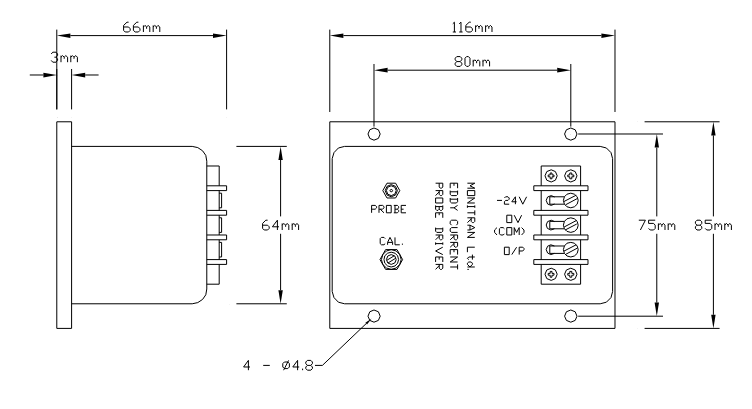
| Mechanical Assembly | DIN rail or mounting plate |
| Maximum System Length | 9 meters of shielded coaxial cable |
| Connectivity | Industrial screw terminals |
| Configurable Models | ECPD24V, ECPD/78, ECPD/60, ECPD85, ECPD2 |
Other products