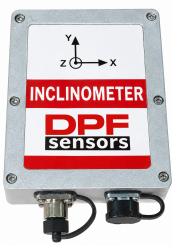
DPS-VGPC – PROFINET 2-axis dynamic inclinometer
- Manufacturer: DPF Sensors
- Category: Inclinometers, SENSORS
He PROFINET DPS-VGPC 2-axis dynamic inclinometer
It is an industrial sensor designed to measure the
pitch and roll of machinery,
moving vehicles and platforms. Combines
MEMS accelerometers and gyroscopes through technology
of inertial sensor fusion (IMU) and a
six-state Kalman filter to estimate
the tilt even in the presence of accelerations and vibrations.
Unlike conventional inclinometers that are based
primarily in gravity, the DPS-VGPC also uses
angular velocity information to compensate for part of the
disturbances caused by movement. It offers
Declared dynamic accuracy of 0.3°,
angular resolution of 0.01° and one
100 Hz refresh rate.
It incorporates native PROFINET IO communication,
allowing the integration of tilt measurements into systems
compatible industrial automation and PLCs.
Its construction with IP67 protection and temperature
operating -40 to +85 °C allows you to use it
in demanding industrial applications, such as cranes, machinery
construction, agricultural equipment, robotics and mobile platforms.
Features of the DPS-VGPC dynamic inclinometer
- Two-axis measurement: pitch ±90° and roll ±180°.
- Technology: MEMS accelerometer and gyroscope with sensor fusion and Kalman filtering.
- Dynamic precision: 0.3° according to the manufacturer's specification.
- Resolution: 0.01°; declared static accuracy of 0.01°.
- Communication: PROFINET IO for integration with compatible controllers.
- Measure update: 100 Hz (10 ms).
- Protection and feeding: IP67, 12–36 Vdc and −40 to +85 °C.
Functioning, integration and applications
MEMS dynamic measurement: accelerometer, gyroscope and Kalman filter
The DPS-VGPC is a dynamic inclinometer with fusion of
inertial sensors. It uses accelerometers to
detect accelerations, including the gravitational component,
and gyroscopes to measure the angular velocity of the movement.
An estimation algorithm based on a
six-state Kalman filter combines
These signals are used to obtain an estimated orientation.
The technology incorporates drift compensation and algorithms
intended to improve the stability of the measures.
This functionality is especially useful when the
The machine accelerates, brakes, rotates, or is subjected to vibrations.
Compared to a purely static inclinometer, the information
The gyroscope helps to differentiate the movements of the
structure of the accelerations that affect the accelerometer.
Compensation does not eliminate all errors nor does it replace
the specified dynamic accuracy limits.
Pitch and roll measurement
- Pitch (heading): longitudinal inclination, with a range of ±90°.
- Roll (rolling): transverse inclination, with a range of ±180°.
- Angular resolution: 0,01°.
- Declared dynamic accuracy: 0,3°.
- Update frequency: 100 measurements per second.
In addition to tilt measurement, the internal technology
It uses inertial parameters such as acceleration and velocity
Angular. Its availability as data transmitted by
PROFINET must be confirmed for the requested configuration.
PROFINET IO communication and integration with industrial PLCs
He DPS-VGPC with PROFINET IO interface
It is designed to transmit tilt angles
to industrial controllers and monitoring systems
compatible with this industrial Ethernet protocol.
The PROFINET interface is integrated into the sensor itself.
Therefore, it does not require an external gateway from
CANopen, Modbus or an analog signal to provide
its native PROFINET interface.
Available data and integration
- Protocol: PROFINET IO.
- Documented process data: pitch and roll angles.
- Declared communication cycle: 10 ms.
- Internal update of measures: 100 Hz.
- GSDML file: available according to the manufacturer.
- Conformity class: B, as declared by the manufacturer.
Integration with Siemens PLCs and other controllers
The DPS-VGPC can be considered for installations with
Siemens S7-1200, S7-1500 PLC and others
controllers with compatible PROFINET IO functionality.
Before integrating it, the GSDML file must be checked.,
the data map, the firmware version, the configuration
network and driver compatibility.
The documentation indicates support availability.
RT/IRT, but the specific functions must be verified,
the type of physical connection and the compliance documentation
applicable to the supplied equipment.
Technical note: the 10 ms PROFINET cycle
and the internal measurement refresh rate of 100 Hz are
different specifications. By themselves they do not establish
neither total latency nor a deterministic response is guaranteed
of the entire control system.
Applications: cranes, mobile machinery, robotics and platforms
The dual-axis dynamic inclinometers
They are used when it is necessary to know the orientation.
of a structure that can experience movement,
accelerations or vibrations during operation.
Cranes and lifting equipment
- Monitoring the pitching and rolling of mobile structures.
- Tilt monitoring during machine movements.
- Angular measurement of platforms and lifting components.
Construction and agricultural machinery
- Measurement of chassis tilt and mobile structures.
- Supervision of orientation during movements and maneuvers.
- Acquisition of tilt data for machine automation.
Robotics, AGVs and mobile platforms
- Measuring pitch and roll in robots and moving platforms.
- Orientation supervision in automated guided vehicles (AGVs).
- Integration of angular measurements into control and acquisition systems.
Naval applications and stabilized platforms
- Measurement of pitching and rolling of vessels.
- Tilt tracking on mobile platforms.
- Orientation measurement during mechanical tests and movements.
IP67 protection does not in itself imply suitability
for permanent submerged operation.
Underwater applications require verification
specifically the sealing conditions,
pressure and assembly.
Mechanical installation, shaft alignment, and vertical assembly
To obtain reliable measurements, the inclinometer must
to be installed on a flat, rigid surface
and stable, avoiding looseness or movement
relatives between the sensor and the measured structure.
The DPS-VGPC reference axes must be aligned
correctly with the longitudinal and transverse axes
of the team. Misalignment can introduce errors
of measurement or cause incorrect interpretations
of the pitch and roll angles.
- Use a flat, rigid mounting surface.
- Ensure a firm, loose mechanical fixation.
- Respect the reference axes indicated by the manufacturer.
- Avoid mechanical deformations and relative movements.
- Verify the intended orientation before selecting the equipment.
The manufacturer envisions horizontal installation or
vertical. However, the vertical mount
requires a specific factory configuration,
which must be indicated when ordering the sensor.
The equipment has IP67 protection and temperature
Operating temperature range: -40 to +85 °C. Checking is necessary.
also the electrical connection conditions,
cabling and environmental exposure of the installation.
Sensor versions: PROFINET, Modbus and 4–20 mA outputs
The family of dynamic inclinometers described
The documentation includes different interfaces.
to adapt to control and acquisition systems.
- PROFINET IO version:
digital communication via PROFINET industrial network,
geared towards integration with compatible PLCs. - Modbus version:
digital interface for control systems
and monitoring that use this protocol. - Analog version:
two independent 4–20 mA signals,
corresponding to the pitch and roll axes.
This sheet corresponds to the DPS-VGPC version
with PROFINET IO. It should not be interpreted that
It simultaneously incorporates 4–20 mA or Modbus outputs.
To select the appropriate version, it is necessary
define the communication protocol, the controller,
the tilt range, the mounting orientation
and the data that needs to be transmitted.
Frequently Asked Questions about the PROFINET DPS-VGPC Inclinometer
What is the difference between a dynamic inclinometer and a static inclinometer?
A static inclinometer determines the inclination
primarily from the direction of gravity.
A MEMS dynamic inclinometer like the
DPS-VGPC combines accelerometers and gyroscopes to estimate
orientation while the machine is moving.
Sensor fusion allows for some compensation of the
disturbances due to accelerations and vibrations.
Can the DPS-VGPC be connected to a Siemens S7-1200 or S7-1500 PLC?
The DPS-VGPC incorporates Native PROFINET IO,
Therefore, it can be considered for controllers
Siemens S7-1200, S7-1500 or other PLCs that have
of compatible PROFINET IO functionality.
The integration requires verifying the GSDML file,
the driver version and the data map.
Exact compatibility must be confirmed beforehand.
of its commissioning.
How accurate is the DPS-VGPC during movement?
The technical sheet specifies a
dynamic accuracy of 0.3°,
a static accuracy of 0.01°
and one angular resolution of 0.01°.
These are three different parameters. The resolution
does not equate to precision when the machine
is subject to accelerations or vibrations.
Does the PROFINET DPS-VGPC inclinometer have PROFIsafe or SIL2?
The available documentation identifies
PROFINET IO and declares a class of
conformity B, but does not provide certification
PROFIsafe, SIL2 or PLd.
These features should not be taken for granted.
If the sensor is needed for a safety function,
The requirements must be verified beforehand.
regulations and system certifications.
GUEMISA technical advice
Do you need to integrate a
PROFINET two-axis dynamic inclinometer
in your machinery or automation system?
Please provide the PLC model, the angular range,
the assembly instructions and the data you need
receive. At GUEMISA we help you review the
specifications of the DPS-VGPC,
confirm the integration requirements and
select the appropriate configuration for your project.
See also our
range of industrial inclinometers and tilt sensors
.
Properties
| TECHNICAL SPECIFICATIONS · DPS-VGPC PROFINET | |
|---|---|
| Sensor type | Two-axis MEMS dynamic inclinometer |
| Model | DPS-VGPC · PROFINET version |
| Measurement technology | MEMS accelerometers and gyroscopes; 6-state Kalman filter |
| Axes / angles | 2 axes · pitch and roll |
| Pitch range | ±90° |
| Roll range | ±180° |
| Declared dynamic accuracy | 0,3° |
| Declared static accuracy | 0,01° |
| Angular resolution | 0,01° |
| Measurement update frequency | 100 Hz (10 ms) |
| Communication | integrated PROFINET IO |
| Process data identified | Pitch angle and roll angle |
| GSDML file | Listed as available |
| PROFINET communication cycle | 10 ms (according to the data sheet) |
| PROFINET Conformity Class | Class B (manufacturer's declaration; certificate not provided) |
| Feeding | 12–36 Vcc |
| Operating current | 20–60 mA (value indicated in the general series table) |
| Operating temperature | -40 to +85 °C |
| Storage temperature | -55 to +100 °C |
| Environmental protection | IP67 |
| Approximate dimensions (L × W × H) | 125 × 103 × 39 mm (exact dimensions pending standardization) |
| Mechanical shock resistance | 2,000 g / 0.5 ms / 3 shocks per axle (according to specifications) |
| Insulation resistance | ≥100 MΩ |
| Electromagnetic compatibility | GB/T Series 17626 (according to data sheet) |
| Mounting | Rigid, flat surface; vertical mounting with factory-specific configuration |
Note: Confirm the Ethernet connector format and RT/IRT implementation with the supplier before ordering or cabling. The original connector has a discrepancy in housing length (124.6 and 124.9 mm).
Related documentation, cases, and guides
Technical documentation
- Notes on sensors: presence, position, distance, and temperature
- TST-1x, YCA360 and CSA-xx inclinometers for the solar and wind energy sector
- Load cells and strain gauges: types and operation
- CO2, VOC and humidity sensors DPF Sensors: model catalog
- DPF Sensors humidity and temperature sensors: overview by model
- Humidity sensors: types, principles and applications
Other products