
















Torque Sensor DF Ibex 5 | 10,000 Nm | 12,000 RPM
- Manufacturer: CENSORED
- Category: Torque sensor, SENSORS
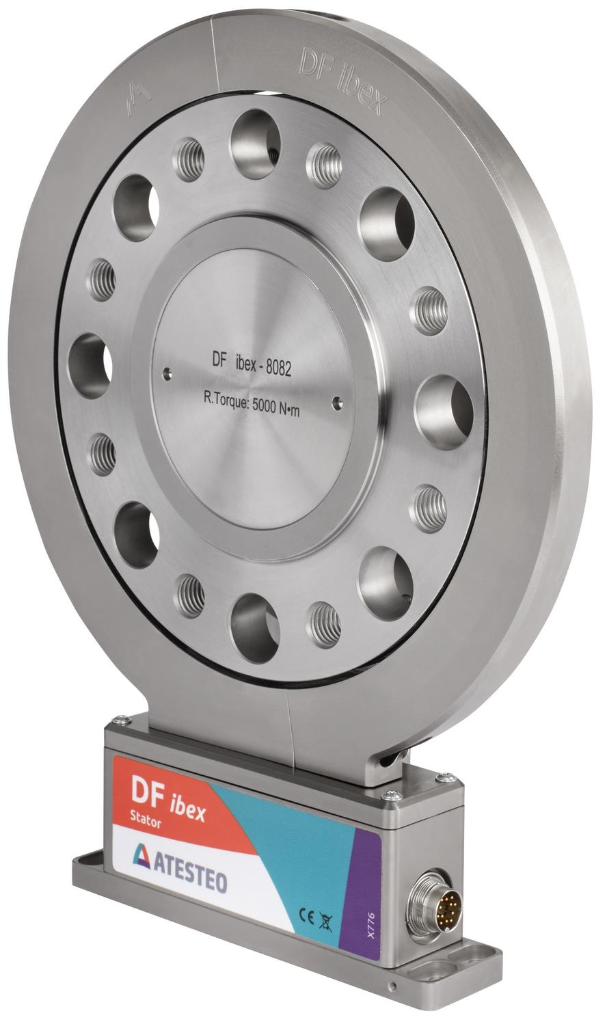
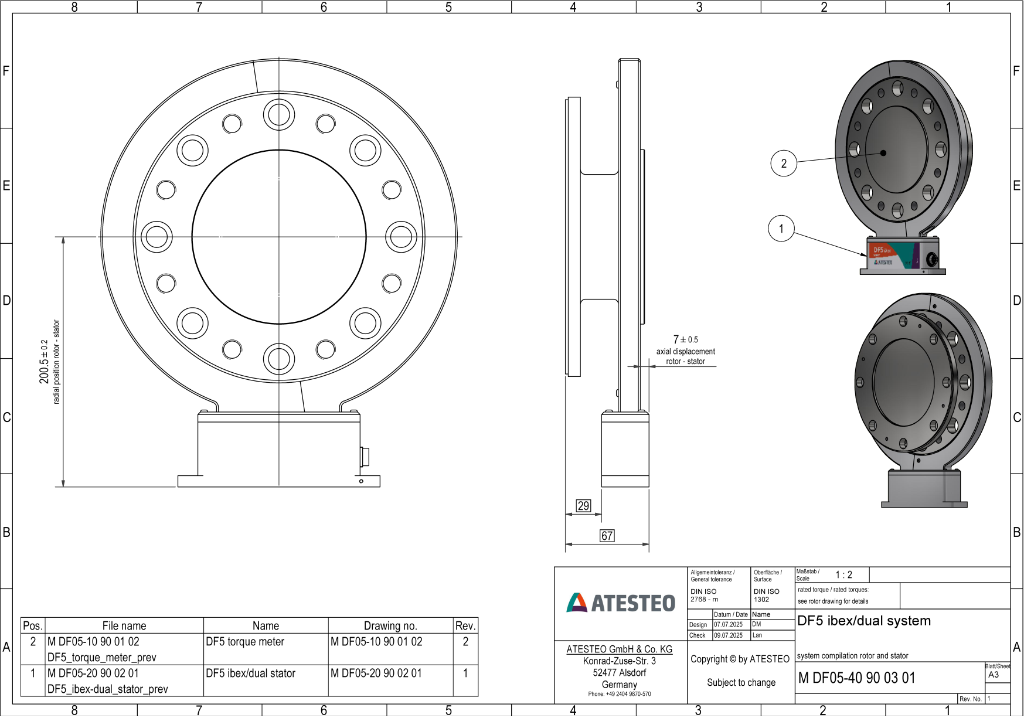
He Torque Sensor DF Ibex 5 It stands out as the most robust metrological axis in the series, specifically designed for instrumentation in extra-heavy land and marine dynamometer testing, as well as for large-scale testing of industrial e-drives. Built on its iconic split-ring stator, the system enables radial concentric insertion onto large-diameter transmission lines (PCD 196.0 mm) without requiring the monumental effort of decoupling the primary shafts. The core of the Ibex 5 is shielded to continuously handle colossal torsional demands of up to 10,000 N·m, absorbing severe asymmetric vibrations resulting from heavy structural inertia.
Revolutionizing conventional physical friction bearing metrology, this sensor operates entirely remotely via interactive inductive field telemetry. The complete absence of mechanical contact eliminates core heating and continuous wear when pushing sustained limits of 12,000 RPM. Furthermore, its robust 7.8 kg rotor boasts a balanced geometric inertia of only 0.0470 kg·m², vectoring the pure torque collected by the DMS array to suppress parasitic centrifugal disturbances. Instant connectivity ensures analytical calibrations with error margins as low as 0.02%, driven from the TCU5 evaluator to high-frequency RS422 outputs and CAN 2B routing. Sizing your heavy equipment requires top-tier instrumentation: design your test pipeline by exploring our core cluster of Industrial Torque Sensors or inspect tactical units in the original page from Gemisah.
Engineering Analysis (FAQ)
The colossal pitch diameter (PCD) of 196.0 mm anchors a massive torsional foundation, virtually indestructible against the brutal deformation energy caused by rigidly braking 10,000 N·m. Pairing this level of static resistance with "Split Ring" technology allows the manufacturing plant to radially assemble the collection sensor; saving the operating team from arduous months of machine downtime dedicated to the structural decoupling of the massive coupling shafts.
Under what specification does the Ibex 5 process clean data of 0.02% while dragging 10 kN·ma at a high speed of 12,000 RPM?
All the heat generated by the rotation is completely suppressed thanks to the inductive dielectric field. Lacking any structural friction components (such as sealed gimbals) and concentrating the aerodynamic vacuum under 0.0470 kg·m² of inertia, the TCU5 processing unit's electrometric network perceives only the actual torque experienced, discarding latencies and harmonic resonances from the high-speed centrifugal regime.
Properties
| Maximum Nominal Pair Range (Mnom) | 10,000 N·m (Base version starts at 5,000 Nm) |
| Metrological Precision Class | 0.05% (Optional assessment restricted to 0.02%) |
| Maximum Speed Continuous Acceleration | 12,000 RPM |
| Teleseismic Measurement Principle | PCM-shielded Inductive Transmission Strain Gauges (DMS) |
| Massive Primitive Circle Diameter (PCD) | ISO calibrated plate 196.0 mm |
| Cylindrical Outer Diameter of Rotor | 230 mm |
| Radial Transverse Constructive Length | 60 mm |
| Geometric Inertia of Constant Drag | 0.0470 kg·m² (Lumped Dynamic Rotational Mass) |
| Dynamic Weight (Rotor/Stator) | 7.80 kg / 1.22 kg |
| Analytical Telecommunications Outputs (TCU5) | High Frequency RS422 Transmission, Linear Scalar Analog, Profibus CAN 2B Network |
| Voltage Incoming Electrical Power | 24V DC Multiple |
| Sustained Thermal Operating Spectrum | Analytical boundary from 0 °C to fixed peaks of +80 °C |
| IP Enclosure and Insulation Standards | NEMA IP54 Operational Industrial Shielding |
Other products