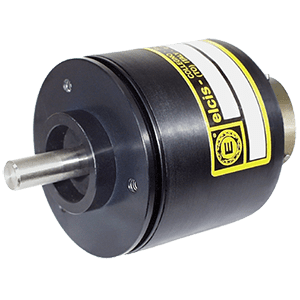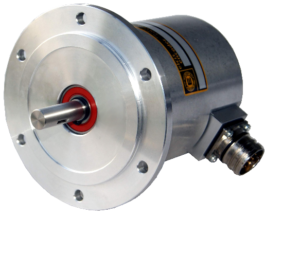




















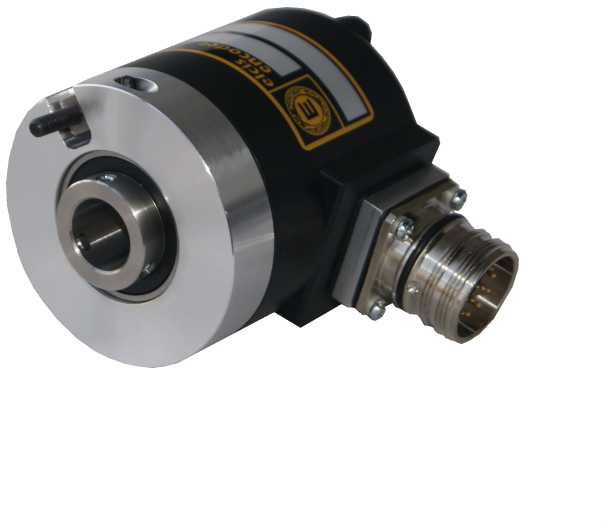
Single-turn Absolute Encoder A/759C
- Category: Encoder, Absolute Encoder, Single-turn Absolute Encoder, SENSORS
The A/759C single-turn absolute encoder solves the critical need for precise, homing-free positioning in applications where motion may stop unexpectedly. It eliminates reliance on external sensors to find the zero point, ensuring immediate stability upon system power-up and preventing downtime for recalibration.
Its SSI interface allows clock-synchronized data transmission up to 500 kHz, while the RS422 option facilitates ASCII communication over longer distances without significant electromagnetic interference. The maximum physical resolution reaches 65536 (16 bits), programmable in Gray or Binary to suit the controller's logic.
Constructed with a VALOX 420 anodized aluminum housing and a hollow stainless steel shaft, it withstands radial/axial loads of 4 kg and vibrations of 4 kg. This robust industrial design ensures continuous operational reliability in demanding environments. Available in guemisa.es.
- Maximum programmable resolution up to 65536 (16 bits) with Gray or Binary code.
- SSI interface with preset and RS422 option for ASCII data transmission.
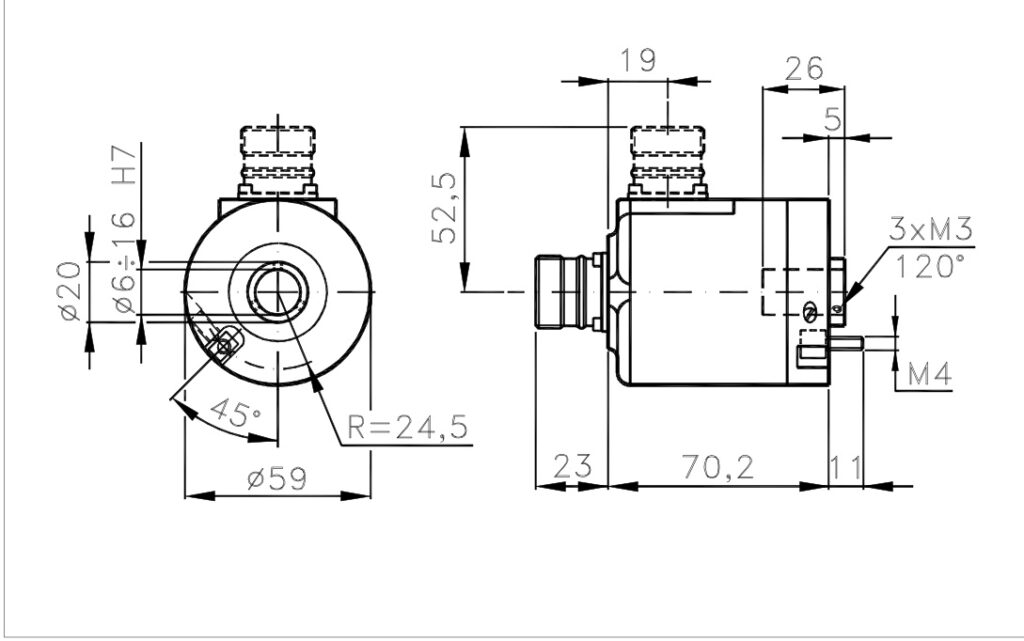
- VALOX 420 anodized aluminum housing with hollow shaft up to Ø 15 mm.
- Stable power supply between 10÷30V DC with a maximum consumption of 200 mA.
Technical Frequently Asked Questions
How does the A/759C model differ from the standard incremental encoder?
The A/759C offers absolute positioning without homing, resolving loss-of-reference problems in critical systems. Unlike incremental models that require a start pulse for reading, this model maintains accurate positioning even after power outages.
What alignment precautions does the encoder shaft require during assembly?
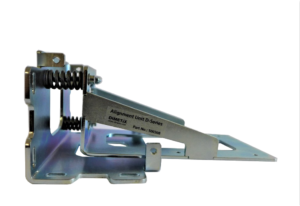
The hollow stainless steel shaft (Ø6÷15mm) must be perfectly centered to prevent radial loads exceeding 5 kg. It is crucial to ensure the anti-rotation pin is properly secured to maintain mechanical integrity during continuous operation.
What connectors and output options are available for the A/759C?
It includes an SSI interface with presets and an RS422 option for ASCII data transmission, as well as incremental Sine/Cosine outputs to 1024 positions. The standard connection allows direct access to the DATA+, DATA-, CLOCK+, and CLOCK- lines for direct integration into controllers.
What are the environmental conditions or operating limits of the Encoder?
It operates between -20 ÷ +85°C and withstands maximum temperatures up to +85°C, with impact resistance of 50 G. The anodized aluminum housing protects the internal components against corrosion and extreme thermal variations.
How does the A/759C integrate with control systems via an SSI interface?
It uses the SSI protocol synchronized with Clock, DIR, and PRESET, allowing reading from MSB to LSB in binary or Gray mode. Programming is possible via PC software connected by USB or directly through the RS422 option for remote configuration.
Properties
| Feature | Specification |
|---|---|
| Sensor Type | OptoAsico |
| Maximum Physical Resolution | 8 bits (256 positions) |
| VCC Power Supply | 10-30V DC |
| Maximum Consumption | 200 mA |
| Maximum Continuous RPM | 6.000 / 3.000 / 8.000 |
| Maximum Clock Frequency | 500 kHz |
| Operating Temperature | -20 – +85 °C |
| Housing Material | VALOX 420 Anodized Aluminum |
| Material Axis | Stainless Steel Ø 6–15 mm. |
| Shaft Diameter Available | Stainless Steel Ø 6–15 mm. |
| Device Weight | 340 g |
| Maximum Radial/Axial Load | 4 Kg |
| Impact Resistance | 50 G x 11 ms |
| Vibration Resistance | 12 G (10 – 2000 Hz) |
| Bearing Life | 1.5 × 10⁹ revolutions |
Other products