
Case study · Dimetix
Case statement
Companies in the metalworking sector need to control various quality and process optimization factors. This document describes three customer cases involving Dimetix laser sensors.
| Fact | Worth |
|---|---|
| Industry | Metallurgical |
| Application type | Level and production process control |
| Case 1 | Homogeneous ingot manufacturing |
| Case 2 | Level in the storage tanks of the aluminum injection presses |
| Case 3 | Homogeneous production of steel bars and tubes |
Aluminum ingots: online fill level
A customer needed to ensure that all ingots had the same amount of aluminum in the molds. They achieved this by measuring the ingot fill level online with a sensor and coordinating the conveyor belt's advance level.
- Quality of manufacture assured.
- Optimized production.
- Fewer reprocessing steps: it avoids remelting ingots that did not meet specifications.


Aluminum injection molding presses: tank level
Another customer implemented a system for monitoring the fill level of the storage tank in their aluminum injection molding machine. The sensor alerts the operator of the transport ladle when the machine needs to be refilled.


Steel bars and tubes: diameter control in continuous casting
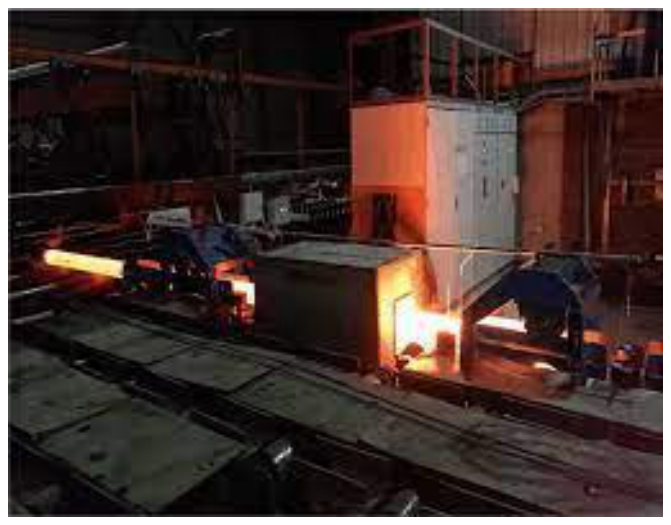
In the continuous casting furnace control system, the sensor measures the diameter of steel tubes and bars at the extruder outlet. The document attributes the result to the sensors' measurement stability up to 60°C.
In some cases the temperature was 120°C. For these, protective housings were designed for the sensor, with Peltier effect cooling, which allow it to withstand high temperatures.


Dimetix sensor data
| Feature | Worth |
|---|---|
| Stable operating temperature | -40 to +60 °C |
| Range on reflective sheeting | up to 500 m |
| Range on natural surfaces | up to 100 m |
| Precision | ± 1 mm |
| Repeatability | ± 0.3 mm |
| Standard interfaces | SSI, RS-422/485, RS-232 and 2 digital outputs |
| Industrial Ethernet interfaces (optional) | PROFINET, EtherNET/IP and EtherCAT |
| Protection | IP65 |
| Weight | 500 g |
| Housing | Aluminum |
| Facility | Visible laser beam |
| Configuration | Free software |
| Maintenance | Maintenance-free operation |
Factory calibration
- 100% of the sensors and electronics are calibrated and tested, one by one.
- Thermal drift calibration in a climate cabinet from -40°C to +70°C, with 2,000 readings per sensor.
- Longitudinal calibration on a 40 m long mobile calibration bench.
- According to the model, calibration with a fixed point at 500 m.

Frequently Asked Questions
What does the sensor measure in the case of aluminum ingots?
The ingot filling level is monitored online to ensure that all ingots have the same amount of aluminum in the molds. This is coordinated with the conveyor belt's advance level.
What is the sensor used for in aluminum injection molding presses?
To monitor the fill level of the storage tank and alert the operator of the transport bucket when the machine should be filled.
What happens when the temperature reaches 120°C?
In some cases, protective housings were designed for the sensor with Peltier effect cooling at 120°C.
What is the range of Dimetix sensors?
Up to 500 m on reflective sheeting and up to 100 m on natural surfaces, with an accuracy of ± 1 mm and repeatability of ± 0.3 mm.
What interfaces are included as standard?
Multiple interfaces including SSI, RS-422/485, RS-232 and 2 digital outputs. Optionally, PROFINET, EtherNET/IP and EtherCAT.
Related
- Non-contact measurement in steel mills and metallurgy with Dimetix laser sensors
- Dimetix laser in cutting and machining: a practical case
- Dimetix: Comparison table of 8 laser sensors
- Laser distance sensors
- Dimetix
- All technical information about GUEMISA
Below, the original PDF document is available for viewing or downloading.