
Technical guide · GUEMISA
Choose a potentiometric sensor if you need a simple, low-power solution for strokes up to about 900 mm; a magnetostrictive sensor if the stroke is long and the measurement must be contactless and accurate; and an LVDT sensor if the stroke is short and you want virtually infinite resolution and wear-free life. All three measure absolute linear position, but each does so using a different physical principle, and their limitations are derived from this principle.
There is also a fourth option, the NOVOPAD type contactless inductive sensor, which fills the gap between the potentiometric and the LVDT with standard analog output.
How each principle works
Potentiometric
A conductive plastic track has a metal cursor that slides along it. The sensor functions as a voltage divider: the voltage across the cursor is proportional to its position. It requires no electronics, only a supply voltage and a very small cursor current, as low as 1 µA in the Novotechnik LWH and TEX models.
Magnetostrictive
A rod or profile contains a guide wire through which a current pulse is sent. A marker with a magnet, which moves along the sensor without touching it, generates a mechanical wave; the sensor measures the time it takes for that wave to reach the end and deduces the position from it.
LVDT
A differential transformer has one primary winding and two secondary windings. A movable core, which does not touch the coils, modifies the coupling between them, and the voltage difference indicates the position. Because there is no friction, the theoretical resolution is infinite, and there is no wear due to friction between the core and the coils.
NOVOPAD Inductive
A system of transmitting and receiving coils on a plate detects a marker or a rod without electrical contact between them. The LS1 does this with a rod, and the TF1 with an independent floating marker.
Comparative table
| Criterion | Potentiometric | Magnetostrictive | LVDT | NOVOPAD Inductive |
|---|---|---|---|---|
| Principle | Cursor on conductive plastic track | Wave propagation time to a magnetic marker | Moving core in a differential transformer | Transmitting and receiving coils on a plate |
| Contact and wear | With contact; lifespan of up to 100 million movements (LWH, TEX) | Contactless; unlimited mechanical life (TH1, TP1) | Core without contact with the coils, no wear due to friction | Contactless on the TF1; the LS1 has a stem with bearings and a lifespan of up to 100 million movements |
| Typical races | 10…900 mm (TEX, LWH); more with yarn | 50…4250 mm (TH1, TP1) | 5…20 mm (F200); up to 360 mm in amplified LVDTs | 25…200mm (LS1); 100…1000 mm (TF1) |
| Resolution and accuracy | Resolution less than 0.01 mm; linearity ±0.04…±0.25% | Resolution up to 1 µm; linearity up to ±0.02% FS (TH1, TP1) | Near-infinite resolution; linearity ±0.1…±0.3% (F200) | Linearity ±0.15% (LS1); ±0.025% FS (TF1) |
| Exit | Voltage divider | 0.1…10 V, 4…20 mA, and also SSI, CANopen, IO-Link | ±10V (F200); 4…20 mA or 0…10 V in amplified | 0.1…10 V or 4…20 mA |
| Around | IP54 to IP67 depending on the model; -40…+85 °C (TEX) | IP67/IP68; -40…+85 °C; 350 bar on rod (TH1) | IP67 with connector (F200); up to 315 bar on SM46 | IP40 (LS1); IP67 (TF1); -40…+85 °C |
| When to choose it | Short or medium stroke, simple measurement and minimal electronics | Long strokes, hydraulic cylinders, continuous measurement without wear | Short strokes, very fine resolution, humidity or pressure (SM46) | Standard contactless analog output, or immunity to magnetic fields |
Decision criteria
Career
Below 20 mm, the LVDT is the natural choice. Between 25 and 900 mm, the potentiometric and inductive sensors compete. Above 1000 mm, the magnetostrictive reaches 4250 mm in the Novotechnik TH1 and TP1, and the wire sensor covers even longer strokes using a different principle.
Contact and wear
The potentiometer wears out with use, although the manufacturer's stated lifespan is around 50 to 100 million movements depending on the model. If the application has thousands of cycles per hour or operates continuously, a contactless sensor is safer.
Resolution and signal
The potentiometer provides a voltage ratio that any analog input can read if the circuit does not load the wiper. Magnetostrictive and inductive potentiometers have their own electronics and provide standardized or digital outputs.
Around
Dirt, dust, and moisture negatively affect the cursor and track. Magnetostrictives are available in IP67/IP68 versions, and the TF1 is IP67 with a pressure equalization membrane. Strong magnetic fields can disrupt a magnetostrictive; the TF1 is described by its manufacturer as resistant to them.
Which GUEMISA products are a good fit?
 Novotechnik LWHPotentiometric stem from 50 to 900 mm, resolution less than 0.01 mm, IP55.View technical specifications →
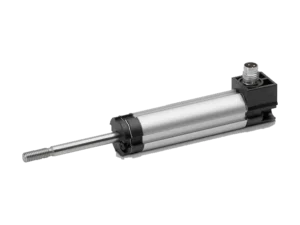 Novotechnik TEXPotentiometric from 10 to 300 mm, IP54, .View technical specifications →
 Novotechnik TH1magnetostrictive from 50 to 4250 mm, linearity ≤ ±0.02 % FS, 350 bar.View technical specifications →
 Novotechnik TP1magnetostrictive profile from 50 to 4250 mm, IP67 / IP68.View technical specifications →
 Novotechnik TM150 to 2000 mm magnetostrictive, IP67, for cylinders.View technical specifications →
 Novotechnik LS1NOVOPAD inductive sensor, 25 to 200 mm, output 0.1…10 V or 4…20 mA, IP40.View technical specifications →
 Novotechnik TF1inductive non-contact from 100 to 1000 mm, linearity ≤ ±0.025 % FS, IP67.View technical specifications →
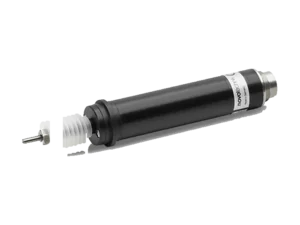 Novotechnik F200LVDT with 5 to 20 mm stroke, ±10 V output.View technical specifications →
For more LVDT, see the categories of LVDT and of amplified LVDTs; he FTI 10 It is a 10 mm model with an output of 4…20 mA.
Documentation and related cases
- Potentiometers: Technical Definitions by Novotechnik (PDF, English)
- LVDT: What it is and how it works (PDF)
- Displacement sensors: general catalog (PDF)
- All technical information about GUEMISA
Frequently Asked Questions
Is an LVDT the same as an inductive sensor?
The LVDT is a type of inductive sensor, based on a differential transformer with a moving core. NOVOPAD inductive sensors use coils on a plate and a marker, not a core.
Which one has higher resolution?
The LVDT, theoretically infinite but limited by electronics. The Novotechnik TH1 magnetostrictive reaches 1 µm and the potentiometric to less than 0.01 mm.
When should you not use a potentiometer?
With long runs, very frequent movements, or in very dirty environments, a contactless sensor reduces wear and tear.
Can they be used in hydraulic cylinders?
Yes, rod magnetostrictives like the TH1 or TM1 are integrated into the cylinder, and the LVDT SM46 supports 315 bar. Potentiometrics are external to the cylinder.
What output do I need for a PLC?
Magnetostrictive and inductive transformers provide 4…20 mA or 0…10 V; the potentiometer delivers a voltage divider and the LVDT without electronics requires a conditioner.
Send us the application, race or reference you have and we will tell you the model and your order code.