





















Laser distance sensors
A laser distance sensor It is a non-contact measuring device that uses a light beam to accurately determine the distance between the sensor and an object. In industrial applications, it is used to measure position, displacement, separation, height, dimensions or level, both on static and moving objects.
The industrial laser distance sensors They allow measurements to be taken from very short distances up to tens of meters, and in certain systems, considerably greater distances. The correct choice depends not only on the range: other factors also play a role. accuracy, repeatability, measurement speed, object surface area, laser spot size, environmental conditions, and output signal.
For this reason, a sensor suitable for measuring at 1 meter with submillimeter accuracy may use a different operating principle than one needed for measuring at 10, 20, 50, or 100 meters. Selecting the correct technology is just as important as selecting the range.
- Non-contact measurement: without mechanical wear or contact with the object.
- Wide measurement range: from centimeters to long distances, depending on the technology and model.
- High precision: from micrometer precision in short-range applications to millimeter precision at several meters.
- Static or moving objects: different measurement frequencies depending on the dynamics of the application.
- Industrial integration: analog signals, serial interfaces, digital inputs/outputs and industrial Ethernet depending on the equipment.
How to choose a laser distance sensor?
To select a laser sensor, simply specifying the maximum distance is not enough. Two applications measuring at the same distance may require completely different sensors if the required accuracy, the object's color, its speed, or the environmental conditions change.
As a general guide, these are some of the typical ranges in industrial applications:
| Approx. distance | Common applications | Important aspects |
|---|---|---|
| Less than 1 m | Dimensional control, thickness, small displacements, precision positioning | Resolution, linearity, laser spot size, and surface type |
| 1 to 10 m | Machine positioning, height, separation, process control | Accuracy, repeatability, target surface area, and measurement frequency |
| 10 to 20 m | Automation, logistics, level, positioning, and mobile machinery | Reflectivity, ambient light, object speed, and communication interface |
| 20 to 50 m | Silos, large machines, automated warehouses, overhead cranes and industrial facilities | Signal stability, laser spot size, alignment, and environmental conditions |
| 50 to 100 m | Infrastructure, large facilities, monitoring, logistics and positioning | Lens reflectivity, atmospheric conditions, mounting accuracy and stability |
| More than 100 m | Large structures, cranes, intralogistics and large-scale facilities | Use of reflector when necessary, alignment, lens size and environmental conditions |
How does a laser distance sensor work?
The sensor emits a laser beam towards the object to be measured. Part of that light returns to the receiver of the device, and by analyzing the received signal, the sensor calculates the distance.
The procedure used to calculate it depends on the measurement technology. In industrial sensors, the following are mainly used: triangulation, time of flight, and phase comparison or shifting.
Laser triangulation
In a triangulation sensor, the beam is projected onto the surface and the reflected light reaches an optical detector at an angle that varies depending on the distance. The object's position is determined from this geometry.
It is a technology particularly well-suited for short distances and high-precision measurements, such as dimensional control, thickness, deformation, profiling and small displacements.
Time of flight (ToF)
The systems Time-of-Flight or ToF They determine the distance based on the time it takes for light to travel from the sensor to the object and back.
They allow working at distances greater than usual in triangulation and are widely used in automation, positioning and object detection.
Comparison or phase shift
In this technology, the laser light is modulated, and the sensor compares the phase of the emitted signal with the signal returning from the target. The distance is calculated from this difference.
It is especially interesting when you need to combine Millimeter precision with ranges of several meters or tens of meters.
What level of accuracy does a laser sensor need?
The required precision depends on the application. To detect the approximate position of a structure, several millimeters of error may be acceptable, while dimensional control may require tenths or hundredths of a millimeter.
It is important not to confuse accuracy, resolution, and repeatability.
- Precision: difference between the measured value and the actual distance.
- Resolution: minimum distance change that the system can represent.
- Repeatability: sensor's ability to provide similar results when repeatedly measuring the same position.
In industrial positioning applications, good repeatability can be as important as absolute accuracy.
Does the color or surface of the object matter?
Yes. The amount and quality of light returning to the sensor depends on the surface being measured. A matte white object, a shiny metal piece, and a black surface can produce very different optical signals.
The dark surfaces They absorb more light and can reduce the available range. Very shiny or specular surfaces can reflect the beam in a different direction than the receiver. Surface roughness, angle of incidence, and object size also have an impact.
For this reason, when selecting a laser distance sensor, it is advisable to know not only the distance, but also what material will be measured, its color, surface finish and possible tilt with respect to the sensor.
Can it be measured without a reflector?
Yes. Many industrial laser sensors are designed to measure directly on the object's natural surface and do not require a reflector.
The available range will depend on the technology used, the power and optical sensitivity of the equipment, and especially on the characteristics of the surface.
Reflectors or reflective sheets are used when it is necessary to increase the intensity of the return signal, improve the stability of the measurement, or work at distances greater than those possible on a natural surface.
Laser measurement of moving objects
When the object is in motion, knowing the sensor's accuracy is not enough. It is also necessary to check the measurement frequency, response time, and output update rate.
A sensor that measures 10 times per second may be sufficient to slowly control a level, but may be inadequate to track a fast-moving part, a crane, a moving cart, or a dynamic process.
It is also important to differentiate between the internal measurement frequency and the frequency with which the equipment can transmit new data to the PLC or acquisition system.
Interfaces and output signals for automation
An industrial laser distance sensor must be properly integrated with the control system. Depending on the manufacturer and model, different outputs and interfaces may be found.
- 0-10 V
- 0/4-20 mA
- RS-232
- RS-422
- RS-485
- SSI
- IO-Link
- Digital inputs and outputs
- PROFINET
- EtherNet/IP
- EtherCAT
The choice depends on the PLC, the distance between the sensor and the control system, the required acquisition speed, and whether it is necessary to transmit only the distance or also diagnostic and configuration parameters.
Applications of laser distance sensors
Laser distance measurement is used when it is necessary to know a position or distance without establishing mechanical contact with the object.
Machinery positioning
It allows determining the position of carts, axles, platforms, moving mechanisms and other machine elements without using cables, measuring wheels or mechanical contact elements.
Automation and logistics
Laser sensors are used for positioning in automated warehouses, AS/RS systems, stacker cranes, conveyors, and mobile equipment.
Level measurement
By measuring the distance to the surface of a material, it is possible to determine the available height or the existing level in certain tanks, silos, and industrial processes.
Overhead cranes and gantry cranes
Non-contact measurement allows the position of the bridge or carriage to be continuously determined and that value to be used within the automation system.
Metallurgical and steel industry
Optical sensors can measure position, length, or level without coming into contact with hot surfaces, moving parts, or materials that make mechanical sensors difficult to use.
Dimensional control
Depending on the technology and precision required, laser measurement can be used to check dimensions, thicknesses, part positions, component separation, and displacements.
Civil works and monitoring
They can also be used to monitor displacements and movements in structures, bridges, pillars, tunnels and other infrastructure when it is convenient to perform the measurement without contact.
Laser distance sensor, photoelectric sensor and LiDAR: are they the same?
No. Although they may use a laser light source, they serve different functions.
A laser photoelectric sensor It is normally used to detect whether an object is present or absent and provides a switching signal.
A laser distance sensor It provides a measured distance value, for example 1,253 mm, 8.42 m or 24.7 m, which can be used by a PLC, controller or acquisition system.
A LiDAR It typically performs multiple measurements and can explore different directions to detect objects, obtain profiles, or generate two-dimensional or three-dimensional maps.
If the goal is to know precisely the distance between a fixed point and a specific target, a point laser distance sensor is usually used.
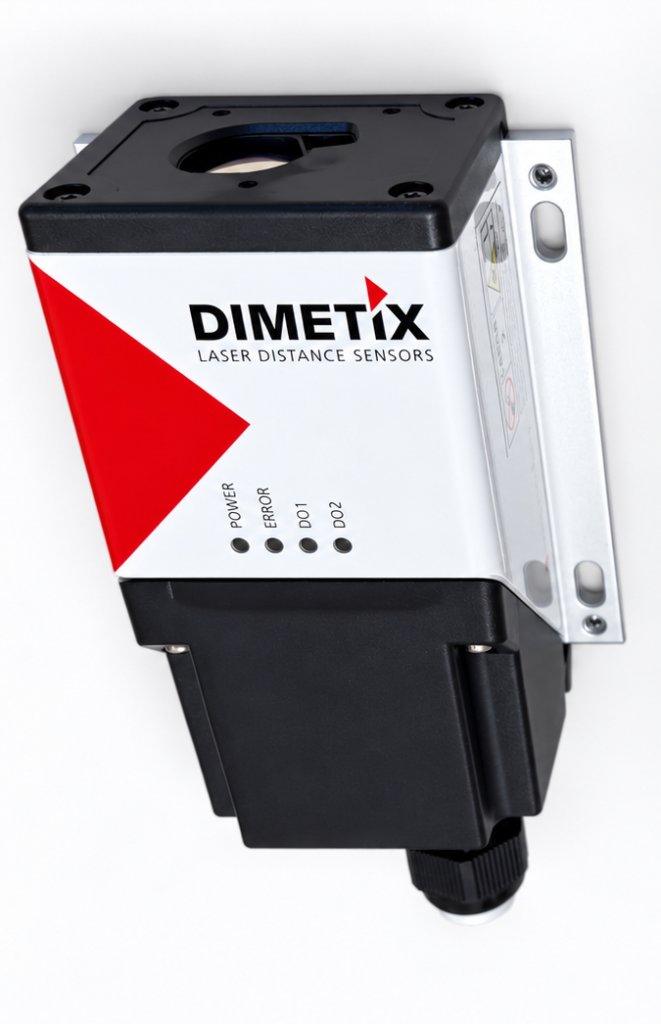
Dimetix Laser Distance Sensors
Within our range of industrial laser sensors, GUEMISA works with Dimetix AG, Swiss manufacturer specializing in precision laser distance measurement for automation, industry and infrastructure.
The D Series offers different versions to adapt the equipment to the accuracy, speed, and range required for each application. Models are available that start measuring from approximately 0.05 m and work directly on natural surfaces up to approximately 50 or 100 m, depending on the model and the reflectivity of the target.
In certain versions, accuracies of up to ±1 mm and measurement frequencies of up to 250 Hz. There are also models designed to significantly extend the range using reflective lenses.
Depending on the version, they may have interfaces such as RS-232, RS-422, RS-485, SSI, 0/4-20 mA analog output, digital inputs and outputs, in addition to options for integration with industrial Ethernet networks.
We have a specific page dedicated to Dimetix Here you can view their models, accessories, and applications. In this category, you can compare different laser distance sensors and select the most suitable one for your application needs.
Frequently asked questions about laser distance sensors
What laser sensor do I need to measure 1 meter?
It depends primarily on the required accuracy. For short distances and very high precision, triangulation is typically used. If millimeter accuracy, industrial robustness, and the ability to use the same sensor over a range of several meters are desired, other distance measurement technologies can be employed.
Which laser distance sensor is suitable for 10 or 20 meters?
At these distances, there are various industrial solutions. To select the appropriate model, you need to know the required accuracy, the material and color of the target, whether the object is moving, and the output required for the PLC or control system.
Is it possible to measure at 50 meters without a reflector?
Yes, there are sensors capable of working on natural surfaces at these distances. The actual range can vary considerably depending on the target's reflectivity, lighting, angle, and environmental conditions.
Can a laser sensor measure a black surface?
Yes, but a dark surface reflects less optical energy than a light surface. Depending on the sensor, this can reduce the maximum range or increase the time required to obtain a stable measurement.
Can a laser sensor work outdoors?
Yes, provided the equipment is designed for it. The degree of protection, temperature range, and performance under direct sunlight, rain, dust, fog, steam, and other installation conditions must be checked.
What information do I need to choose a sensor?
At a minimum, it is advisable to know the minimum and maximum distance, required accuracy or repeatability, target material and color, object speed, environmental conditions, and required output signal or communication protocol.
Products: 21