





















A study confirms the accuracy of direct measurement on the PTO axis
The precise measurement of the torque transmitted by the power take-off (PTO, Power Take-OffThe torque of tractors is a fundamental aspect for understanding the energy behavior of agricultural implements and optimizing machinery management in the field. A study developed by researchers specializing in agricultural engineering has demonstrated that rotary torque sensors installed directly on the PTO shaft can provide highly accurate measurements under real operating conditions.
This work presents the development and validation of a data acquisition system specifically designed to measure torque and rotational speed on the PTO shaft of a tractor without the need to modify the transmission system or the connected implement.
This type of instrumentation allows for the direct evaluation of the power transmitted to agricultural implements such as mowers, balers, shredders, or harvesters, providing valuable information for machinery sizing, energy optimization, and research in agricultural mechanization.
The power take-off: the key point of power transmission
In modern tractors, the power take-off (PTO) is one of the most efficient means of transmitting mechanical power from the engine to the implements. Through the PTO shaft, the rotary power generated by the engine is transferred directly to the implement, enabling the operation of multiple mechanical systems with high levels of efficiency.
However, accurately measuring the torque transmitted at this point in the transmission has traditionally been complex. Many solutions require modifying the implement shaft or incorporating bulky measuring systems that alter the geometry of the tractor-implement assembly.
The objective of the study was precisely to develop a measurement system that could be installed directly on the standard PTO shaft of a tractor and that was capable of reliably recording both the transmitted torque and the rotation speed.
Rotary torque sensor integrated into the PTO shaft
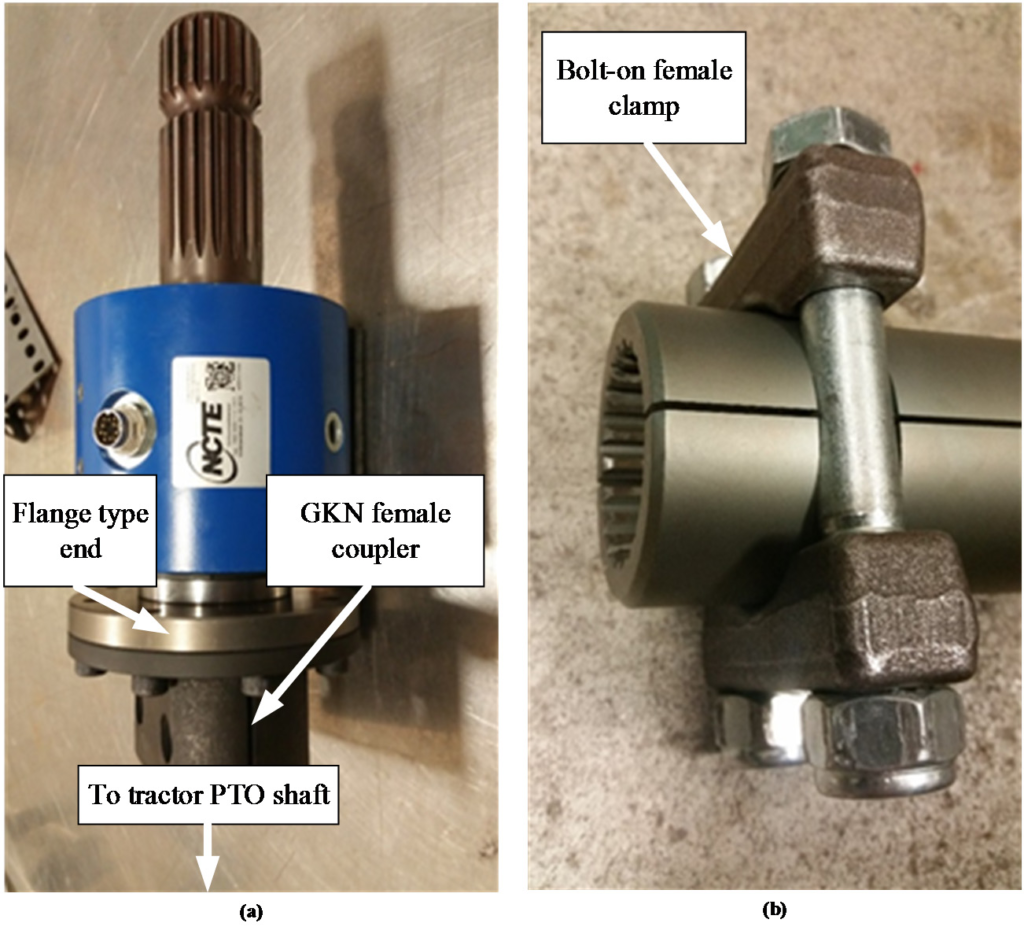
The developed system is based on a rotary torque sensor installed between the tractor and the implement's drive shaft. This sensor measures the transmitted torque while the shaft is rotating, providing an analog signal proportional to the torsional force.
The sensor evaluated in the study is a model specifically designed for PTO applications, capable of measuring torques up to 5000 N·m and rotational speeds up to 3600 rpm. The device integrates mechanical couplings compatible with standard PTO shafts, allowing for direct installation without structural modifications.
One of the system's standout features is its 0–10 V analog output, which facilitates integration with data acquisition systems and instrumentation platforms used in agricultural research.
Data acquisition and measurement recording system
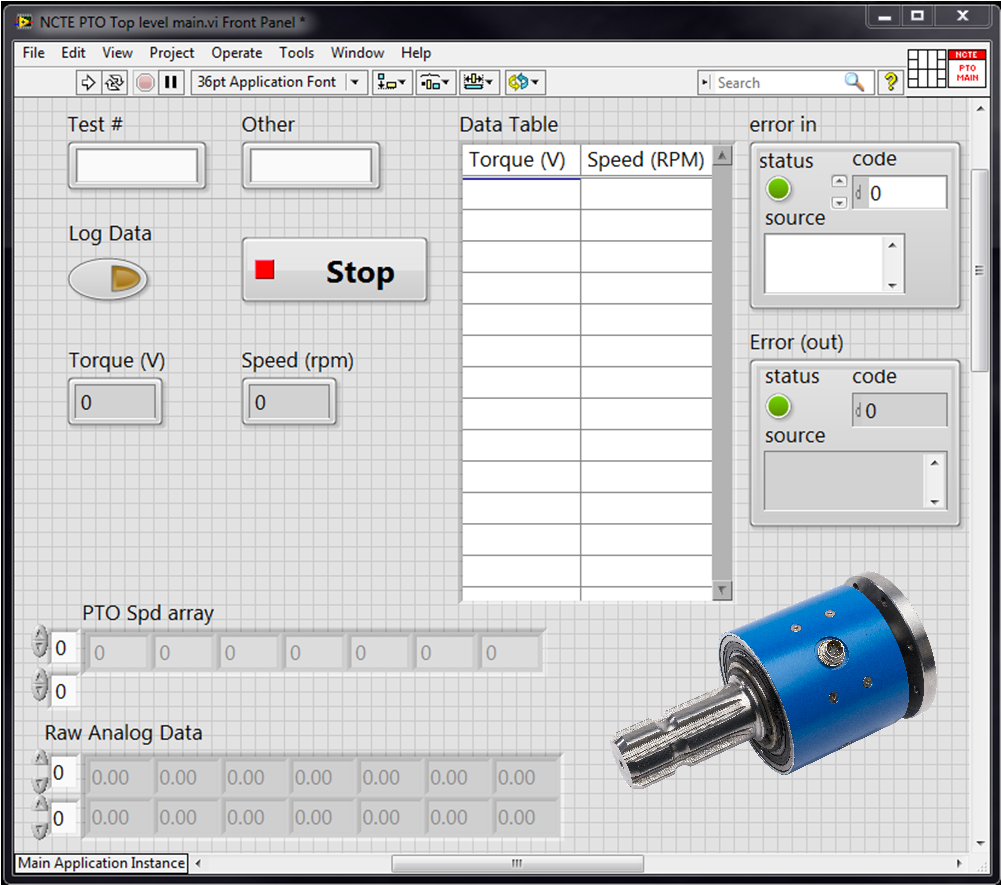
To record torque and speed measurements, a data acquisition system based on modular industrial instrumentation hardware was developed. The system includes analog and digital modules capable of simultaneously recording:
- torque signal generated by the sensor
- PTO shaft rotation speed
- additional tractor parameters during the tests
The control and recording software was developed using an instrumentation programming environment, allowing real-time visualization of measured values and storage of data for later analysis.
This approach allows for high-resolution data recording during tractor performance tests, including variable load situations typical of agricultural operations.
Calibration using a high-power dynamometer
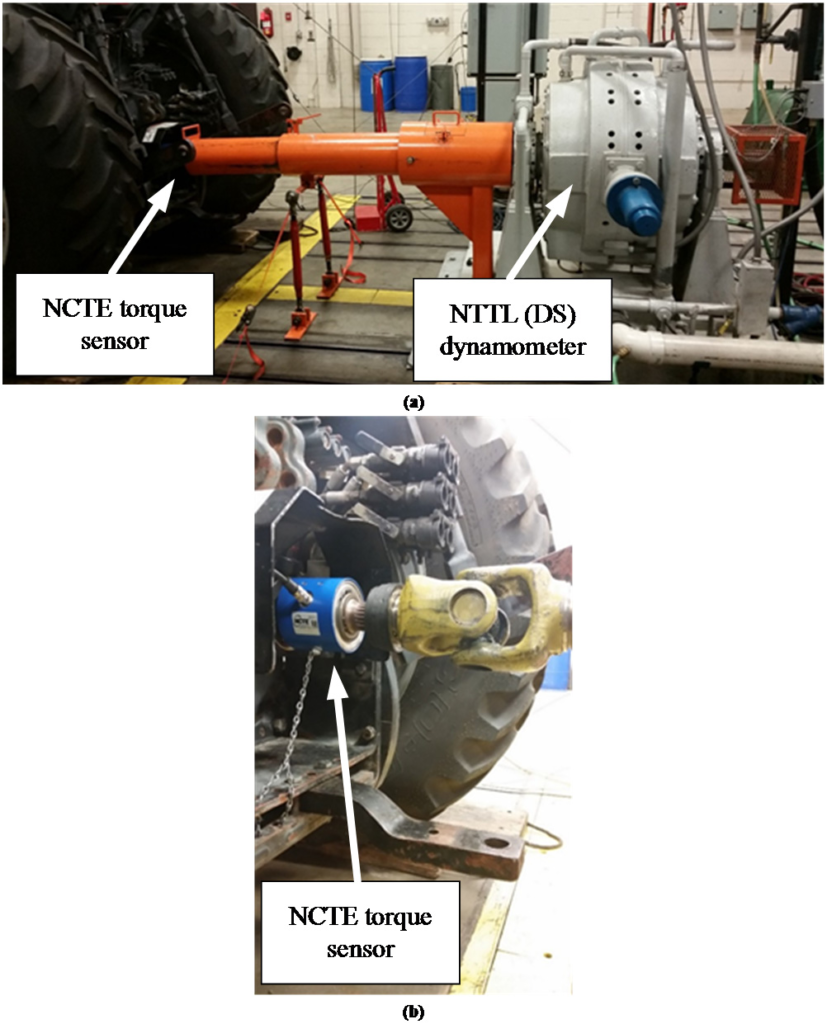
To validate the accuracy of the measurement system, a calibration process was performed using a laboratory dynamometer capable of applying controlled loads to the PTO shaft.
During the tests, different load levels and rotation speeds were applied with the aim of generating multiple calibration points between the sensor signal and the actual torque measured by the dynamometer.
The results showed an extremely precise linear relationship between the sensor's output signal and the applied torque, obtaining a virtually perfect correlation coefficient between both magnitudes.
This result confirms the reliability of the sensor for measuring torsional torque in real-world agricultural power transmission applications.
Verification under operating conditions
After the initial calibration, additional verification tests were performed using full load tests at different PTO rotation speeds.
In these tests, the torque values measured by the sensor were directly compared with the values recorded by the reference dynamometer.
The results showed very small differences between the two measurement systems. In all cases, the relative error remained within acceptable limits for field instrumentation, confirming that the system is capable of measuring transmitted torque with high accuracy even under dynamic operating conditions.
Applications for research and development of agricultural machinery
The ability to directly measure the torque transmitted by the PTO shaft opens up new opportunities for analyzing the performance of agricultural machinery. Key applications include:
- assessment of the energy consumption of agricultural implements
- tractor-implement sizing optimization
- efficiency analysis in mechanical transmission systems
- research in advanced agricultural mechanization
- development of intelligent power management systems
Direct instrumentation of the PTO shaft allows obtaining real information on the energy demand of each agricultural operation, facilitating the improvement of implement design and the more efficient use of the power available in the tractor.
A tool for precision agriculture
The study demonstrates that rotary torque sensors installed on the PTO shaft constitute a robust and accurate technical solution for measuring the power transmitted during agricultural work.
Integrating these sensors with modern data acquisition systems opens up new possibilities for monitoring machinery performance in the field, contributing to the development of more efficient and sustainable farming systems.
In a context where energy optimization and digitalization of the agricultural sector are increasingly relevant, direct instrumentation of power transmission is emerging as a key tool for the future of agricultural mechanization.