


















Industrial laser distance sensor up to 500 m DPE-10-500
- Manufacturer: DIMETIX AG
- Category: Displacement, SENSORS, Laser distance sensors, Level Sensors, Level sensors for solids
He Dimetrix DPE-10-500, reference 500630, it's a long-range industrial laser distance sensor For measuring position, displacement, length, and level without contact. It can measure from 0.05 m to approximately 100 m on natural surfaces and reach up to 500 m when using a suitable reflective sheet.
Its typical accuracy ±1 mm, repeatability of ±0.3 mm and measurement speed of up to 250 Hz They allow its use in industrial automation, logistics, civil engineering, steelmaking, mining, and positioning systems.
- Reflectorless range: up to approximately 100 m.
- Range with reflector: up to 500 m.
- Typical accuracy: ±1 mm.
- Measurement speed: up to 250 Hz.
- Standard interfaces: 4-20 mA, RS-232, RS-422/RS-485 and SSI.
- Optional industrial Ethernet: PROFINET, EtherNet/IP or EtherCAT.
Industrial applications of DPE-10-500
The DPE-10-500 is designed for permanent integration into machinery, industrial installations, and control systems. Optical measurement allows for distance determination to an object without mechanical contact, preventing wear and tear and facilitating the monitoring of moving components, structures, stored materials, and hard-to-reach targets.
Positioning of overhead cranes and gantry cranes
The sensor can be used to measure the position of a crane's bridge, trolley, or lifting mechanism. Its measurement speed allows for monitoring rapid movements and coordinating actions in large installations.
- Longitudinal and transverse positioning of overhead cranes.
- Control of trolleys, hoists and lifting mechanisms.
- Parallel gait and synchronized positioning.
- Control of distance between cranes or work areas.
- Measurement of deformations or displacements under load.
Important: The DPE-10-500 can provide distance information to support collision avoidance systems, but it is not a certified safety device and does not replace the functional safety systems required by the facility.
Logistics, stacker cranes and automated warehouses
In intralogistics systems, it can measure the position of stacker cranes, shuttles, transfer carts, shuttles, and other mobile equipment. It also allows for checking stationary positions, monitoring work zones, and detecting implausible distance changes.
- Positioning of stacker cranes.
- Shuttle and shuttle control.
- Automated warehouses and AS/RS systems.
- Position of cars on rails.
- Separation control between mobile equipment.
- Measurement in material handling systems.
Civil works and structural monitoring
Its precision and long range allow for remote measurements on bridges, buildings, and large structures. It can be used to detect movements or deformations during construction, excavation, lifting operations, or work near existing infrastructure.
- Monitoring of displacements in bridges and pillars.
- Control of structures during lifting and assembly operations.
- Monitoring of buildings near excavations.
- Measurement of movements in tunnels and large infrastructures.
- Deformation control in metal structures.
- Monitoring of historic buildings and heritage.
In very long-distance outdoor measurements, the effects of temperature, humidity, and atmospheric pressure on the optical path must be considered. Above approximately 150 m, atmospheric conditions that are very different from the reference conditions can affect accuracy.
Iron and steel industry, foundries and hot materials
Non-contact measurement allows monitoring the position of coils, plates, billets, transfer carts, and other hot materials while keeping the sensor at a safe distance.
- Position of carts transporting hot steel.
- Control of coils and stacked materials.
- Length and position measurement on rolling lines.
- Material feeding and cutting control.
- Tracking hot products in motion.
- Distance measurement in areas near industrial ovens.
The sensor is not designed for direct installation inside an oven. In areas with high ambient temperature, thermal radiation, dust, or splashes, it must be installed in a protective housing and, where necessary, insulated or air-cooled.
Level measurement in silos and bulk materials
The DPE-10-500 can be used as laser level sensor for solids. The equipment measures the distance to the surface of the material and the PLC or control system can calculate the occupied level from the total height of the tank.
- Aggregates, stone and sand.
- Grain, animal feed and agricultural products.
- Biomass and bulk stored materials.
- Scrap metal and metallic materials.
- Control of piles and stacked materials.
- Height measurement on conveyor belts.
The presence of airborne dust can reduce range and dirty the optics. In very dusty environments, it may be necessary to install additional protection, perform regular cleaning, or use an air purge system.
It is not recommended to use this sensor as a general-purpose sensor for directly measuring the level of clear liquids. Clean water, glass, and highly reflective surfaces can cause reflections or measurement errors.
Roads, mining and hydraulic installations
- Height control in paving machines.
- Measuring the thickness of asphalt or concrete layers.
- Positioning of lifting equipment in mining.
- Measuring material height on conveyor belts.
- Focus control in LIBS analysis systems.
- Measurement of position and height of dam or canal gates.
Dimensional control and industrial manufacturing
One or more DPE-10-500 sensors can be used to monitor dimensions and positions without coming into contact with the product.
- Measurement of length, width, height and diameter.
- Control of paper reels and rolls.
- Alignment of saws and cutting elements.
- Positioning of parts and structures.
- Progress control and material feeding.
- Measurement of separation between components.
Range of 100 m without reflector and up to 500 m with reflector
On natural surfaces, the measurement range can reach approximately 100 meters. To measure distances up to 500 meters A suitable orange reflective sheet should be placed over the lens.
Actual range and speed depend on distance, reflectivity, color, and surface geometry, as well as environmental conditions. Light-colored, matte, and flat surfaces provide the best measurement conditions.
Dark, rough, wet, transparent, or very shiny surfaces can reduce range or cause errors. Bright sunlight, dust, fog, rain, or snow can also affect performance.
For outdoor applications or on difficult targets, it is advisable to perform a test and, when necessary, use a reflector.
Accuracy, measurement modes, and moving targets
The DPE-10-500 allows you to select different measurement characteristics to adapt the speed, accuracy, and stability of the signal.
- Normal mode: balance between precision, range and speed, with a maximum frequency of 20 Hz.
- Quick mode: Measurement frequency up to 250 Hz, with a typical accuracy of approximately ±1.5 mm.
- Precise mode: Typical accuracy approximately ±0.8 mm, with a maximum frequency of 10 Hz.
- Timed mode: It allows you to define a fixed measurement frequency.
- Mobile target mode: Optimized for targets with continuous movement at speeds up to 10 m/s.
The typical specified accuracy of ±1 mm at 2σ This corresponds to a statistical confidence level of 95.4% under average conditions. On difficult surfaces, in intense sunlight, or at high distances, the deviation may increase.
Update speed according to the interface
In moving target mode, the maximum refresh rate depends on the interface used:
- Until 250 Hz via RS-232, RS-422 or RS-485.
- Until 500 Hz via Industrial Ethernet.
- Until 1 kHz via SSI, analog output or digital outputs.
The 1 kHz output frequency does not equate to 1,000 independent optical measurements per second. The sensor performs up to 250 measurements per second and updates certain outputs at a higher frequency in the dedicated moving-target mode.
Filters, alarms, and control functions
In addition to measuring distance, the DPE-10-500 incorporates filtering and monitoring functions that facilitate its integration into industrial positioning systems.
- Measurement and transmission of distance and speed.
- Configurable moving average filter.
- Suppression of peaks and measurement errors.
- Stabilization filter for variable signals.
- Distance jump detection as a plausibility check.
- Monitoring the strength of the received signal.
- User-configurable offset and gain.
- Automatic start of measurement when power is connected.
- Activation of measurements via digital input.
The two digital outputs can be configured according to distance, speed, signal strength, or internal temperature of the sensor. They support operation with hysteresis or pulse generation and can be configured as NPN, PNP, or Push-Pull.
The equipment also has a separate output for error signaling.
PLC connection: 4-20 mA, RS485, SSI and Industrial Ethernet
The sensor includes as standard a programmable analog output of 0-20 mA or 4-20 mA, one digital input, two programmable digital outputs and an additional error output.
It also has interfaces RS-232, RS-422/RS-485 and SSI. The USB connection is intended exclusively for configuration using Dimetix's Laser Sensor Utility software.
The RS-422/RS-485 communication uses Dimetix's proprietary ASCII protocol and allows up to 100 addressable sensors to be connected on a single line. The presence of RS-485 does not imply direct compatibility with Modbus RTU.
Optionally, the DPE-10-500 can be equipped with an interchangeable cover for:
- PROFINET: integration with Siemens PLC and other compatible controllers.
- EtherNet/IP: integration with Rockwell Automation/Allen-Bradley controllers.
- EtherCAT: integration into compatible automation and control systems.
PROFIBUS communication is also possible via an optional external converter.
Temperature, outdoor and industrial environments
The DPE-10-500 features an aluminum casing and protection IP65 and extended temperature version to work between -40 and +60 °C.
When the sensor starts at very low temperatures, the internal heating system may require some time before measurements begin. In continuous operation, the maximum permissible temperature may be reduced.
When the optional industrial Ethernet cover is installed, the maximum operating limit is set at +50 °C.
In environments with thermal radiation, dust, rain, snow or projections, the installation of a housing, visor, insulation or cooling system should be considered to keep the optics clean and the sensor within its acceptable temperature.
Alternative to other laser positioning sensors
Due to its range, accuracy, speed, and interfaces, the Dimetix DPE-10-500 can be studied as Technical alternative to SICK Dx100/DL100, Leuze AMS 300i, Pepperl+Fuchs R1000 and WayCon LDI laser positioning sensors.
The replacement should not be considered directly interchangeable. To determine compatibility, it is necessary to check:
- Measurement range on natural surface or reflector.
- Required accuracy and repeatability.
- Target displacement speed.
- Measurement frequency and required update.
- Communication protocol.
- Electrical connections.
- Dimensions and mounting system.
- Environmental conditions of the installation.
Frequently Asked Questions about the DPE-10-500
Can it measure up to 500m without a reflector?
No. The range over natural surfaces is up to approximately 100 m. To measure distances up to 500 m, a suitable reflective sheet must be used.
Can it measure on dark surfaces?
Yes, but color, roughness, tilt, distance, and lighting all affect signal strength. A dark surface can reduce the measurement range or speed compared to a light, matte, flat surface.
Can it be used outdoors?
Yes. It has IP65 protection and a temperature range of -40 to +60 °C. However, direct sunlight, fog, rain, snow, dust, and atmospheric conditions can affect the measurement.
Can you measure hot materials or work near ovens?
It can measure hot materials without contact as long as the sensor remains within its permissible temperature range. In areas with strong thermal radiation, a protective housing, insulation, or air cooling must be used.
Does it have Modbus RTU communication?
Not natively. The RS-422/RS-485 interface uses Dimetix's proprietary ASCII protocol. Integration must be performed by implementing their commands or using the appropriate industrial interface.
Can it connect to a Siemens PLC?
Yes. It can be connected via the 4-20 mA output, a compatible serial interface, or the optional PROFINET cover. Dimetix provides description files and documentation to facilitate integration.
Is it useful for measuring the level of solids?
Yes. The sensor measures the distance to the material surface, and the PLC can calculate the level from the total height of the silo. Dust, geometry, and material reflectivity must be taken into account.
What is the difference between 250 Hz measurement and 1 kHz output?
The sensor performs up to 250 optical measurements per second. In moving-lens mode, it can update certain outputs at up to 1 kHz, depending on the interface used.
Sensor selection and configuration
The DPE-10-500 is particularly suitable when an application requires combining Long range, millimeter precision, fast measurement and different PLC connection options.
For less demanding applications in terms of speed, temperature, accuracy or distance, the Dimetix D Series has other models that can offer a more suitable solution.
To select and configure the sensor correctly, the following must be defined:
- Minimum and maximum measuring distance.
- Type, color and reflectivity of the surface.
- Target displacement speed.
- Environmental conditions.
- Required update frequency.
- Interface required by the PLC or control system.
Consult your application to select the most suitable configuration, interface, and accessories.
Properties
| DIMETIX DPE-10-500 TECHNICAL SPECIFICATIONS | |
|---|---|
| Model / Reference | DPE-10-500 / 500630 |
| Sensor type | Long-range industrial laser distance sensor |
| Measurement principle | Non-contact optical distance measurement |
| Range on natural surfaces | 0.05…approximately 100 m |
| Range with reflective sheeting | Approximately 0.5 … 500 m |
| Typical accuracy at 2σ | ±1 mm, under average conditions |
| Typical accuracy at 1σ | ±0.5 mm |
| Typical repeatability at 2σ | ±0.3 mm |
| Typical repeatability at 1σ | ±0.15 mm |
| Minimum unit shown | 0.1 mm |
| Maximum measuring speed | 250 Hz |
| Maximum output speed | Up to 1 kHz in moving target mode, depending on the interface used |
| Maximum speed of the target | 10 m/s in moving target mode |
| Measurement modes | Normal, fast, accurate, timed, and moving target |
| Light source | Visible red laser diode, 620 … 690 nm, typically 650 nm |
| Laser class | Class 2, power less than 1 mW |
| Typical laser spot size | 7 x 3 mm at 10 m / 28 x 13 mm at 50 m / 55 x 30 mm at 100 m |
| Analog output | 0-20 mA or 4-20 mA, programmable, current source |
| Analog output resolution/error | 12 bits / ±0.1 % of programmed span |
| Maximum load of the analog output | 500 Ω |
| Standard communication interfaces | RS-232, RS-422/RS-485 and SSI |
| RS-422/RS-485 Protocol | Dimetix ASCII protocol, addresses 0 … 99 |
| USB | Included, exclusively for configuration |
| Optional Industrial Ethernet | PROFINET, EtherNet/IP or EtherCAT via interchangeable cover |
| PROFIBUS | Available via optional external converter |
| Digital entry | 1 programmable input |
| Digital outputs | 2 programmable NPN, PNP or Push-Pull outputs and 1 error output |
| Feeding | 12 … 30 VDC |
| Power consumption at 24/12 VDC | 0.5 A / 0.8 A, not considering the loads connected to the outputs |
| Operating temperature | -40 … +60 °C |
| Temperature with industrial Ethernet | -40 … +50 °C |
| Storage temperature | -40 … +70 °C |
| Relative humidity | Up to 85 % RH, non-condensing |
| Degree of protection | IP65 according to IEC 60529 |
| Shock and vibration tests | IEC 60068-2-27 / IEC 60068-2-6 |
| Housing material | EN-AW 6060 anodized aluminum alloy |
| Electrical connection | Internal screw terminals |
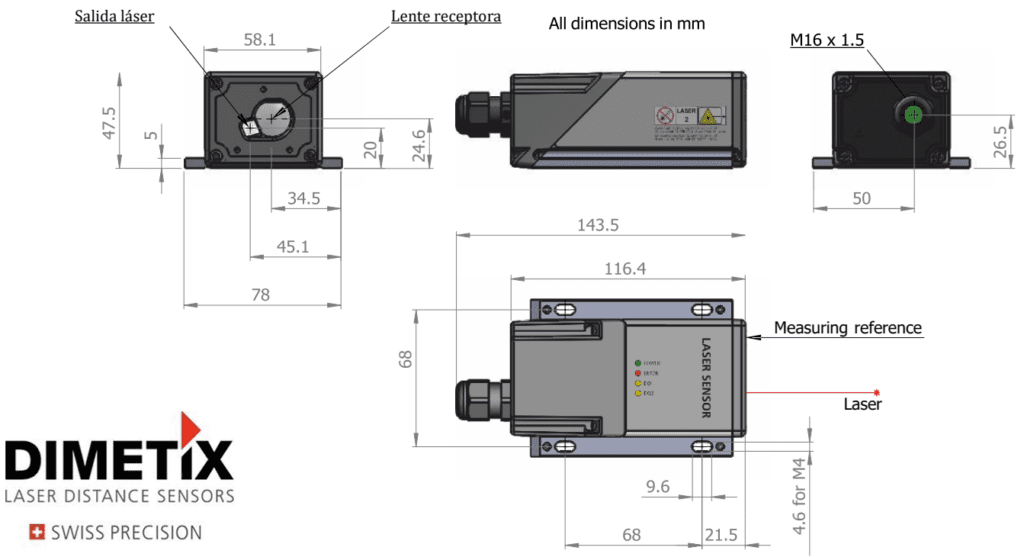
| Dimensions | 140 x 78 x 48 mm |
| Weight | 350 g |

Other products