





















Incremental Encoder
Incremental encoders are sensors used to measure angular position, rotational speed, and shaft displacement in industrial machinery, automation systems, and motion control.
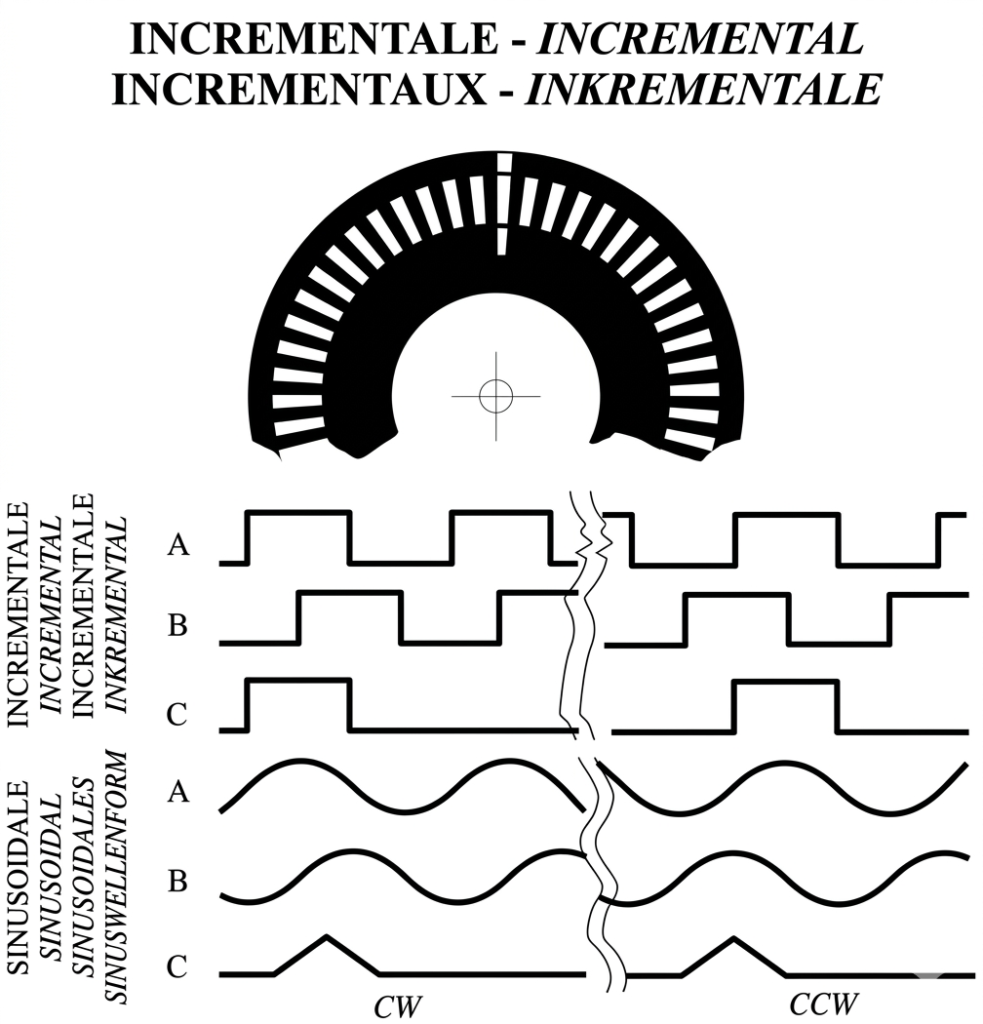
An incremental encoder generates a series of electrical pulses as the shaft rotates. These pulses are produced by two digital signals, A and B, which are 90° out of phase with each other (quadrature signals). This phase shift allows the encoder to determine both the speed and direction of rotation of the shaft.
Many incremental encoders also incorporate a reference signal called Z or index. This signal appears once per revolution and allows an absolute reference position to be established within the control system.
The resolution of an incremental encoder is typically expressed in PPR (pulses per revolution). Depending on the application, resolutions can range from a few pulses per revolution to several thousand pulses per revolution. The higher the number of pulses per revolution, the greater the positioning accuracy of the system.
Incremental encoders are widely used in industrial machinery, robotics, electric motors, CNC systems, conveyors, packaging machinery, speed control in motors, and positioning systems.
Among the most common technical characteristics of incremental encoders are:
• Resolutions from 100 to more than 5000 PPR
• TTL, HTL, Push-Pull or RS422 electrical outputs
• Industrial protection IP65, IP67 or higher
• Wide operating temperature range
• Versions with solid shaft or hollow shaft
• Robust encoders for demanding industrial applications
At GUEMISA we offer a wide range of industrial incremental encoders suitable for automation, motion control and speed measurement applications in industrial environments.
Products: 46