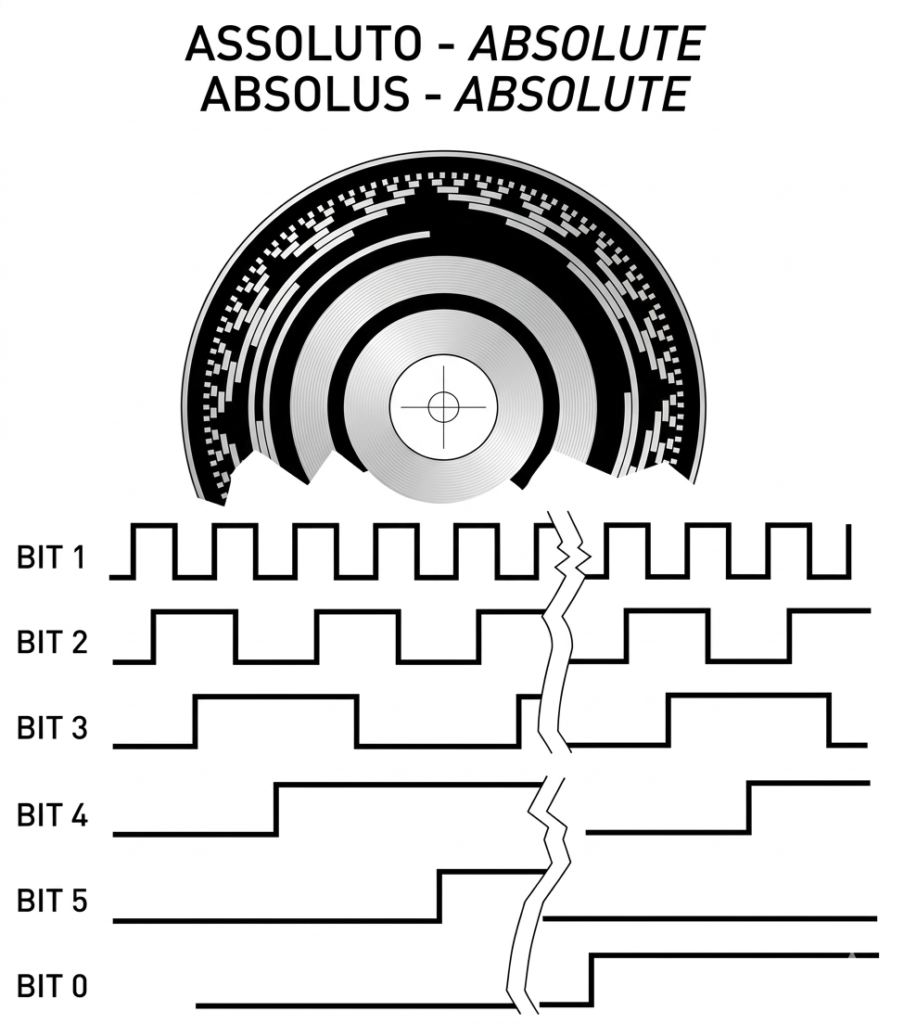



















Absolute Encoder
Industrial encoders are position and speed sensors used to convert the mechanical movement of a shaft or linear displacement into electrical signals that can be used by PLCs, variable frequency drives, servo drives, and control systems. In industrial automation, they are a key component for accurately determining the angular position, direction of rotation, rotational speed, or displacement of a mechanism. This information allows for process synchronization, motor control, improved repeatability, and increased machine safety and efficiency.
At GUEMISA, we work with incremental, absolute, magnetic, and linear encoders for applications in industrial machinery, robotics, transportation, energy, CNC machinery, test benches, and positioning systems. Depending on the application, different resolutions, shaft diameters, mechanical configurations, and output types such as TTL, HTL, Push-Pull, SSI, CANopen, EtherCAT, Profinet, or Modbus can be selected. Versions are also available for demanding environments with dust, vibration, humidity, or explosion risks.
Choosing the right encoder depends on factors such as required accuracy, operating speed, available space, mounting type, and environmental conditions. At GUEMISA Sensors and Instrumentation, we offer technical advice to help you select the most suitable industrial encoder for your application, whether for speed measurement, position control, motor feedback, or advanced automation.